


Crude Oil
September 04, 2025
Chinese refiners reluctant to plug India's weaker Urals crude gap amid poor feedstock economics
HIGHLIGHTS
As India buys less, unsold Urals crude may seek Chinese bids
Urals crude faces logistical, quality challenges for Chinese refiners
Traders see Urals should ideally be $10/b discount to ESPO
As India faces growing pressure to cut back on its Russian crude purchases, any unsold Urals crude could actively seek new outlets in China. However, both state-run and private Chinese refiners are mostly reluctant to fully embrace the medium sour grade due to poor trading and feedstock economics.
Russia has consistently ranked as China's top crude supplier annually for decades, with medium sweet ESPO Blend crude comprising the majority of feedstock purchases by Chinese refiners from the non-OPEC supplier.
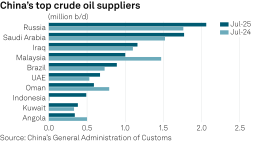
However, logistical costs and cracking economics for Russia's Urals crude loading from Primorsk in the Gulf of Finland do not favor Chinese refiners' overall margins, according to feedstock management and trading sources from both state-run and private-sector Chinese refiners.
Although India is expected to sustain its Russian crude purchases despite the US imposing a 25% tariff on Indian goods, analysts and traders across Asia anticipate that Asia's second-largest crude buyer may reduce its Urals crude imports due to increasing international pressure and tighter sanctions against Moscow.
According to data from S&P Global Commodities at Sea, India was the largest importer of Russian crude, with inflows reaching 1.80 million b/d in 2024. India's imports of oil from Russia in the first half of 2025 also maintained a similar trend.
As of mid-August, however, Indian imports of Russian crude fell to 1.304 million b/d, down from previous months.
Although Asia-wide market participants and sour crude traders in Singapore widely believe Urals suppliers would automatically seek Chinese buying interest to clear any of their unsold inventories, Chinese state-run and independent refinery feedstock managers indicated that they are largely reluctant to significantly increase buying of Urals crude unless prices fall substantially.
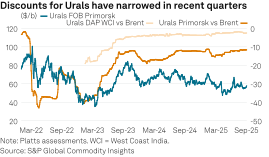
Theoretically, China can absorb large volumes of Urals crude, given its total crude imports average more than 11 million b/d. Additionally, facilities can be reconfigured to refine various other Russian grades, which several state-run and independent refineries have done if prices are low enough, according to a Beijing-based refinery crude procurement planner.
However, China must continue diversifying its crude sources and maintain healthy supplies from other producers to avoid over-dependence on a single supplier, the feedstock planner added.
Moreover, trading sources with state-owned firms and private mega plants said if the US imposes secondary sanctions on Russian energy products, they are set to keep away from the seaborne Urals supplies, leaving only the small independent refineries in the market as potential buyers of the medium-sour Russian grade.
Not enough discount
Considering the lengthy shipping distances for Far East Asian end-users, along with numerous sanctions-related complications and less-than-ideal crude specifications, Urals should be offered at a steep discount or it will struggle to attract Chinese buyers, according to traders in Singapore and feedstock procurement managers across East Asia familiar with West of Suez arbitrage crude trades.
"First, the enormous shipping distance is a problem. Refiners don't want to wait months for feedstocks to arrive," said a feedstock strategist at a state-run Chinese refiner in Beijing.
The shipping distance from Urals crude loading port Primorsk to Far East Asia is approximately 7,000 nautical miles, double the distance from the Persian Gulf to Far East Asia, which typically ranges from 3,000 to 4,500 nautical miles. Meanwhile, the maritime distance from ESPO crude loading port in Far East Russia's Kozmino to China's Shandong is only around 1,500 nautical miles.
Additionally, Urals is viewed as lower quality crude compared to ESPO and may struggle to attract buying interest from Chinese private refiners unless offered at a much steeper discount, according to refinery sources in Shandong. Traders in Singapore indicated that Urals should be offered at a discount of at least $10/b compared to ESPO.
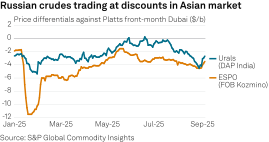
Platts, part of S&P Global Energy, assessed Urals crude on DAP West Coast India basis at a discount of $2.69/b to front-month Dubai on Sept. 3. The second-month ESPO on FOB Kozmino basis was assessed at a discount of $3.5/b on the same day.
"There is no need for [small private-sector] refiners to switch to Urals crude since its price is not that attractive," said a trading source at a Chinese independent refining sector. "If Indian buyers don't completely exit Urals, prices are unlikely to drop enough to attract broad Chinese interest.
Among Russian grades, ESPO is the most popular in China. Urals, typically imported by India, has a 31.7 API and 1.19% sulfur content, making it less popular in China. Its relatively higher levels of metals, carbon residue, and chlorine are considered too high for producing gasoline and gasoil for Euro-6 equivalent fuels and can cause corrosion, according to market sources.
ESPO crude purchases by China's independent refiners in the first eight months of the year reached 17.47 million mt, up 19.2% year over year, Platts data showed. ESPO made up 75.6% of all Russian crude imported during this period, compared with 73.4% in the same span in 2024.
