NGLs, Crude Oil, Chemicals, Agriculture, Energy Transition, Biofuel, Renewables
September 01, 2025
INDIA CEO SERIES: Indian Oil eyes flexible crude buying strategy amid shifting trade flows
HIGHLIGHTS
Refinery, petrochemical expansion to lead to more varied crude diet
Russian imports driven by commercial considerations, adheres to sanctions
Revenue from gas, renewables set to grow amid changing energy landscape
The India CEO Series by S&P Global Energy is a compilation of exclusive interviews by Asia Energy Editor Sambit Mohanty with some of the leaders of the biggest energy companies in India.
Indian Oil Corp. is adopting a crude import strategy that emphasizes a higher proportion of spot contracts and a more diverse supplier base, aiming to leverage evolving geopolitics and changing supply flows to optimize purchases for its expanded refinery and petrochemical operations, its Chairman Arvinder Singh Sahney said.
In an exclusive interview with Platts, part of S&P Global Energy, Sahney said while Middle Eastern term contracts would continue to form a significant portion of its crude import basket, the emergence of new suppliers and availability of opportunity crudes were prompting the need to have more flexibility in buying strategy.
"A few years ago, 80% of our purchases were term contracts. Now, we are buying about 60% of the volumes on the term and 40% from the spot market. We are moving towards a scenario in which we will be splitting our term and spot crude volumes equally. If you are saddled with more term contracts, people don't approach you when there are opportunity crudes," he said.
Sahney said IOC was looking to scale up its annual group refining capacity from the current 80.75 million mt (1.62 million b/d) to 98.4 million mt (1.98 million b/d) by 2028, with expansions in its Panipat, Barauni, Gujarat and Digboi refineries. And on the petrochemicals segment, annual capacity is set to rise to 13 million mt by 2030, from the current 4.3 million mt.
And to support the expanded capacity, IOC is enhancing its pipeline network from over 20,000 km to more than 22,000 km through 21 ongoing projects, alongside significant upgrades to marketing infrastructure, storage facilities, and last-mile delivery systems, he said.
"We have 10 refineries with different configurations and a varied crude diet and a few of them are now expanding. Therefore, we must keep an open mind on feedstocks. New fields are coming online, and we have to keep exploring and testing new crudes. A few years ago, we were buying from 27 geographies but today we are buying from 40 geographies -- for example, Brazil and Guyana. US and Canadian crudes are also forming a part of the supplies," Sahney added.
Tariffs and sanctions
Commenting on its purchases from Russia, he said that all purchases were made with a focus on fulfilling commercial obligations while adhering to the sanctions framework.
"For Russian imports, we are mindful of the origin of the cargo as well as the services being used for delivery, which need to be compliant with the provisions of sanctions. Even on Russian crude, it's the commercial objective in mind on both sides. Tomorrow, if geopolitics change and Russia gets a better deal selling their oil in Europe, they will send it there," Sahney said.
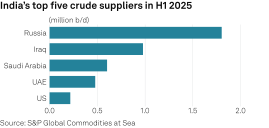
Sahney added that tariffs and sanctions were external factors that could significantly disrupt global supply chains and contribute to price volatility. "To keep ourselves prepared for any eventuality, our approach centers around diversifying our crude basket. This diversification helps us maintain supply security and operational stability, even in the face of geopolitical uncertainties."
Energy expects that oil markets will stay calm as the most recent developments have been factored in. Rising crude oil production, modest demand growth and a slower pace of stock building in China will lead to a greater supply surplus and bring Dated Brent prices below $60/b before the end of 2025.
Oil's role in energy mix
Sahney added that despite the global shift towards decarbonization, oil would remain a cornerstone of India's energy mix for decades. India's energy demand is projected to nearly double by 2050, with its share in the global energy mix rising from 6.5 percent to about 12 percent. Rapid urbanization, industrialization, and rising incomes were set to make India the largest driver of global oil demand.
However, India was facing a dual challenge -- meeting rising energy demand while advancing towards its net zero emissions target by 2070. As a result, the country was pursuing a balanced energy transition strategy through adoption of green hydrogen, rapid adoption of biofuels and sustainable mobility.
"Today, we are primarily a liquid fossil fuels company, but going forward, this portion of my business will come down to around 60%-65% in the next 10-15 years, while another 30%-35% will come from other things that I have mentioned. We have a target to make this company net zero by 2046. Progressively, we will convert part of our revenue stream from mainly liquid fossil fuels to gas, petrochemicals, and renewables," he added.
He added that the demand for fossil fuels in India won't witness any kind of peak until 2040-45. However, growth rates would be relatively slower. "It would be a more flattish kind of trajectory. Diesel and gasoline demand might not grow in the pace that we are used to."
Other business segments
On the upstream segment, IOC's upstream portfolio comprises 25 assets -- 14 domestic and 11 overseas assets -- including nine producing fields. The company plans to scale up output through fresh licensing rounds and farm-in opportunities.
Sahney said that in line with the government's goal to increase natural gas's share in the energy mix from 6% to 15%, IOC was making significant investments in infrastructure, including regasification terminals, pipelines, city gas distribution networks, and LNG stations.
"We plan to increase our natural gas sales by two to three times by the end of this decade through aggressive infrastructure development and market expansion," Sahney said.
IOC was also rapidly expanding its footprint in the electric mobility sector, with its EV charging network exceeding 13,600 stations across India. As part of its strategy, IOC was intensifying efforts to embrace battery-swapping technologies.
Sahney added that IOC had become the first in the country to receive the ISCC CORSIA certification for sustainable aviation fuel production at Panipat refinery. "This represents a major step towards fulfilling India's SAF blending mandate and mitigating the environmental impact of the aviation industry."
