Crude Oil, Refined Products, LPG
August 26, 2025
South Korea cements energy ties with US crude, LNG supply deals after landmark summit
HIGHLIGHTS
Trump commits to ample crude and LNG supplies for South Korea
Trump, Lee acknowledge mutual need for enhanced energy cooperation
South Korea poised to fulfil $100 billion energy purchase deal with ease
South Korea and the US agreed to boost cooperation in the energy sector, with US President Donald Trump emphasizing his commitment to supplying ample crude and LNG, while Seoul is expected to comfortably fulfill its $100 billion energy purchase agreement.
South Korean President Lee Jae-myung and Trump began their first summit at the White House on Aug. 25, with both leaders acknowledging their mutual need for cooperation in the energy and shipbuilding sectors.
Trump emphasized the abundance of US energy resources, stating, "We have more oil and gas and coal than any other nation in the world by far, and we're going to use it," highlighting the US commitment to supplying ample crude oil to South Korea, which relies entirely on imports for its refinery feedstock needs.
Trump's praise for South Korean products, including ships, reinforced the sentiment that "we love what they do," further solidifying the partnership as both countries recognize the importance of working together to ensure energy security and manufacturing sector growth.
In addition, Trump and Lee said they have agreed to uphold the trade agreement reached in principle last month, which includes South Korea purchasing $100 billion worth of US energy products over four years, and the US lowering import tariffs for South Korean goods to 15%.
Trump's commitment to supply ample US crude to South Korea aligns with the country's efforts to reduce reliance on Middle Eastern sour grades amid ongoing geopolitical risks in the Persian Gulf, according to South Korean refining industry participants.
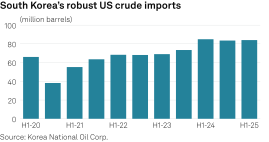
South Korea is already Asia's largest buyer of US crude. Strengthening US crude supply commitments and energy security presents a "win-win" scenario for both countries, according to feedstock managers at three major South Korean refiners and petrochemical companies, including SK Innovation.
Furthermore, light sweet US crude grades have appeared highly attractive in recent trading cycles, with WTI Midland's premium over light and medium sour Middle Eastern grades trending sharply lower, traders in Singapore and refinery feedstock managers across South Korea, Japan and Thailand said.
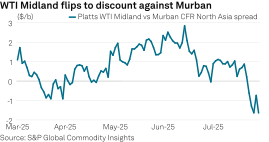
Platts, part of S&P Global Energy, assessed the spread between WTI Midland and Murban on a CFR North Asian basis at minus $2.1/b on Aug. 25, sharply lower from the year-to-date peak of $2.51/b on June 4.
$100 billion purchase target
With South Korean refining and other industries keen to embrace US energy products, especially crude oil, Seoul can comfortably fulfil the $100 billion purchase agreement, according to refinery feedstock managers, trade ministry officials and industry analysts.
Major South Korean private sector refiners -- including SK Innovation, Hyundai Oilbank, GS Caltex and Hanwha TotalEnergies -- have purchased 84 million barrels of US crude and condensate combined in the first six months of the year, the latest data from state-run Korea National Oil Corp. showed.
Refiners paid on average $76.21/b for US crude shipments in the first half of 2025, totaling $6.4 billion in spending during that period, according to KNOC data. The import cost data includes freight, insurance, tax and other administrative and port charges.
South Korea's petrochemical sector is also projected to spend around $4 billion annually as US LPG serves as an important feedstock for the country's downstream chemicals sector. The country imported 41.5 million barrels of LPG from the US in the first half and spent $1.98 billion, KNOC data showed.
There are many other US energy products that South Korea regularly purchases from the US, including coal and naphtha, but refinery feedstock managers and analysts said crude oil and LPG can already cover around two-thirds of the $100 billion commitment for the four-year period.
"Among major supply sources, South Korea is simply choosing to increase its reliance on US energy products, so it is unlikely to significantly impact the domestic economy," Finance Minister Koo Yun-cheol said previously.
LNG
Korea Gas Corp. was included in the delegation for the summit and the state-run company signed a long-term LNG import contract with global energy trading houses, including Trafigura, for an annual volume of 3.3 million tons of US LNG starting in 2028 and lasting about 10 years.
Kogas has been working on a strategy to ramp up LNG purchases from the US, while reducing supplies from Middle Eastern producers, a trading manager at Kogas told Platts.
The volume from this long-term contract with Korea Gas is expected to be supplied based on LNG projects, including the one operated by Cheniere in Corpus Christi, Texas.
"This contract is a concrete result of our multifaceted efforts to diversify supply sources for LNG supply stability and enhance the competitiveness of natural gas prices," said Kogas President & CEO Choi Yeon-hye.
Meanwhile, President Trump mentioned that he would "reach an agreement to establish a joint venture with South Korea regarding Alaska LNG, similar to that with Japan," indicating that expectations for the Alaska LNG value chain are likely to regain attention in the short term.
