Crude Oil
August 04, 2025
India treads cautiously on Russian crude, keeps options open to diversify further
HIGHLIGHTS
India imported 1.8 mil b/d Russian crude in 2024: CAS
Higher OPEC+, non-OPEC supplies can offer breathing space
Refiners wonder how 'penalty' can be implemented, enforced
Indian refiners are going slow on Russian import deals while stepping up efforts to diversify their crude import basket further, as they wait for clearer signals on secondary sanctions threatened by US President Donald Trump.
While New Delhi has given its refiners a free hand to plan crude purchases keeping commercial viability in mind, refiners and analysts told Platts, part of S&P Global Energy, that for now, refiners would be adopting a cautious approach and try to strike a balance by boosting purchases from the US and other non-OPEC suppliers.
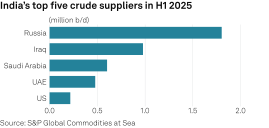
"Given the scale of Russian imports, a swift unwind in Russian crude shipments to India is unlikely, despite increasing political pressure from the US. But if it happens, the shift will likely lead to a resurgence of Middle Eastern suppliers such as Iraq, Saudi Arabia, and the UAE, and potentially some increase in light crude imports from the US," said Benjamin Tang, head of liquid bulk at S&P Global Commodities at Sea.
According to CAS data, India is the largest importer of Russian crude, with inflows reaching 1.80 million b/d in 2024. China followed at 1.24 million b/d, while Turkey was in the third place at 0.3 million b/d.
The statement followed a move by the EU to ban imports of petroleum products made from Russian crude starting in January 2026, while revising its oil price cap mechanism and blacklisting over 100 shadow fleet tankers in its latest sanctions measures against Russia. As part of the package, it has also imposed sanctions on the Rosneft-backed Vadinar refinery, a unit of Nayara Energy.
Following the sanctions, oil logistics disruptions have persisted at Nayara Energy's terminal in Vadinar, as mainstream tanker operators become increasingly cautious on Russia-linked trades. CAS data has shown relatively much smaller traffic of ships at the terminal after the EU announcement.
"The ripple effects of sanctions on Nayara are being felt across the refining chain, even though there may not be a cause for immediate worry," said one refining source.
Enforcing 'penalty'
The US has also said it would impose a 25% tariff on Indian imports and an unspecified "penalty" tied directly to India's continued purchase of Russian oil and military equipment.
"By tying trade policy to India's defense and energy sourcing decisions, the US has elevated economic relations into strategic territory, unlike in the case of other countries. The real test now is whether India can strike a balance -- defending its strategic autonomy while preserving hard-earned export gains," said DLN Sastri, director for oil refining and marketing at the Federation of Indian Petroleum Industry.
"India may lose the benefit of low-priced crude oil, and Indian refineries may have to look for alternate cheaper sources to Russian crude," he added.
Russian crude has been trading near the $60/b G7 price cap for much of the year. Platts, part of S&P Global Energy, assessed Urals crude on an FOB basis at Primorsk at $59.52/b Aug. 1.
Indian refining sources added that there was still no clarity on how any "penalty" tied to purchases of Russian oil by India could be implemented and enforced.
"We can understand sanctions, and India will respect them when they come. But how a penalty tax can be implemented by a third country on business done by two other countries -- in this case India and Russia -- will be one to watch," said one senior Indian refining source.
Alternative strategy
Refining sources said that EU sanctions on Nayara Energy and the possibility of additional sanctions by Washington had prompted Indian refiners to adopt a wait-and-watch approach, even though the government had not advised its refiners to refrain from Russian purchases.
"If the entire Russian volume is suddenly sanctioned or blocked, without a credible replacement strategy, the consequences will be felt globally. It is a move that inflicts pain on everyone -- developed and developing economies alike. Inflation will surge, refining spreads will narrow, and global trade dynamics will get distorted," said Shrikant Madhav Vaidya, former chairman of state-run Indian Oil Corp.
But if the situation demands, Indian refiners would be able to recalibrate quickly, given their aggressive diversification strategy in recent years, Vaidya added.
"High crude prices have invariably incentivized increased production across the board -- from OPEC's spare capacity holders like Saudi Arabia, UAE, and Kuwait, to non-OPEC producers, such as the US, Brazil, Guyana, and Canada," Vaidya added.
OPEC+ agreed Aug. 3 to increase production quotas by 547,000 b/d in September, completing the full unwinding of the 2.2 million b/d voluntary cuts introduced in 2023. According to Energy, the increase in OPEC+ production will primarily shift eastward, as official price formulas are less attractive for refiners west of Suez. This shift may lead Asian refiners to reduce their purchases of Atlantic Basin crudes, although this adjustment may take some time.
In a recent interview with Platts, Indian Oil Minister Hardeep Singh Puri warned that oil price inflation remains a major risk in the event of new clampdowns and said that global price benchmarks could have shot up to $130/b in 2022 without the country's purchases of Russian crude.
Puri has said that India was not unduly worried about oil supplies despite Washington's threat of secondary sanctions, as it believes global markets have sufficient supply to meet their energy needs.
