Refined Products, Crude Oil, Diesel-Gasoil, Gasoline
July 30, 2025
Angolan protests disrupt fuel station operations, threaten subsidy reforms
By Kelly Norways and Charlie Mitchell
HIGHLIGHTS
Violent unrest takes 90% of fuel stations offline in Luanda
Public outcry over fuel price hikes risks delays to subsidy phaseout
Fuel market liberalization critical to Angolan economy, IMF says
Violent clashes in Angola over the phaseout of its diesel subsidies have ground the capital's fuel logistics to a halt and threatened to set back vital economic reforms to liberalize its fuel sector.
Protesters first took to the streets of the capital Luanda on July 28 to oppose rising diesel costs, which jumped by over a third in July as the government hiked the price of its state-run fuel supply.
It followed a strike by taxi drivers in the city that was set to last three days, but which has since erupted into mass protests, public looting and clashes with police, leaving at least 20 dead and thousands detained.
Speaking to Platts, part of S&P Global Energy, July 30, a local source said security concerns had forced 90% of Luanda's fuel stations to suspend service, with the remaining supplies supervised by a police escort.
The country's sole 60,000 b/d refinery in Luanda continues to operate unaffected, said a representative for the national oil company Sonangol, who said the "situation is under control" at the state-owned facility.
Cargo activity in Luanda has avoided disruption, while another local source hoped that the situation would normalize in the coming days.
However, the public outcry has piled pressure on the government to put the brakes on its subsidy phaseout, which global lenders warn is imperative to support the economy. Such costly subsidies are common in import-dependent African countries.
Since June 2023, the Angolan government has been pushing to remove subsidies, but has focused mostly on gasoline, a lesser-used fuel type. After hiking diesel prices to Kwanza 400/l (44 cents/l) this month, triple the level in early 2024, further price increases will therefore provide a key test for the administration to see through its plans.
Economic calculations
Aggressive price hikes could put national oil consumption at risk if fuel costs become unaffordable for Angolan citizens.
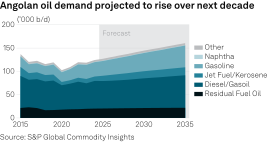
According to estimates from Energy analysts, Angola consumes roughly 60,000 b/d of diesel/gasoil, accounting for about half its total oil consumption.
However, widespread fuel smuggling makes actual figures hard to capture, and proponents for ending the subsidy say consumption declines could reflect a drop in illicit exports.
Nevertheless, governments often have to weather inflation spikes to enact subsidy reforms, risking unpopularity among voters. For Angola, scheduled presidential elections for 2027 will make the timing of its policy decisions critical.
Delays to the subsidy phaseout beyond a 2025 target could compound economic challenges for Africa's second-largest oil producer as it strives to stabilize its balance sheet and progress major energy investments.
According to the latest estimates from the International Monetary Fund, Angola spent roughly $3 billion on fuel subsidies in 2024, driving high debt that has put pressure on its spending plans.
At an oil price threshold of $68/b, analysts at S&P Global Market Intelligence estimate that the country would only be able to cover 90% of its debt service, increasing its risk of insolvency.
Limited access to financing has already challenged the ability for Sonangol to advance three refinery construction projects, a key policy objective to reduce the country's fuel deficit and diversify its revenues from upstream oil and gas.
Upstream boost
The widespread unrest comes amid long-awaited progress in Angola's vital upstream sector, where officials have been striving to reverse years of production declines due to underinvestment and field maturation. In recent months, the country has won plaudits for its openness to investment, incentives, flexible fiscal terms and openness to smaller upstream participants.
On July 30, Azule Energy -- an Angola-focused joint venture between BP and Eni -- said it had achieved first oil from its Agogo FPSO on offshore Block 15/06, which is expected to add up to 175,000 b/d of crude production to the 1 million b/d the country recorded in June, according to upstream regulator ANPG.
That followed France's TotalEnergies announcing it had started production from its offshore Begonia and CLOV phase 3 oil projects, which will produce a combined 60,000 b/d.
Angola, which pumped 1.9 million b/d of crude at its peak -- at one point briefly eclipsing peer Nigeria -- quit OPEC in 2024 following a row over its production quota, which officials in the country said would jeopardize critical upstream investment.
Operators reached by Platts July 30 said they were closely monitoring the situation in Luanda, although most international operators have assets offshore, shielding their operations from the unrest.
"As we only have limited personnel on the ground, our exposure remains minimal; however, we continue to assess the situation as it evolves," said one company executive with oil projects in the country on condition of anonymity, due to the sensitivity of the situation.

Editor: