Refined Products, Crude Oil, LPG
July 15, 2025
Asian oil firms eye US crude to counter tariffs, prioritize refining economics
By Gawoon Vahn, Leon Wong, and Anita Nugraha
HIGHLIGHTS
Indonesia's Pertamina signs US crude supply MOU
PTT recommends that Bangkok highlight US crude imports
KNOC sells Basrah Medium, buys WTI Midland
Several state-run oil companies in Asia are actively exploring increased purchases of US crude to offset the impact of US tariffs. However, most private-sector refiners have emphasized that refining economics will remain their primary consideration in feedstock procurement, taking precedence over diplomatic factors.
To mitigate the impact of US tariffs ranging from 25% to 36%, key Asian economies such as Japan, South Korea, Indonesia and Thailand are pursuing diplomatic efforts to negotiate more favorable terms and preserve strong trade relations with the US.
Earlier in July, US President Donald Trump announced that starting Aug. 1, imports from multiple Asian countries would be subjected to significant tariffs. For key Asian economies, the tariffs range from 25% on goods from South Korea and Japan to 32% for Indonesia and 36% for Thailand.
Industry participants and government officials have indicated that these nations see increased purchases of US crude oil, LNG and other energy products as a potential bargaining chips in negotiations. With the tariffs scheduled to take effect Aug. 1, the Asian economies are eager to leverage their purchasing power to encourage a softer US stance.
In Southeast Asia, Indonesia's state-run energy firm Pertamina has signed a memorandum of understanding with the US on crude oil supply as part of reciprocal tariff negotiations. "The cooperation includes optimizing the supply of feedstock or crude oil for energy security, as well as potential collaboration in downstream refinery sectors," said Fadjar Djoko Santoso, vice president of corporate communication at Pertamina.
Although Indonesia mainly relies on various Southeast Asian and Australian sweet crude grades, light sweet US crudes, including WTI Midland and West Texas Light, are expected to integrate well into the domestic refinery system due to their similarly low sulfur content specifications, according to a refining operations management source at Pertamina.
Jakarta highlighted that Indonesia is a regular buyer of US oil products. Energy and Mineral Resources Minister Bahlil Lahadalia noted that 54% of Indonesia's LPG imports currently originate from the US, along with about 4% of its total fuel imports.
Thailand's state-run PTT indicated that the country has been keen to increase US crude purchases in 2025. The sharp uptrend in WTI Midland crude imports over the past few years could serve as valuable data for Bangkok to showcase during upcoming tariff negotiations with Washington.
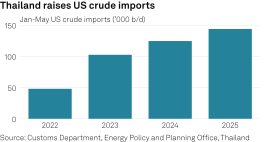
Thailand bought 143,771 b/d of US crude in the first five months of 2025, up from 124,450 b/d during the same period a year earlier, 102,438 b/d over January-May 2023 and 48,000 b/d over January-May 2022, according to data from Thai customs.
In South Korea, state-run Korea National Oil Corp. issued a spot tender in July to sell an unspecified quantity of Iraqi Basrah Medium crude oil, making room in its reserve storage facility to accommodate US crude, traders in Singapore and refinery sources in Seoul and Ulsan with close knowledge of the matter said.
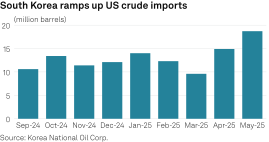
According to traders in Singapore, KNOC may have bought a Very Large Crude Carrier of WTI Midland crude at a premium of around $1.10/b to front-month Platts Dubai.
KNOC declined to comment on the spot trade deal. However, an official from the state-run oil company told Platts, part of S&P Global Energy, that both the South Korean government and KNOC are considering increasing purchases of US energy products to help address trade imbalances between South Korea and the US, as Seoul seeks ways to strengthen its position in reciprocal tariff negotiations.
Private sector refiners
Refiners in South Korea's and Japan's private sectors have indicated that US crude is gaining popularity as a feedstock option primarily because of business interest, rather than diplomatic factors.
"We have both domestic and international investors to look after as a publicly listed company on the Tokyo Stock Exchange," said a feedstock inventory management source at a major Japanese refiner. "We respect the government's diplomatic stance and strategies, but our feedstock crude oil procurement and trading decisions are purely based on refining margins and logistical economics."
Top US crude buyers in South Korea, including SK Innovation and Hanwha TotalEnergies, have stated that their purchasing decisions will be based solely on feedstock and logistical economics, while neither the government nor KNOC can compel major local refiners to buy US crude oil.
Asian refiners are increasingly turning to US crude to diversify supply sources amid geopolitical uncertainties in the Middle East.
The appeal of US crude is further bolstered by its logistical advantages and high quality. Despite the longer transportation route from the US Gulf Coast to Asia, the availability of VLCCs ensures a reliable supply. WTI Midland, in particular, is highly valued for its ability to maximize middle distillate yields and is considered more cost-effective, especially in light of recent increases in Middle Eastern official selling prices, according to feedstock managers at South Korean and Japanese refiners.

Platts assessed the spread between WTI Midland and Murban on a CFR North Asian basis at minus 4 cents/b on June 30, significantly weakening from the year-to-date peak of $2.51/b on June 4. The spread was last assessed at $1.03/b on July 14.

Editor: