


Crude Oil, Refined Products, Maritime & Shipping, NGLs, Natural Gas, Gasoline
July 11, 2025
Trump agenda bill clears path for US oil and gas, but impact may be marginal: analysts

HIGHLIGHTS
Price environment more important than lease availability
Federal onshore leases less attractive
Offshore, Alaska could benefit
The passage of the One Big Beautiful Bill Act -- first major legislative achievement of US President Donald Trump's second term – has been lauded by industry and Republican lawmakers who argued the bill would "unleash" American energy.
But while the bill contains dozens of provisions designed to incentivize US oil and gas production on federal lands and waters, the technical realities of the US federal leasing program, lead times in project development, and broader market imperatives of US producers may limit its impact on US supply and energy prices, analysts told Platts.
While the legislation cleared an easier path for federal lands and waters development, there are no guarantees that US companies will act anytime soon, Kevin Book, Managing Director at ClearView Energy Partners, said.
"The way to conceptualize it is you get an option to produce -- but not an obligation," Book said. Where the environmentally focused leasing policies of former US President Joe Biden "reduced the option set if a signal from the market called to the oil patch," Book said, the industry may be more responsive under a more permissive and attractive leasing program.
"But that assumes that these policies endure for years," Book said.
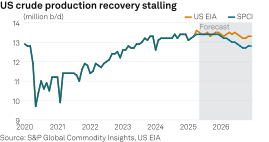
Meanwhile, as US oil and gas firms reduce capital expenditure and cut rigs amid lowered prices and OPEC+ production increases, federal development will require extended favorable pricing conditions.
Ultimately, "price drives activity," Bob Frkylund, vice president of upstream energy at S&P Global Energy, said.
Lobbying win
The One Big Beautiful Bill Act, signed into law July 4, mandates in the next decade four new lease sales in Alaska's National Wildlife Refuge; five in the National Petroleum Reserve-Alaska; 30 Gulf of Mexico lease sales; six sales in Alaska's Cook Inlet, and quarterly leases in nine Western states under the Mineral Leasing Act. It also lowered royalty rates from the current 16.75% to 12.25%, in line with pre-Inflation Reduction Act levels.
While environmentalists threw scorn on the legislation -- the Center for Biological Diversity called it a "full-scale assault on the air we breathe, the water we drink and the wild places we cherish" -- the oil and gas industry's largest trade group, the American Petroleum Institute, rejoiced over a long-sought lobbying victory.
"This historic legislation is a win for American-made energy, consumers and the workers who power our economy," API President and CEO Mike Sommers said in a July 3 statement.
In the fall of 2024, after Trump's election win, API released a five-point policy road map that asked the administration to make more federal lands and waters available for exploration and drilling, among other requests.
In a July 3 appearance on CNBC, Sommers called the bill the "most transformational legislation we've seen in decades in terms of access to both federal lands and federal waters." Sommers noted the bill "includes almost all of our priorities."
Federal share
Despite industry's celebration, certain parts of the new leasing regime seemed unlikely to significantly spur US crude production, even in the long term.
According to a January Congressional Research Service report, oil production on nonfederal lands accounted for 72% of overall US production in 2023. While the share of onshore production on federal lands increased in the previous decade -- from 7% in 2013 to 13% in 2023 -- it still represented a relatively modest slice of US crude output.
Meanwhile, many producers have already begun to shy away from a crowded federal onshore development landscape, Fryklund said.
"Most is already leased out, so what the bill would affect is pretty small," Fryklund said. "Also, the good stuff is generally already leased, so what's left available isn't much, and it's not very productive. While the changes to federal leasing for onshore may grab headlines and rile voters, it's pretty much a nothing-burger."
Bigger Gulf
Where the bill could have its biggest effects, analysts said, is its requirement for a robust schedule of new leases in the Gulf of Mexico, as well as new mandatory lease sales in Alaska -- though even those impacts could be difficult to discern.
"The difference might be offshore in the Gulf, where we will have more regular sales," Fryklund said. "But it will not see any production for five to 10 years."
Top among API and other groups' recent lobbying efforts was the reinstatement of a robust Gulf of Mexico offshore leasing regime. The Biden administration's 2023 five-year leasing plan featured no sales in 2024 and the fewest total sales in the history of the Bureau of Ocean Energy Management's program.
The mandated lease sales in the reconciliation bill will increase those opportunities for producers and provide more favorable terms, including an 80 million-acre lease minimum and lower royalty rates.
Still, production increases in the next decade could prove minimal relative to the size of current US production.
In January 2021, a study by Energy & Industrial Advisory Partners, commissioned by the API, said it expected the US outer continental shelf to produce an average of 2.5 million barrels of oil equivalent per day from 2025 to 2034. The study found that a legislative leasing plan almost identical to the one passed in reconciliation would by 2034 increase US offshore production by 140,000 boe/d more than the Biden administration's five-year plan.
"One of the big challenges is the latency between a lease sale and the development of that lease," Book said. "To link it to one specific policy is hard to do."
Alaska wild card
A similar latency could affect Alaska. The Trump administration and Republicans in Congress have focused on rolling back Biden-era environmental protections and encouraging development in the NPR-A and ANWR.
Still, recent ANWR lease sales have drawn little industry interest. In January, Representative Bruce Westerman, Republican-Arkansas, argued that the Biden-era sales were deliberately made unattractive. But drilling in the undeveloped ANWR, a nexus of environmentalist and conservation efforts, has "become pretty toxic politically, at least nationally," Brett Watson, professor of Applied and Natural Resource Economics at the University of Alaska Anchorage, said.
But the NPR-A -- where ConocoPhillips is developing its Willow Project, which is set to produce its first oil in 2029 and projected to reach a peak of 180,000 b/d when completed -- could benefit most from the reconciliation bill's mandates.
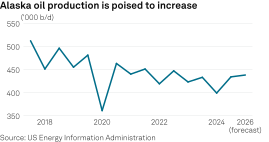
"The lack of interest is not the case in NPR-A," Watson said. "When those tracts become available, they tend to draw interest."
In June, the US Geological Survey said the US contains a mean estimate of 29 billion barrels of undiscovered but technically recoverable onshore crude oil, of which 14 billion barrels were located in Alaska. Alaskans are eager to develop those resources to help cover gaps in funding for state services, Watson said. ConocoPhillips has confirmed its ongoing interest in Alaskan development.
But the economic challenges of development in the NPR-A -- and the potential for policy changes in four years' time -- could yet act as a counterweight to new leasing enthusiasm.
"Conoco sort of has its hands full with Willow right now," Watson said. "They're doing some prospective development in the areas around Willow, but they've got plenty of capital committed there already, and I think most companies will be in a wait and see mode for a while."

Editor: