Crude Oil
July 03, 2025
US, Brazilian crudes witness sharpest growth in Indian crude basket in H1 2025
HIGHLIGHTS
Refiners embracing more non-OPEC crudes amid diversification efforts
Russia remains the biggest supplier; Jan-June volumes at 1.67 mil b/d
Crude inflows from Saudi Arabia, Iraq, Angola, and Colombia decline
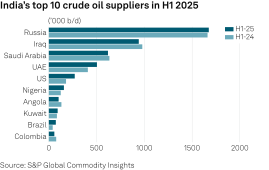
India's crude oil inflows from the US surged more than 50% in the first half of 2025, compared with H1 2024, while flows from Brazil rose 80% over the same period, signaling a growing affinity of its refiners for non-OPEC crudes as New Delhi looks to widen its source of supplies.
While sluggish purchases by China amid higher tariffs have opened up a window for India to ship in more US crude and work towards bridging the trade deficit with Washington, multiple recent diplomatic visits by Indian petroleum minister Hardeep Singh Puri and other government officials to Brazil to strengthen energy ties have started to yield results, traders, analysts and government sources told Platts, part of S&P Global Energy.
"Crude supplies from the US have been rising, but have been limited to a few refiners in India. This allows room for other refiners to grow US imports further during the year," said Abhishek Ranjan, South Asia oil research lead at Energy.
According to data from S&P Global Commodities at Sea, India imported 271,000 b/d of crude oil from the US in the year's first half, up around 51% from 180,000 b/d imported in the same period in 2024.
Renewed interest
Indian refiners have been used to relatively large volumes of US crude in the past, but volumes had slowed down over the past two to three years when India turned to Russian crude.
India's appetite for US crude is again showing signs of revival amid renewed diplomacy with the new US government. Prime Minister Narendra Modi's visit to the US in mid-February and the pledge by the two world leaders to boost energy ties would mean increased US crude flows to India in the whole of 2025, both on a spot and term contract basis, analysts and industry sources said.
Even the tariff scenario has implications for crude flows. The US announced reciprocal tariffs on India and a host of other nations on April 2, and then paused the increase for 90 days from April 10 to negotiate trade deals with these countries.
For India, the reciprocal tariff was 26%, lower than the tariff on many other Asian peers. According to CRISIL, part of Energy, the US in 2024 exported $6.5 billion worth of crude oil to India, which accounted for 16% of its merchandise exports of $41.8 billion to India that year.
"There seems to be good complementarity in the energy space as the US is a large exporter and India is a large importer of energy commodities. But, the dynamics differ based on the energy product. The prospects of increasing crude oil imports from the US would have to be viewed against challenging factors such as higher cost of transportation and longer transit time," said Dharmakirti Joshi, chief economist for India at CRISIL.
Brazil posts highest growth
Crude inflows from Brazil posted the sharpest growth in the six-month period, rising about 80% year over year to 73,000 b/d from nearly 41,000 b/d, CAS data showed.
"Supply security is paramount for an import-dependent economy like India, and in view of geopolitical tensions in the Middle East, diversification of supply sources is an important lever to achieve supply security. Indian refineries can take a wide range of crudes, hence imports from distant regions such as the US and Brazil are up, while imports from the Middle East are down," said Tushar Bansal, senior director at consulting agency Alvarez and Marsal.
However, shipping costs pose some challenges to sharply boosting volumes. It currently costs about $4-$6/mt and takes about a week to ship crude oil from some destinations in the Middle East, while it costs $15-$20/mt and takes about a month to bring in crude oil from Brazil, market sources and analysts said.
Russia retains top spot
Russia retained the position as India's top crude supplier in January-June with shipments of 1.67 million b/d, up marginally from 1.66 million b/d in the same period a year earlier, CAS data showed.
"With a modest level of Russian imports in the early months of 2025, volumes are rising again, supported by lower crude prices that enable higher volumes to be procured below the price cap. As the global oversupply is expected to continue putting pressure on prices, we expect Russian flows to remain at current levels, if not increase," Ranjan said.
Spot FOB Pimorsk Urals crude rose above the G7-led $60/b price cap on Russian oil for much of the Israel-Iran conflict, exceeding the cap on June 13 and staying above it until June 24. Platts assessed Urals FOB Primorsk at $56.32/b on July 1.
OPEC+ is scheduled to meet July 6, with participants widely expecting the alliance to approve an additional 411,000 b/d increase starting in August -- a move that could contribute to a growing surplus in the global oil market.
While crude inflows into India from Iraq and Saudi Arabia declined by modest levels of 4% and 2%, respectively, volumes from Angola declined by a sharp 22% year over year in January-June. Inflows from Nigeria rose 26% to around 158,000 b/d in the six-month period.
"However, gradually rising crude throughput in Dangote refinery will mean that those Nigerian crudes will not be able to support crude demand growth from India. There might be a few months of higher crude imports, but they should decline on an annual basis in terms of imports to India," Ranjan added.
