Crude Oil
June 16, 2025
OPEC trims 2025 oil demand growth estimate but hikes ‘call’ on its crude

HIGHLIGHTS
Demand for OPEC+ oil up 100,000 b/d in 2025, 300,000 b/d in 2026
OECD crude stocks rose 21 mil barrels in April, below historic average
Bullish on prospects for world economy amid US-China tariff thaw
OPEC has nudged down its 2025 world oil demand growth estimate, but sees thirst for its crude and that of its Russia-led allies increasing further this year and next at the expense of its rivals in the Americas.
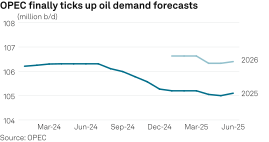
In its latest monthly oil market report June 16, the OPEC secretariat in Vienna predicted global oil demand would rise 1.29 million b/d in 2025, down from its May estimate of 1.3 million b/d, and left its 2026 forecast unchanged at 1.28 million b/d.
Those estimates take global demand to 105.1 million b/d in 2025 and 106.4 million b/d in 2026, up 100,000 b/d on May's predictions. This is the first time OPEC has nudged up its 2025 world demand estimate since April 2024.
Crucially, the "call" on OPEC+ crude -- the quantity it must pump to balance supply and demand -- was estimated at 42.7 million b/d in 2025 and 43.2 million b/d in 2026, up 100,000 b/d and 300,000 b/d, respectively, from the May estimates.
Reflecting OPEC's bullishness about the tightness of the oil market, those forecasts remain well above the 41.23 million b/d pumped by the alliance in May, according to secondary sources used to estimate output. That is despite production rising 180,000 b/d from April as the group's accelerated quota increases came into effect.
Meanwhile, non-OPEC+ production growth in 2026, driven by countries such as the US, Canada and Guyana, was seen as down month over month by 100,000 b/d and unchanged in 2025 at 800,000 b/d.
Healthy global economy
While OPEC's forecasts did not change dramatically in its June report, the secretariat struck a somewhat bullish tone, particularly on the state of the global economy amid a thaw in US-China trade tensions, which had raised fears of a global demand slump.
OPEC said the global economy "outperformed expectations" in the first quarter, boosting oil demand. It predicted that partial trade deals between the US and key partners would be reached by the second half of the year.
"As trade patterns partially normalize, trade-related distortions in growth trends are expected to ease, with consumption and investment projected to remain firm," the report noted.
"Nonetheless, some risks may persist on the tariff front, particularly given the scheduled expiration of the 90-day pause on reciprocal tariffs in July and August, including those targeting China."
The report did not make any reference to the military escalation between Israel and Iran, which began following the reporting window.
That conflict, which has spiraled into attacks on domestic oil and gas infrastructure, prompted a dramatic spike in oil prices before they ultimately settled.
Platts, part of S&P Global Energy, last assessed Dated Brent at $75.19 on June 13, a $4.35/b increase on the previous day.
Market share
OPEC remains far more confident on crude demand than its rival forecasters, particularly the Paris-based International Energy Agency, with officials insisting privately that backwardation in the crude market shows evidence of near-term tightness.
In its monthly report, it noted that OECD crude stocks had risen 21 million barrels in April to 1.344 billion barrels, but that is 129 million barrels below the 2015-2019 average.
Nevertheless, Haitham al-Ghais, the OPEC secretary general, urged the IEA to show restraint on stock releases June 13 as attacks by Israel and Iran intensified.
Eight members of OPEC+ implementing 2.2 million b/d of voluntary cuts have used low inventories as a key rationale for returning the barrels to market -- including with 411,000 b/d of quota hikes in May, June and July -- prompting speculation that the alliance had foregone price defense in favor of a market share approach.
Attempts to shore up the crude market in recent years have been undermined by poor quota compliance -- which is now being rectified by some with compensation cuts -- surging production in the Americas, volatility driven by conflict and sluggish Chinese demand.

Editor: