LNG, Natural Gas, Crude Oil
June 13, 2025
South Korea considers raising crude imports from Americas as Middle East tensions rise
HIGHLIGHTS
Energy ministry holds emergency meeting following Israel's strike on Iran
'All oil tankers from the Middle East operating without disruptions': ministry
South Korean crude oil importers might step up efforts to reduce their heavy reliance on the Middle East by raising shipments from the US and other American countries in the aftermath of escalating tensions following Israel's strike on Iran, industry sources in Seoul said June 13.
The Ministry of Trade, Industry and Energy held an emergency meeting with local crude oil and LNG importers, including Korea National Oil Corp. and the Korea Petroleum Association, a group of crude importers.
The ministry also conducted an emergency review of the country's crude oil and LNG supplies. South Korea is the world's fourth-biggest crude importer and the third-largest LNG buyer.
"All oil tankers and LNG carriers heading to South Korea from the Middle East are operating without any disruptions at the moment," the ministry said in a statement.
The ministry also said it has checked the current status of the country's crude oil and LNG reserves to brace for any supply disruptions from the Middle East.
"We will be closely monitoring the impact of the airstrikes on the domestic supply and prices of oil and LNG, and respond swiftly to minimize the burden on the national economy," it said.
"Given South Korea's high dependence on oil and gas imports from the Middle East, developments in the region are closely tied to our energy security," the ministry said.
The renewed tensions in the Middle East are likely to induce South Korean crude importers into stepping up efforts to lower their heavy dependence on the loadings in the Persian Gulf, refinery officials said.
The tensions come as South Korea has already been reducing crude oil imports from the Middle East.
Asia's third-biggest crude importer received 51.236 million barrels from the Middle East in April, accounting for 63.5% of its total imports of 80.676 million barrels, falling sharply from 73.5% in March, latest data from state-run Korea National Oil Corp. showed.

"The import volume from the Middle East in April also marked the smallest in almost three years since June 2022," an official at the Korea Petroleum Association said.
In contrast, shipments from the Americas, including the US, Mexico and Brazil, rose to 21.92 million barrels in April, accounting for 27.2% of total imports.
"This import volume marked the biggest since July last year when South Korea's intake of American grades marked the record-high of 26.35 million barrels, or 31.3% of total imports," the KPA official said.
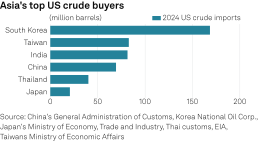
Imports from the US are likely to keep rising as South Korea might raise purchases of American energy sources to meet trade pressures from the Trump administration.
South Korea's initial strategy is now focused on more LNG imports from the US, but it can also include crude oil to help address trade imbalances.
South Korea and the US have agreed to push to conclude a "package" agreement on new US tariffs and economic as well as industrial cooperation, including energy issues, by July 8, when US President Donald Trump's 90-day pause on reciprocal tariffs ends.
