


Refined Products, Chemicals, Crude Oil
March 27, 2025
India panel recommends refined products diversification, crude buying for SPRs
HIGHLIGHTS
Refining profitability vital when demand starts falling
Strategic reserves should remain filled consistently
Reducing fossil fuel reliance has wide implications
India must expand its refining capabilities by diversifying its product mix and increasing focus on petrochemicals, biofuels and sustainable aviation fuel, to help refineries adapt to changing market demand and reduce dependence on traditional petroleum products, according to a parliamentary committee report of the petroleum ministry.
While India will boost refining capacity from 258.1 million mt to 309.5 million mt by 2028, the expansion will focus on building flexible production capabilities, keeping long-term objectives in mind, while balancing between smooth transition, utilizing local energy resources and the goal of achieving decarbonized energy systems, it said.
"The committee feels that more efforts are needed to ensure that the huge refining infrastructure created in the country is properly utilized even after the demand of petroleum products starts falling as a result of energy transition and shift toward green energy," the report said.
According to S&P Global Energy analysts, of the refinery expansion projects India is pursuing, about 58% of the increase is expected to come from brownfield expansions over the next three years, while the remaining would come from greenfield projects.
Key projects include Indian Oil Corp.'s expansion of its Panipat, Paradip, Gujarat and Barauni refineries to raise their capacities and integrate petrochemical production units. Bharat Petroleum Corp. is also expanding its Bina refinery's crude processing capacity while increasingly integrating petrochemical production capacity.
HPCL Mittal Energy also expanded its refinery capacity and integrated petrochemicals, raising petrochemical intensity to around 20%. HPCL Rajasthan Refinery is developing a 9 million-mt/year refinery and petrochemical project in Rajasthan, with an expected petrochemical intensity of around 26%, one of India's highest.
"Even though India's energy intensity per GDP [gross domestic product] has been falling, its energy demand has been on rise for sustaining growth and higher economic activities. As a result, the demand for auto fuels and refining capacity is expected to remain robust in near future," the report said.
Crude buying to fill SPRs
India's strategic petroleum reserves cover about 9.5 days of total net oil imports, while state-run oil companies hold storage facilities for crude oil and petroleum products for 64.5 days of total net imports, resulting in a total national storage capacity of 74 days of total net imports.
"The committee would also urge upon the government to strive to achieve global standard of maintaining 90 days of crude oil storage in the country as a long-term measure," the report said.
In its first phase, India set up SPRs at three locations with a combined capacity of 5.33 million mt: 1.33 million mt at Visakhapatnam, 1.5 million mt at Mangalore and 2.5 million mt at Padur in Karnataka.
The report urges the government to fill the caverns with oil completely as early as possible to ensure energy security.
"The committee -- while appreciating the intention of the government to wait for the right time and the right price point to procure oil for the purpose of filling caverns in order to avoid overpaying for crude oil -- also recommends to the ministry to remain proactive toward exploring the possibility of arranging cheaper crude oil for strategic storage, particularly keeping in view current geopolitical considerations," it added.
Upstream sector challenges
The committee noted no significant increase in crude oil or gas production in recent years, which resulted in higher petroleum product import dependency. Therefore, more funds needed to be allocated to the upstream sector.
"Even after a significant increase in exploration efforts over the years, no new important oil field has been discovered. The committee feels that the exploration efforts need to be increased substantially, especially in those areas which have been little explored," it added.
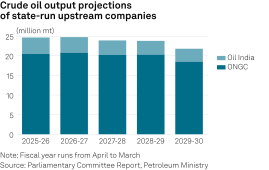
In recent years, India has undertaken multiple upstream reforms, such as greater marketing freedom for producers and the Open Acreage Licensing Policy, but overseas interest in exploration bidding rounds remained elusive.
Reliance on fossil fuels
The report said coal still accounted for a significant portion of electricity generation, but there was a strong push to reduce fossil fuel dependence and increase renewable energy share.
"The global shift toward a low-carbon economy, driven by the dominant climate narrative, has significant implications for India's energy sector and other sectors. This transition aims to mitigate climate change by reducing greenhouse gas emissions and promoting sustainable energy practices," it said.
Adopting renewable energy sources, such as solar, wind and hydro, is crucial for reducing carbon emissions, requiring substantial investments in renewable energy infrastructure and technology.
"Reducing reliance on coal, oil and other fossil fuels will have economic and social implications, including job losses in traditional energy sectors and the need for retraining workers," it added.