


13 Feb 2020 | 10:15 UTC — London
Haftar holds Libyan oil hostage in his quest for more control

Highlights
Attempts to export oil on behalf of NOC East considered
Blockade could last months not weeks, analysts say
OPEC+ wary of Libyan oil return as it mulls deeper cuts
London — Fully controlling Libya's oil sector, particularly its oil and gas revenues, remains the big prize for Khalifa Haftar's self-styled Libyan National Army.
Haftar controls the bulk of Libya's key oil infrastructure, but does not have access to the oil revenues via the Central Bank of Libya. Neither does he hold the reins of the state-owned National Oil Corporation. These are both on his wish list.
Not surprisingly, these are also the demands from the Eastern Libyan tribesmen (supported by Haftar), who have orchestrated an oil port blockade since January 18, slashing Libya's oil output.
Libya's oil production has collapsed to around 180,000 b/d in the past few days from around 1.10 million b/d before the blockade, and could fall to just 72,000 b/d in the coming days.
 NOC East exports
Libya's oil sector is deeply fractured along western and eastern lines, much like most of the country.
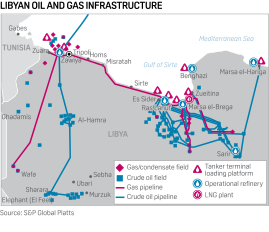
As Libya's oil exports remain mostly paralyzed due to the Eastern-led blockade, the LNA is refocusing its efforts on selling Libyan oil from the eastern terminals, according to several sources.
Sources said the LNA -- along with representatives from a company that calls itself NOC East [the main rival to the Tripoli-based NOC] -- have in the past few weeks, discussed ways to export crude from the oil terminals it controls, with some of its allies.
Previous efforts by the Eastern-based NOC to export oil have not succeeded, but analysts and trading sources said there would be less international pressure on the LNA if it were to reattempt oil exports.
"[There is] definitely change in sentiment from the international community. I wouldn't be surprised if it goes through this time," a source active in the Libyan oil industry said. "So definitely it is a warmer environment for eastern-NOC exports," he added.
Representatives at NOC East were unavailable for comment.
The Tripoli-based NOC is the legitimate producer and exporter of Libyan oil, according to several UN resolutions, and this was also confirmed in the official communique at the recent Berlin peace talks.
NOC has regularly warned its oil buyers and shipowners to avoid "illegal" cargoes from the east.
At a recent event in London, NOC chairman Mustafa Sanalla admitted these attempts to load "illicit cargoes" are continuing. "This is illegal, but they never stopped trying. They never stopped," he said.
NOC has previously accused NOC East of signing supply contracts with UAE and Egyptian companies.
In April last year, there were reports NOC East was looking to export 2 million barrels of Saris/Mesla crude, but the shipment did not materialize.
In March 2014, US forces took control of the Morning Glory tanker in international waters after it had loaded from the then-rebel-held port of Es Sider.
Blockade demands
Sources also said that eastern tribesmen, who initiated the blockade, are now pushing to get NOC transferred from Tripoli to Benghazi based on a 1967 decree.
"Looks like the scenario is becoming real...Haftar is looking to move everything to Benghazi and the East," said a source active in the Libyan security sector.
The UN has said that experts will study the allocation of oil revenues between West and East Libya after the rival parties met at the UN-led meeting in Cairo this week.
Haftar has weaponized oil in this long-running conflict, hoping this blockade will cut funding to his rivals in the UN-backed Government of National Accord.
Most analysts do not expect some of these demands to be met until a broader political and security deal is done.
"Meeting eastern demands will require a political agreement that would necessitate significant concessions on the part of the GNA," Mohammad Darwazah, a director at Medley Global Advisors said. "And there currently are no indications the GNA is willing to budge."
How long will it last?
Hamish Kinnear, an analyst at Verisk Maplecroft, said a lengthy oil blockade measured in months as opposed to weeks is now likely, as Haftar will be happy to maintain the blockade as he strives for increased access to the central bank.
"GNA will also be reluctant to give in to Haftar's demands to have increased CBL access. In their view this would only feed the LNA war effort, and the Tripoli government has the financial means to hold out for much longer," Kinnear added.
The international community has also not put enough pressure on the LNA to reopen the terminals, according to analysts.
This is unlikely to change as some of Haftar's key allies, Russia, the UAE and Saudi Arabia who are part of OPEC/non-OPEC coalition, are mulling deeper production cuts to support oil prices, which have plummeted as the coronavirus has eaten into global oil demand.
An end to the oil blockade would mean a return of more than 1 million b/d of oil to the market, and "likely counteract the impact" of the proposed cuts by OPEC and its allies, Kinnear said.
"This is not in the interests of Saudi Arabia and the UAE, leading OPEC+ members who back Haftar," he added.
Darwazah said one of the scenarios in which Libyan oil would return to the market are if there is "sustained external pressure, especially by the US, to reopen the terminals."
"But to get Washington on board at current oil prices would require pressure from Haftar's Arab backers -- the UAE and Egypt -- which are currently supporting the closures and, in fact, looking for ways to pick up shadow crude cargoes," he added.