Crude Oil
January 13, 2025
OPEC+ cut tapering to create 1.01 million b/d oil surplus in 2026: Saudi think tank
By Lauren Holtmeier and Herman Wang
HIGHLIGHTS
KAPSARC revises down demand growth forecast
OPEC+ set to start raising crude production in April
Too much spare capacity dampening oil prices
The oil market will be heavily oversupplied by 2026, as members of OPEC+, a coalition of OPEC and other oil producers, taper their production cuts, Saudi think tank KAPSARC said Jan. 13, challenging the producer alliance as it seeks to regain market share without depressing crude prices.
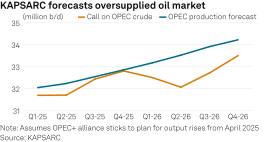
In its latest quarterly market forecast, Riyadh-based KAPSARC said it expects a 260,000 b/d surplus in 2025, rising to 1.01 million b/d in 2026.
US shale production will lead the expansion of global oil supply in the coming year, outpacing tepid demand growth from a slowing Chinese economy, while the Saudi-led OPEC+ coalition is set to begin raising output quotas from April.
"On a technical basis, there is no major shortage of supply for the next two years," KAPSARC said. "Relaxing cuts from OPEC+, growth in non-OPEC+ nations, and an uncertain outlook for demand will yield some surpluses in the short term, although this depends on non-technical factors related to policy and geopolitics."
OPEC+ members announced in December they were holding their production quotas in place through the first quarter of 2025 in their latest extension after having originally planned to taper some 1.6 million b/d of cuts from October.
Delegates said the move was intended to shield the market from any downside due to the typical first-quarter refinery maintenance period.
Indeed, KAPSARC's forecast sees a 350,000 b/d oversupply in the first quarter.
However, if OPEC+ countries stick to plans to start raising production in April, that surplus rises to 540,000 b/d in the second quarter, before expected seasonal demand in the northern hemisphere summer eats up most -- but not all -- of that additional supply in the third and fourth quarters.
Reduced first-quarter 2026 demand then causes the surplus to balloon as the OPEC+ alliance carries on with boosting supply.
"There is room for tapering down this surplus, if China's economy performs better than expected, if further sanctions are imposed on certain exporting countries, if tariffs are reduced, and/or if the geopolitical situation improves," KAPSARC said. "Likewise, an escalation of the geopolitical situation can also render higher demand."
OPEC+ communication
OPEC+ ministers have said they may keep extending the production cuts -- or accelerate their relaxing -- as market conditions warrant. A nine-country monitoring committee co-chaired by Saudi Arabia and Russia is scheduled to convene in early February, while the full alliance will meet May 28.
KAPSARC, for its part, said it did not anticipate any reversals for now. Members of the alliance are cognizant, KAPSARC said, that they hold too much spare production capacity, which averaged 5.6 million b/d in 2024 -- more than what the UAE and Kuwait have pumped combined in recent months.
That much spare capacity, while useful in offsetting any disruptions to the market, has had a dampening effect on prices, with traders concerned about a flood of crude coming back if OPEC+ opens the taps. It has also generated angst amongst some OPEC+ members who have been eager to reclaim lost market share and stop losing money on idled wells.
KAPSARC advised in its report that the alliance to keep communicating its intentions to the market.
"Gradual and calculated increments over the coming two-year horizon may not make everyone happy, but it does make sense to the person holding the spare capacity," it said. "Considering how volatile the market could be for the next two years, clear signals concerning the maximum speed of relaxation of cuts (barring a supply shock) are a useful gauge for the way forwards."
Slowing China
KAPSARC's 2025 forecast included a downward revision of 150,000 b/d in global oil consumption from its previous quarterly report, and an upward revision of 120,000 b/d in supply. As a result of the adjustments, the think tank has forecast demand to rise 1.21 million b/d year on year, while supply will increase 1.48 million b/d.
Regarding supply, KAPSARC expects global tight liquids production to expand 480,000 b/d in 2025, easing to half that level in 2026.
International oil companies in countries including the US, Canada, Mexico, Norway and the UK could slow down production in 2026 if prices are impacted by an oversupply, it added.
Organization for Economic Cooperation and Development demand growth will be sluggish in 2025 at 120,000 b/d, KAPSARC said. Non-OECD growth is likely to reach 1.09 million b/d in 2025 and 2026, KAPSARC said, noting that India is likely to lead demand growth, surpassing China.
"We do not expect China to witness strong growth as it did in previous years, and we limit our growth projections to 210,000 b/d in 2025 and 190,000 b/d in 2026," it said.
Demand from the Middle East will likely stand at 200,000 b/d, according to KAPSARC, with African growth reaching 120,000 b/d and Latin America 110,000 b/d.
KAPSARC is funded by and advises the Saudi government but maintains its research is independent.