Coal, Maritime & Shipping, Dry Freight
September 24, 2025
Private sector involvement in South Africa's logistics sector may boost coal exports
HIGHLIGHTS
Coal exports from RBCT to rise to 55 million mt in 2025
Coal producers may benefit from improved logistics in the long run
Positive development to increase rail capacity, enhance competitiveness of South African coal exports
The South African government's decision to open its logistics sector to private investment signals a promising new chapter for the nation's coal exports. After years of underperformance and lack of investment, this move aims to capitalize on previously missed opportunities.
On Aug. 22, the South African government announced that Transnet SOC Ltd., through its operating division Transnet Rail Infrastructure Manager (TRIM), completed the process of adjudicating new train operating companies. As a result, the 11 shortlisted companies by the South African government will negotiate with the state-owned operator to gain access to 41 routes and six corridors for a period of up to 10 years through licensing, currently maintained and operated by Transnet, to export coal, chrome, manganese, fuel and other goods.
The move is expected to boost South African exports including thermal coal as years of downturn due to underinvestment and misgovernance at Transnet damaged the potential that South African thermal coal suppliers may have achieved as a result of the shifting trade dynamics in the thermal coal market.
"This is a positive development to increase rail capacity and enhance the overall competitiveness of South African coal exports. In recent years, the country's coal sector suffered opportunity losses due to logistics constraints, especially in 2022, when the Russia-Ukraine war triggered an escalation of prices," South African miner Menar's Managing Director Vuslat Bayoglu said.
South African mining companies, Menar and Exxaro Resources Ltd., which are also involved in thermal coal exports, have already reached an agreement with Transnet to gain access to certain routes to transport various goods, including coal for exports. Many more miners are likely to sign agreements with Transnet in the coming weeks and months.
"In my opinion, this is positive for coal exports, it should gradually strengthen South Africa's ability to lift RBCT exports closer to potential," a South Africa-based thermal coal trader said.
Another trader from South Africa struck a similar note, suggesting that "the private players will give their best shot to put equipment on the ground and try to maximize their chance." "We are also optimistic for this to happen, enabling more fair play with more participants in the game," the trader added.
Suppliers may get a breathing space
Market participants expect that such a move will provide South African thermal coal suppliers with room to reduce their operational costs, which in turn may allow them to price their products at a competitive level and expand their share in the market.
"Yes, it improves suppliers' economics even if prices ease somewhat with more supply, better rail lowers FOB cost bases, letting miners operate comfortably at current or slightly lower price levels," the first trader said.
South African thermal coal suppliers have been under pressure in recent years as falling prices of their products have weighed on the miners' operating margins. This has weakened suppliers' capacity to adjust prices in a price-competitive market, leading to a loss of market share.
After reaching a peak of $429.90/mt in March 2022, Platts-assessed FOB Richards Bay 5,500 kcal/kg NAR coal prices have been in a steady downward trend, marred by a lack of demand and logistical and operational challenges. This year, prices fell to their lowest level of $65.50/mt FOB at the beginning of July.
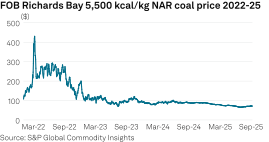
Despite such a drop in price, South African thermal coal suppliers have at times found it difficult to compete with suppliers from Russia, Colombia, Australia and Indonesia, who have been flexible enough to price their products competitively to cater to the demand coming from Asia-Pacific.
Moreover, better logistics in those countries have led to buyers preferring material from them rather than placing orders with South African thermal coal suppliers and face uncertainties due to lengthy disruptions on the rail line, port operations and the freight corridor operated by Transnet.
Recovery plan healing South African logistics
Transnet has undergone a massive shift in recent years following the change in the company's board, which resulted in Transnet adopting various measures under the recovery plan, launched in August 2023.
The recovery plan already reaped benefits, with exports from RBCT touching 52.1 million mt in 2024, the highest since 2021 and up from 47.2 million mt in 2023. Moreover, in the first half of 2025, coal exports from RBCT surpassed 27 million mt, putting it on course to meet the 2025 target of 55 million mt.
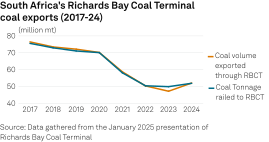
Following the plan's rollout, cable theft incidents declined notably from 5,506 incidents in FY2021-22, which caused a revenue loss of Rand 2.10 billion, to 3,877 incidents in FY2022-23, resulting in a reduced loss of Rand 1.68 billion. Transnet also boosted the number of operational locomotives, which helped increase rail volumes by 8.7% to an expected 193 million mt in FY2024-25, reversing the steady decline seen over the previous five years.
Port volumes also improved, with container handling capacity growing from 4,229 containers in FY2022-23 to nearly 5,000 in FY2024-25, and automotive throughput increasing by 48 units. These gains supported a broader increase in export efficiency and capacity at RBCT, which serves as the main coal export hub.
Additionally, industry experts acknowledged that while challenges remained, the recovery plan had laid a solid foundation for turning around South Africa's logistics system.
"Logistics problems are a part of every country, and while I agree it has impacted South Africa more, I see improvement on the ground and in about 2-3 years, we'll be able to get rid of many transportation and allied problems to be able to ship more products outside of the country," Vuslat Bayoglu, managing director of South African mining company Menar said in his interview with Platts in August 2024.

Editor: