Chemicals, Aromatics, Solvents & Intermediates
October 27, 2025
Asian benzene term contract discussions kick off amid poor demand outlook
By Haitian Fang, Sophia Yao, and Zi Nin Tan
HIGHLIGHTS
Macroeconomic outlook, oversupply dampens sentiment
FOB Korea cargoes heard at flat to $1/mt premium against wMOPK
China remains largest consumer of South Korean benzene
Initial discussions have started for benzene term contracts in the Asian market next year after industry participants returned from a conference which took place over Oct. 14-17, with sentiment in the market sharply more bearish than last year amid worries over a weak macroeconomic outlook, oversupply and capacity rationalizations.
The current weak spot market for benzene means that initial talks for 2026 term contracts will start low, a producer said. With the FOB Korea marker in a contango, spot trades for December loadings were last heard at discount of $3.50/mt against the December weekly Mean of Platts FOB Korea (wMOPK).
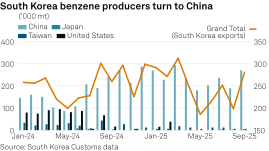
Contrary to expectations, US import demand has evaporated in the second half of 2025 for Asian producers. Amid a confluence of factors such as higher refinery run rates in the US Gulf, lower styrene operating rates and also imports from Europe, the US -- normally the second biggest buyer of Asian benzene -- has ceased imports from Northeast Asia since March.
A closed arbitrage from the East, as well as the US administration's subsequent imposition of a 15% import tariff on goods from Japan and South Korea goods, both major suppliers of benzene to the US, has kept traders away from the Northeast Asia-US Gulf trade.
All this has meant that spot discussions have dipped sharply from 2025 term contract levels. For example, bids and offers for a strip of Jan-Dec loading FOB Korea cargoes were last heard at between flat to a $1/mt premium against the loading month wMOPK, compared to the 2025 term discussion level of a $10-$12/mt premium.
Demand outlook uncertain
In previous years, some producers based in Northeast Asia have argued for the arbitrage value of cargoes, referring to the premium afforded to FOB Korea arising from demand from arbitrage players who moved benzene from Northeast Asia to the US Gulf.
Import demand from the US comes from both downstream chemical derivative demand, as well as the use of derivative intermediates such as ethylbenzene and cumene as a non-oxygenated gasoline blendstock. In addition, demand from the gasoline pool has also competed with molecules for aromatics extraction in the past.
This year, however, the Asia-US arbitrage has remained persistently closed for benzene, with South Korean exports to the US at zero since April given unworkable arbitrage economics. Subsequent import tariffs imposed by the US have further shut off any possibility of trans-Pacific movements.
Against a backdrop of low derivative operating rates and increased imports from both Europe and within the Americas, the US has managed to fulfil its import demand without any Asian-origin cargoes since April, according to data from S&P Global's Global Trade Atlas.
Consequently, demand in Asia comes entirely to China, said several market sources based in Northeast Asia, which provides the single biggest buyer of benzene in the world greater leverage in discussions. Coupled with the poor macroeconomic outlook and also worries of a global environment that is increasingly unfriendly for trade, many take a dim view of demand in 2026.
Consolidation efforts
On the supply front, however, there are some bullish indications.
With South Korean crackers expected to submit a plan to the government on consolidation and self-help efforts by the end of the year, there are expectations that South Korean cracker throughput could see a drop of 25%.
However, the impact on aromatics supply remains uncertain.
Comparison of 2025 and 2026 term discussion: premiums against loading/arrival month wMOPK
| 2025 concluded levels | 2026 buying indications | 2026 selling indications | ||
| FOB Korea | +$10-12/mt | flat | $5/mt | |
| CFR China | +$25-30/mt | up to $15/mt | $18/mt | |
| CFR Taiwan | +$24-26/mt | flat | up to $5/mt | |

Editor: