


Chemicals, Solvents & Intermediates, Olefins, Aromatics
October 08, 2025
Acetone producers eye PGP pricing shift as RGP market faces liquidity issues
HIGHLIGHTS
RGP index discontinuation expected by 2026
Acetone contracts shift to PGP minus formulas
Discount range debate spans 5-30 cents/lb: sources
A shift in pricing dynamics for refinery-grade propylene due to a loss in liquidity is projected to impact the downstream acetone and cumene markets, according to market participants.
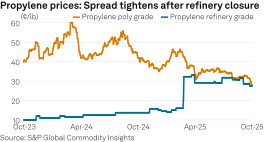
RGP prices surged in the first quarter of 2025, following Lyondell Basell's Houston refinery closure. Platts, part of S&P Global Energy, assessed RGP at 33 cents/lb on March 27, a four-year high, with low-volume trades at 38 cents/lb.
Since then, prices for RGP have remained elevated, with no pipeline trades seen since early in the second quarter. During the first months after the refinery's closure, propylene market participants were unsure whether the change in pricing was structural or if the market would return to a previous 30 cents/lb spread between RGP and polymer-grade propylene.
The spread between the grades has since narrowed and remained below 10 cents/lb, creating structural changes that market participants expect to persist as Phillips 66 announced the closure of its California refinery in the fourth quarter.
The removal of production capacity from the market has led to a lack of spot trades which resulted in a structural shift in the pricing dynamics, with market participants across the value chain looking for a way to adapt to this change.
"Most of the RGP in the market is now contracted," one propylene producer said.
"RGP profitability has likely shifted from splitters to refinery," said Rob Stier, chemicals analyst at Energy.
Benchmark transition
Acetone producers have historically used RGP as a reference in their pricing formulas, but as concerns mount over the reliability of that price and the sudden elevation in prices, they are now moving toward a PGP-based formula, with debates around a fixed discount.
Multiple sources in the acetone market said a commonly used RGP reference index is expected to be discontinued by 2026, as its usefulness has declined amid recent market shifts. The index has served as a contract reference for acetone and cumene producers for over a decade.
"The current index is based on spot trades, but the volume of these trades has dwindled from about thirty a decade ago to only three or four per month," an acetone producer said.
Pricing formula debate
On the cumene side, producers are adjusting away from RGP toward PGP-minus formulas, with universal support for the transition but significant disagreement over appropriate discount levels.
"Everybody is in favor of moving; the question is how big the discounts could be," a supplier source said, noting the range spans from minus 5 cents to minus 30 cents/lb. "30 is too high, but 5 to 10 cents seems reasonable."
"It depends on who you talk to. I have heard a range of 5 to 10 cents/lb from different derivatives markets," one propylene trader said.
According to several propylene sellers, the transition would be gradual due to existing longer-term contracts. Market participants stressed that consensus across the entire supply chain, including cumene and acrylic derivatives markets, will be essential.
"In any case, the change needs to be agreed on across the whole chain," an acetone buyer said.
Platts last assessed spot polymer-grade propylene at 26.50 cents/lb FD USG on Oct. 7, down 1.375 cents day over day. US prompt refinery-grade propylene was assessed at 27.50 cents/lb FD USG, flat day over day. This marked the first time PGP has been assessed below RGP and comes as a result of low liquidity for RGP, with only one trade reported for railcars in October, and a deep drop in PGP as a consequence of weak market conditions and high inventory levels across the supply chain.

Editor: