Refined Products, Diesel-Gasoil, Gasoline
September 25, 2025
Russia tightens fuel export controls amid drone strike risk
By Elza Turner and Kelly Norways
HIGHLIGHTS
Gasoline ban extended to year-end amid drone attacks
Small refiners and traders banned from diesel exports
Analysts expect most diesel exports to stay immune
Russia will extend its gasoline export ban and partially restrict its diesel shipments to combat mounting energy security concerns over drone attacks, the country's energy ministry said in a statement.
Months of Ukrainian drone attacks have mounted pressure on Russia's oil sector by targeting major refineries, pipelines and oil terminals, stoking fears of a domestic fuel crisis as prices have soared to record highs. In the last three months, roughly 20 refineries have been attacked, reducing crude runs to about 1 million b/d.
Responding to low domestic stocks, the government had already ordered the suspension of most foreign gasoline deliveries until the end of September, but had avoided interfering with key export markets like diesel.
However, new regulations will extend the gasoline restrictions until the end of 2025, and prevent traders and small refiners from sending diesel outside the country over the same period, according to a Sept. 24 statement.
The new diesel regulations remain limited in scope, applying only to refineries with a capacity of under 1 million mt/year (20,000 b/d) and oil traders. The large refineries responsible for the bulk of the country's production will remain free to export their supplies.
Nonetheless, the move signals a shift toward tougher government controls on one of Russia's largest export markets, with far-reaching impacts if measures are expanded.
The decision marks the Kremlin's first attempt to regulate its diesel flows since 2023, when exports were temporarily banned for two months from September to October.
Russia typically produces 50% more diesel than it consumes, according to estimates from S&P Global Energy analysts, in contrast to the gasoline market, where the surplus is narrower.
Gasoline restrictions exempt deliveries under intergovernmental agreements, leaving exports to countries including Kazakhstan, Kyrgyzstan, Belarus and Armenia unaffected.
Government fuel concerns
A statement from Russian Deputy Prime Minister Alexander Novak said the restrictions were designed to ensure sufficient domestic supplies and address a "small deficit" in the retail market. He stressed that oil stocks are sufficient to cover current levels and that the current situation is in line with seasonal patterns.
Officials previously assured in June that stock levels close to historic highs would prevent Russian fuel shortages. However, a record number of Ukrainian drone attacks has pushed prices to record highs in the past month, and local media have reported rising incidents of gasoline shortages at independent retail stations.
Shortages have been aggravated by increasingly destructive drone attacks that have persistently targeted Russia's largest facilities.
"Historically, Russian refineries have shown remarkable resilience, often resuming operations within days or weeks when damage to structures was superficial. But the current wave of strikes has been far more intense," JP Morgan analysts said in a recent industry note.
Since August, drone attacks have partially or fully halted operations at major fuel outlets including the entire Samara hub, Volgograd, Ryazan, Saratov, Salavat and the Astrakhan gas condensate processing plant on the Volga river.
Unplanned outages come at a time when diesel availability is supported by autumn harvest season, while gasoline consumption is also supported by domestic tourism and driving demand.
Market sources had considered diesel restrictions to be a last resort for the Kremlin as it seeks to sustain its oil revenues and support its stalling war economy. As a result, officials still have strong incentive to avoid tougher restrictions, according to Ronald Smith, partner at Emerging Markets Oil & Gas Consulting Partners.
"The domestic supply is unlikely to get in deficit as things stand now, though unplanned outages are difficult to forecast," Smith said, expecting restrictions to stay limited in scope.
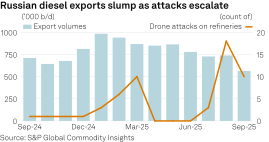
As refinery outages have accumulated, Russian diesel exports have steadily slumped, pushing volumes in September to their lowest since 2020, according to S&P Global Commodities at Sea data. In the month to date, diesel exports have averaged around 560,000 b/d, CAS data shows, down from 780,000 b/d in June before attacks began ramping up.
ICE gasoil prices rose sharply to over $725/mt in Sept. 25 trading from $710.75/mt at the previous close. Prices are up almost $20/mt week over week, and were last higher in late July.

Editor: