Agriculture, Energy Transition, Refined Products, Biofuel, Renewables, Jet Fuel
November 14, 2025
UK biofuel supply rises to 2.4 billion liters through October but SAF lags

HIGHLIGHTS
UK biofuel supply reaches 6.8% of transport fuel
SAF mandate struggles with only 1.6% adoption rate
Compliance issues emerge for SAF mandate certification
Verified renewable fuel supplied to the UK reached 2.4 billion liters equivalent in the first 10 months of 2025, with biofuels accounting for 6.8% of total transport fuel supply, according to second provisional data released by the Department for Transport on Nov. 13.
However, the inaugural Sustainable Aviation Fuel mandate is showing significant compliance friction, with only 163 million liters of SAF supplied and just 2 million HEFA-derived SAF certificates issued as of Oct. 31.
The data reveal a fundamental market gap between regulatory ambition and supply-side mobilization as the UK pursues dual-mandate compliance frameworks for road biofuels and aviation.
RTFO volumes edge forward
Renewable Transport Fuel Obligation volumes reached 2.4 billion liters through October 2025, with 1.2 billion RTFCs issued cumulatively. Development fuels — a growth pathway for hydrogen and advanced blends — contributed 64 million certificates, up sharply from prior-year quarterly runs, signaling early traction in hydrogen-blended fuel trials.
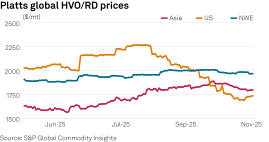
Bioethanol led supply at 1.1 billion liters (47% of renewable volumes), followed by biodiesel at 519 million liters (22%). Hydrotreated vegetable oil (HVO) volumes dropped to just 408 million liters (17%) through October — a decline that reflects supply-side constraints and competitive pricing pressure as HVO feedstocks are increasingly diverted to SAF production.
Certificate trading activity remained robust, with 1.2 billion RTFCs transferred across supplier-to-supplier, supplier-to-trader, and trader-to-trader transactions through Q3 2025. Double-counting waste feedstock RTFCs continue to dominate, representing 1.8 billion certificates (86% of issued volume) — underscoring the ongoing structural incentive driving UCO, tallow, and food waste prioritization.
SAF mandate shows early adoption lag
The UK's first-year SAF mandate, requiring 2% blending by volume in 2025, is tracking well behind target. 163 million liters of SAF have been supplied through October, representing just 1.63% of total jet fuel supply — a significant gap with only 2.5 months remaining in the compliance period.
More critically, only 2 million HEFA-derived SAF certificates have been issued, despite 163 million liters of SAF being reported as supplied. This 1.05% certification rate indicates substantial compliance friction: suppliers are reporting SAF volumes but face delays in ISCC and other voluntary scheme verification, creating a backlog of unverified fuel and certificate issuance delays.
Feedstock, compliance complexity emerge
All SAF certified as sustainable originated from used cooking oil, with Chinese-origin UCO accounting for 71.6% of verified volumes and Japanese and Taiwanese UCO making up the remainder. This reflects HEFA's near-monopoly on early SAF supply, with no alcohol-to-jet, Fischer-Tropsch, or power-to-liquid volumes reported — technologies not yet at commercial scale in the UK market.
The carbon intensity of certified SAF volumes averaged 83.3 gCO2e/MJ, delivering an average 83.3% GHG savings versus fossil kerosene — well above regulatory minimums but indicating the fuel mix is skewed toward premium waste feedstocks.
Compliance timeline compression
Suppliers have nine weeks to bridge the 0.37 percentage-point gap to meet the 2% SAF mandate for 2025. Traders and suppliers report three structural constraints:
- Verification bottleneck: Voluntary scheme (ISCC, BBFS) audit capacity is constrained, creating backlogs in certification
- Feedstock availability: HEFA-eligible UCO is tight globally; Chinese supply (71.6% of certified SAF) faces geopolitical and tariff uncertainty
- Certificate trading underdevelopment: SAF certificate trading activity was minimal (only 1 million certificates transferred in Q3), limiting liquidity for compliance-driven purchasing
The RTFO, by contrast, shows mature certificate markets with multi-billion-unit trading activity and at least nine suppliers competing actively. The SAF market, still in its infancy, lacks this depth.
Rising mandate
The mandate ramps to 2% in 2025, 5% in 2026, and 10% by 2030. If early adoption remains this sluggish, suppliers face rapidly accelerating compliance costs and potential supply shortages as mandates advance. Industry participants monitor:
- Voluntary scheme capacity expansions to accelerate HEFA SAF certification
- Chinese and other Asian UCO export availability amid tariff shifts
- Emerging ATJ and FT project timelines (currently absent from UK SAF supply)
- SAFC pricing dynamics as demand escalates in 2026
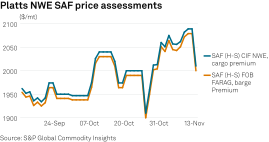
Tight prompt supply, blending bottlenecks, and obligated demand pushed European SAF prices to record highs in the week ending Nov. 13.
Platts, part of S&P Global Energy, assessed the SAF (HEFA-SPK) FOB Farag outright price at $2,889/mt, up by $29/mt in the week to Nov. 12. The SAF premium to fossil jet barges rose to $2,079/mt, while the CIF cargo premium was assessed $10/mt higher at $2,089/mt.
In crop, FAME 0 premiums declined 4.37% day over day and were assessed at $568.75/mt, losing $26/mt. RME premiums demonstrated marginal upward ticks and were assessed at $730.25/mt, up just $3.75/mt.
In second generation, Platts assessed the UCOME FOB ARA premium up $10.25/mt at $789.75/mt. The UCOME FOB ARA outright also gained on the day, up $36.50/mt to $1,499/mt.

Editor: