


Agriculture, Energy Transition, Refined Products, Biofuel, Renewables, Jet Fuel
November 14, 2025
China’s Shandong ships first large-scale SAF cargo to EU as Beijing expands export rollout

HIGHLIGHTS
Shandong ships 14,000 mt SAF cargo to EU from China
Beijing accelerates SAF export approvals to 1.2 mil mt/year
China's domestic SAF consumption also rising rapidly
China's eastern Shandong province has completed its first large-scale export of sustainable aviation fuel, with a 14,000 mt cargo of used cooking oil-based SAF sailing to the EU in recent days.
The shipment was supplied by Shandong Haike Chemical Co., operator of what the authorities describe as China's largest single-train SAF unit, located in the Dongying Chemical Industry Park, according to a Nov. 12 update from the provincial government.
The facility can process over 500,000 mt/year of UCO and waste fats and produce around 370,000 mt/year of SAF via hydroisomerization. Local officials estimate associated lifecycle emissions reductions of 1.18 million mt CO2/year.
The cargo marks the first major export since Dongying was added to China's second batch of SAF export "white list" pilot cities in late September.
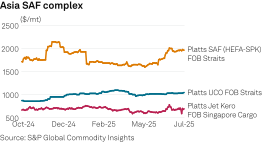
The shipment comes as Beijing accelerates approvals under its SAF export "white list" scheme, authorizing a combined 1.2 million mt/year of export quota to date.
Haike Chemical was granted an annual export quota of 370,000 mt, making it one of just four companies nationwide with approved export capacity under the scheme, while EcoCeres was allocated 300,000 mt/year and Shandong Sanju Bioenergy received 158,000 mt/year.
This followed an earlier allocation of 372,400 mt/year to Zhejiang Jiaao Enprotech in April, taking China's total authorized SAF export quota pool to 1.2 million mt/year across four facilities.
Additional Shandong exports emerge
Separately, Shandong Sanju Bio-energy recently exported 2,500 mt of biomass aviation fuel from Rizhao port to Europe, the local authorities said. Rizhao was also included in the second "white list," with Sanju receiving approval for 158,000 mt/year of SAF export capacity.
The white-list mechanism -- jointly overseen by China's Ministry of Commerce, National Energy Administration, General Administration of Customs, and State Administration of Foreign Exchange -- aims to streamline outbound flows of waste-based biofuels that meet international sustainability criteria, while ensuring traceability and regulatory oversight.
Under the September expansion of the "white list" pilot program, Dongying and Rizhao were approved as designated SAF export cities, enabling producers to load directly for international markets. Officials said Haike and Sanju have already completed initial shipments, with Sanju sending 2,500 mt of biomass aviation fuel from Rizhao to Europe.
Growing domestic and export momentum
China's domestic SAF consumption is also rising, following a March 2025 policy that requires all flights departing from Beijing Daxing, Chengdu Shuangliu, Zhengzhou Xinzheng, and Ningbo Lishe airports to use a 1% SAF blend, adding an estimated 50,000 mt/year of demand. The authorities plan to extend the pilot to major provincial airports, particularly in the Yangtze River Delta, Pearl River Delta, and Beijing-Tianjin-Hebei regions.
Provincial regulators in Dongying said they have set up a cross-departmental working group to support SAF exporters, including streamlined customs clearance procedures, regulatory guidance, and training for firms navigating overseas sustainability verification and trade requirements.
China's domestic SAF momentum
China's internal SAF consumption is also ramping up following a March directive requiring all flights departing from Beijing Daxing, Chengdu Shuangliu, Zhengzhou Xinzheng, and Ningbo Lishe airports to refuel with a 1% SAF blend, adding an estimated 50,000 mt/year of new demand.
The authorities plan to extend the program to major provincial airports, particularly in the Yangtze River Delta, Pearl River Delta and Beijing-Tianjin-Hebei regions.
Global demand outlook
Global SAF demand is expected to grow rapidly as airlines pursue ICAO CORSIA compliance and national mandates tighten. IATA forecasts consumption to reach 7 million mt in 2025, rising to 20 million mt by 2030 and over 80 million mt by 2050, underscoring the increasing role of waste-based feedstocks such as UCO in meeting supply gaps.
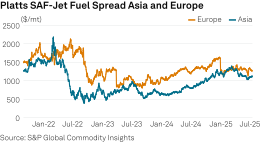
Market participants said Chinese supply is expected to ease near-term tightness in Europe as airlines seek to comply with early-stage blending requirements. Europe is forecast to require 1.5 million mt of SAF in 2026, according to S&P Global Energy analysts.
"The additional volumes from China will largely ease the tightness in the European market, and we might see European SAF prices cool down a bit," a Singapore-based trader said.
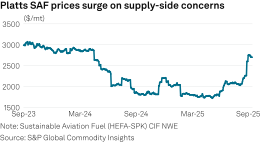
Tight prompt supply, blending bottlenecks, and obligated demand pushed European SAF prices to record highs in the week ending Nov. 13.
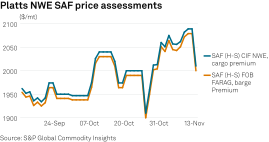
Platts assessed the SAF (HEFA-SPK) FOB Farag outright price at $2,889/mt, up by $29/mt in the week to Nov. 12. The SAF premium to fossil jet barges rose to $2,079/mt, while the CIF cargo premium was assessed $10/mt higher at $2,089/mt.

Editor: