


Agriculture, Meat
November 05, 2025
MONTHLY ASIA CHICKEN WRAP: Prices hit record high on tighter supply, stronger year-end demand

HIGHLIGHTS
Oct average rises 6.3% month over month to record high
Labor shortages in Brazil reduce exports to Japan: trader
Higher Japan, S Korea prices drive up chicken leg prices in Asia-Pacific
North Asian chicken leg monthly average prices hit a record high in October, driven by tighter supply in Brazil and stronger year-end demand, according to market sources.
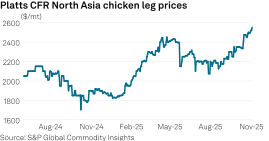
Platts, part of S&P Global Energy, assessed the CFR North Asia chicken leg monthly average price at $2,416/mt in October, up $143/mt, or 6.3%, month over month.
Platts assessed North Asia chicken leg prices at a new record of $2,550/mt on Nov. 4, up from $2,350/mt on Oct. 3.
Japanese prices rise
The Japanese market maintained its upward momentum from September, with market participants reporting higher tradable values for Brazil-origin boneless chicken legs (200 grams and above) at over $2,500/mt CFR Tokyo in October, while sized boneless legs were quoted at $2,700/mt CFR Tokyo.
Market sources attributed the price increase to tighter supply conditions in Brazil, stemming from labor shortages and a decline in the number of day-old chicks.
"Brazil is still facing labor shortages, which have led to reduced production of boneless chicken products," a Japan-based trader said. "As a result, the offer volumes to Japan declined."
A Japanese importer said the limited availability of day-old chicks in Brazil has significantly reduced broiler supply and export volumes.
Anticipation of stronger year-end demand for chicken legs has also boosted prices, as consumers favor hotpot dishes in winter, according to a Japanese market source. "Nabe, a traditional Japanese hotpot, is typically prepared with boneless chicken legs or 'kakugiri,' leading to increased demand for these cuts," the source said.
Additionally, a weaker Japanese yen has increased import costs, putting pressure on importers. The yen has depreciated 4.8% month over month in November against the dollar. However, importers continued to purchase due to low inventories and stronger demand, the Japan-based trader said.
S Korean market
Market activity in South Korea was reported to be sluggish in early October, following the Chuseok holidays, according to market sources.
Demand strengthened as the month progressed, with importers seeking to replenish stock following import restrictions on Brazil amid the bird flu outbreak between May 18 and June 20.
Several importers reported a $2,530/mt CFR Busan price for Brazilian boneless chicken legs (200 grams and above) in October, which narrowed the price spread with Japan to around $50/mt.
"The North Asian market is readjusting as stronger demand and elevated offer prices to South Korea have pushed the Japanese market higher," a South Korean trader said.
South Korea confirmed its second H5N1 bird flu case at a small geese farm in Gwangju on Oct. 21, according to the Ministry of Agriculture.
In response, the country elevated the crisis warning level to 'serious' from 'caution,' as authorities remain vigilant against a potential outbreak.
Asia-Pacific
A Brazilian exporter noted that higher prices in Japan and South Korea have led to increases in boneless chicken leg prices in other markets, such as the Philippines and Singapore.
A Singapore-based trader indicated an offer from Brazil at $2,700/mt CFR Singapore in October. "It is unusual that Singapore is paying more than Japan," the trader said.
China has suspended about 20 slaughterhouses in Thailand, pending a safety review, which is expected to conclude in November, according to a source from the Thai Broiler Exporters Processing Association. As a result, the supply of chicken feet and paws, originally bound for China, has been largely redirected to the domestic market, resulting in weaker prices, the source said.
In Indonesia, a local poultry integrator expects demand for chicken meat and eggs to rise ahead of the New Year, driven by procurement for Ramadan and Eid in February and March.
Outlook
North Asian importers are expected to continue seeking imports to meet year-end demand for the Christmas and New Year holidays, while also making procurement arrangements for early 2026, according to regional market sources.
Market participants said they will closely monitor the potential reopening of Brazilian chicken exports to China following the bird flu outbreak earlier in the year.

Editor: