Agriculture, Biofuel, Pesticides
October 29, 2025
Indonesia’s E10 plan stirs high-RON gasoline demand, but ethanol supply gap looms
HIGHLIGHTS
Indonesia targets 10% ethanol blend by 2027, requiring ninefold production increase
Plans 1 million hectares of cassava, 400,000 hectares of sugarcane for feedstock
Faces constraints in processing capacity, infrastructure, and policy coordination
Indonesia's plan to mandate a 10% ethanol blend in gasoline by 2027 is gaining momentum as a central pillar of President Prabowo Subianto's energy independence agenda, but the ambitious timeline is colliding with a stark production reality that sources say could undermine the policy's credibility.
Energy Minister Bahlil Lahadalia confirmed that the government aims to roll out the E10 mandate by 2027-2028, requiring an estimated 1.4 million kiloliters of bioethanol annually, nearly nine times Indonesia's current production capacity.
The policy formally positions ethanol as the gasoline sector equivalent of Indonesia's successful biodiesel program, which has scaled from B10 to B40 over the past decade.
Yet market participants and industry data reveal fundamental supply constraints that cast doubt on the 2027 target.
Indonesia produced just 160,946 kl of ethanol in 2024, from an installed capacity of 303,325 kl, representing only 53% capacity utilization, according to Apsendo, the Indonesian association of methylated spirits and ethanol producers.
Meeting the E10 requirement would demand an 8.7 times increase in production within roughly two years.
"The question is, how do you get the ethanol? 10% is pretty [a] big [portion]," a Singapore-based industry source told Platts, part of S&P Global Energy.
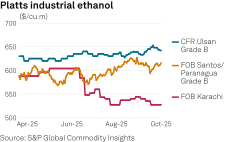
Platts, part of S&P Global Energy, assessed Asian fuel ethanol down $8.34/cu m day over day at $572.33/cu m CIF Philippines on Oct. 30, following movement in US futures.
Feedstock plans and agricultural expansion
The government's answer centers on massive agricultural expansion.
Agriculture Minister Amran Sulaiman announced plans on Oct. 21 to cultivate 1 million hectares of cassava specifically for ethanol production, alongside 400,000 hectares of sugarcane—a combined land area larger than the entire island of Bali.
On paper, the cassava program appears to solve the supply equation.
Based on standard Indonesian cassava productivity yields of 20 mt/hectare and conversion rates of 150 liters/mt, 1 million hectares could theoretically produce 3 million kl of ethanol annually, more than double the E10 requirement.
"I think with proper planning and strong government support, this could be a positive step for local farmers and help boost domestic biofuel production, supporting the success of the E10 rollout as planned," a South Korea-based trader said.
However, sources emphasized the conditional nature of that support. "It may be difficult to get enough local supply to meet the target as they need a very strong strategy," a Malaysia-based industry source said.
"Meeting the 2027 target will require stronger policy coordination, better infrastructure, and careful preparation to ensure the plan runs smoothly," echoed a South Korea-based trader.
The cassava expansion represents a significant acceleration from previous plans. When serving as Defense Minister in 2020, Prabowo had targeted 1.4 million hectares of cassava plantations by 2025 under a broader food security program, but that initiative fell short.
The government has not disclosed which specific regions will host the new 1 million hectares or provided detailed timelines for land acquisition and planting cycles.
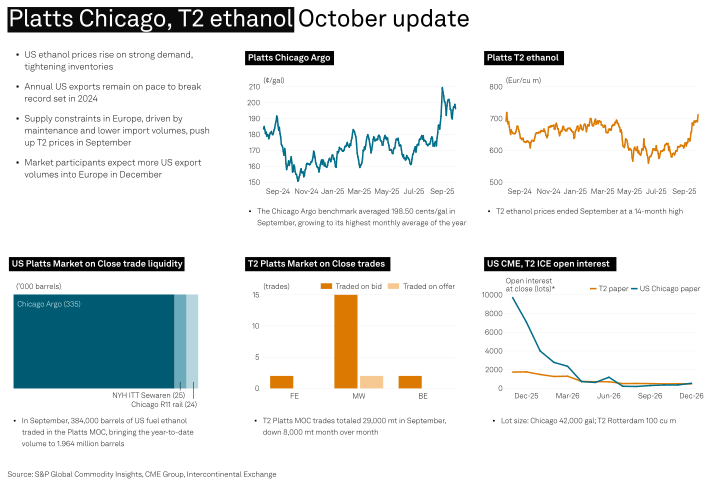
Platts assessed grade B ethanol down $3/cu m day over day at $637/cu m CFR Ulsan on Oct. 30, amid limited market activity.
Supply chain infrastructure bottlenecks persist
Processing capacity presents another critical constraint. The government has announced plans for a major bioethanol complex in Merauke, South Papua, with three production units totaling 900,000 kl annual capacity, expected to begin operations in 2027.
This single facility would cover 64% of the E10 requirement if it comes online as scheduled.
Yet large-scale biorefinery projects typically require several years from groundbreaking to commercial production.
Indonesia's state energy company Pertamina has pledged support for the E10 rollout and conducted a limited E10 trial for selected vehicles starting November 2024.
However, the company has not publicly detailed the blending infrastructure, storage tank modifications, or distribution network upgrades required for nationwide implementation.
E5 troubled rollout casts shadow
Indonesia's recent experience with lower ethanol blends suggests implementation challenges ahead.
The government launched E5 gasoline (Pertamax Green 95 RON) in July 2023 at select stations in Jakarta and Surabaya, with plans to expand across Java Island within a year.
As of October 2025, the E5 program remains limited to approximately 160 stations nationwide.
Energy ministry officials admitted in July 2024 that the rollout had "fallen far behind schedule," missing its original 2020 target by four years. The delays stemmed from "limited feedstock for producing bioethanol, expensive and fluctuating raw material prices as well as a lack of incentives," according to renewables director general Eniya Listiani Dewi.
Moreover, E5 sales remain captured in a premium niche market.
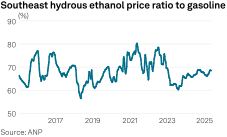
According to the USDA Foreign Agricultural Service, RON 90 gasoline (Pertalite) accounted for 84% of total gasoline sales in Indonesia in 2023, with the government maintaining a subsidized price of 10,000 rupiah per liter.
By contrast, Pertamax Green E5 (RON 95 with 5% ethanol) retails at approximately 13,500 rupiah per liter—a 35% price premium that limits adoption in Indonesia's price-sensitive market, where subsidized fuel dominates consumer purchasing decisions.
The government now proposes jumping directly to nationwide E10 by 2027, bypassing the gradual scaling that characterized the biodiesel program's evolution from B10 to B40 over more than a decade.
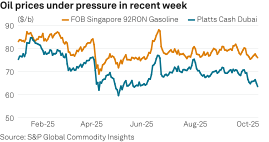
The Platts-assessed physical FOB Singapore 92 RON gasoline rose 34 cents/b day over day, and $1.71/b week over week to $79.80/b at the Oct. 30 Asian close.
Gasoline market implications
The E10 policy is already influencing regional gasoline markets, particularly demand for high-octane, non-oxygenated grades suitable for ethanol blending.
"They are trying to blend [gasoline with ethanol] by themselves. I heard they're looking for non-oxygenated high RON [gasoline], it's one of the reasons why the 95/92 [inter-RON spread] is strong," a Singapore-based trader said.
However, the same trader expressed skepticism about execution: "Blending competition is tough. Even if they get the high RON gasoline, we don't know if they can really blend, but it'll definitely move the market sentiment [to be] stronger."
Indonesia imported 378,500 barrels/day of gasoline in 2024, making it Asia-Pacific's largest gasoline importer according to GTT customs data.
Singapore supplied over 60% of total volumes at 279,000 b/d, followed by Malaysia at 97,000 b/d. The country imported approximately 22 million kl of gasoline annually, meaning a 10% ethanol blend across all grades would actually require around 2.2 million kl of ethanol, substantially more than the government's 1.4 million kl estimate focused on non-subsidized fuels.

Editor: