Agriculture, Oilseeds
October 16, 2025
ANALYSIS: China seen using soybeans as leverage in trade rift with US
HIGHLIGHTS
Has made no forward purchases ahead of peak US export window
Tariffs pushed China to sideline US soybeans for Brazilian crop
China expected to start purchasing US soybeans in early 2026
China has made no forward purchases of US new-crop soybeans as of mid-October, marking a first in two decades, ahead of the peak US export window to China during November-January, according to US Department of Agriculture data and traders at three global agricultural trading firms.
The last Chinese purchase of US soybean was in May, according to the latest USDA data as of Sept. 18, before the US government shut down. According to key traders familiar with US-China flows, China has not purchased or locked in any shipments for US soybeans over the past few weeks as well, amid the ongoing trade rift.
US President Donald Trump on Oct. 15 called China's refusal to buy any US soybeans an "economically hostile act" in a post on Truth Social and threatened to suspend used cooking oil imports from China in response.
Over the previous five years, China sourced nearly 30% of its annual soybean imports from the US, according to data published by China's General Administration of Customs.
Market participants said Beijing may use its soybean trade with the US as leverage in future trade negotiations. Trump is expected to meet Chinese President Xi Jinping at the Asia-Pacific Economic Cooperation summit Oct. 31-Nov. 1 in South Korea.
"Beijing has deliberately refrained from locking in any US fourth-quarter cargoes while trade talks drag on. In short, any sudden surge in US buying would be politically driven, not market-driven," said Rosa Wang, analyst at Shanghai-based agro-consultancy JCI.
"China is looking to use the soybean trade with [the] US as a chip in [any] future talks and leverage to deal with the tariffs. That's precisely why they have not booked any shipments of US soybeans as of yet," said a trader with a Netherlands-based global grains trade firm.
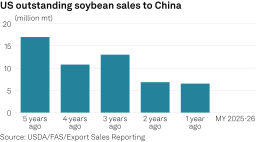
"During the last trade war, China only bought zero soybeans from the US for two total months out of the entire trade war. Right now, China is on track to do it for four consecutive months. We expect them to make it six consecutive months before buying this time," Larimer said.
China may start buying US soybeans in late December to early January, when the Brazilian and Argentine new crops start to trickle in, several trader sources said.
"Even if the crops start trickling in early, it may take a while for China to secure enough to meet its requirement, and it may look at purchasing US crops," a trader with a Switzerland-based grain trading firm said.
A trader with a US-based multinational grains trading firm said China might look to buy US crops starting in late December, as the supplies from South America may dry up and the fresh crop may take a while to reach the markets.
China's outstanding demand
As traders based in China point out, China still has significant open demand for soybeans in December and January, creating a potential window for US exports.
According to shipping data from a US-based multinational grains trading firm, as of Oct. 14, 82% of the total 6 million mt soybean demand for November shipment had been covered, leaving the open demand of around 1 million mt. Meanwhile, only 13% of December's total demand of 4.5 million mt has been covered so far, and January demand is fully open.
"[The choice between Brazil and Argentina remains] largely dependent on price. However, with competitively priced Argentine cargoes currently scarce, buyers have to buy Brazilian soybeans again," said the same trader.
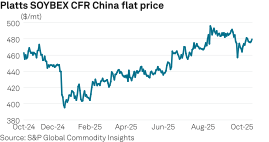
Another trader based in China said the sharp recent depreciation of the Brazilian Real against the US dollar may also align with China's procurement needs, likely keeping old-crop Brazilian soybean CFR premiums firm due to supported demand.
Platts, part of Energy, assessed CFR China first-month soybeans at $479.60/mt on Oct. 16, up $2.94/mt day over day. The September soybean CFR China first-month flat price averaged $480.98/mt, down $1.77/mt from $482.75/mt in August.
Brazil's climb to soy supremacy
Rising trade frictions with the US accelerated China's shift toward Brazil, whose growing yields, competitive pricing, and counter-seasonal supply advantage made it the preferred alternative.
"China has become more reliant on soybeans from Brazil due to the trade disputes between the US and China," said Darin Friedrichs, co-founder of Shanghai-based Sitonia Consulting. "While China is working to diversify supplies, it is difficult to find sources that provide exports on the same scale as countries like Brazil or the US."
Brazil's soybean sales during January-October surpassed previous records, reaching 102.2 million mt, with 79% shipped to China, according to data released by grain exporter association ANEC on Oct. 8.
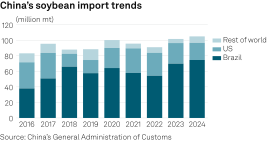
China imported 12.87 million mt of soybeans in September, up 4.8% from August and 13.2% year over year, setting the second-highest level on record for the month, according to preliminary customs data released Oct. 13.
According to market participants in Argentina, China bought over 6 million mt of soybeans in September, when Argentina suspended export taxes on grain and oilseed shipments from Sept. 22-25. In September 2024, China bought 612,746 mt of soybeans from Argentina, according to China Customs data.

Editor: