Agriculture, Energy Transition, Refined Products, Biofuel, Renewables, Jet Fuel, Vegetable Oils
October 08, 2025
EU-US waste oil imports surge twentyfold as biofuel demand hits vegoil supply: IEA

HIGHLIGHTS
Biofuels claiming 27% of vegetable oil production by 2030
Aviation SAF competing for same waste oils as road transport
Advanced feedstocks still niche despite policy support
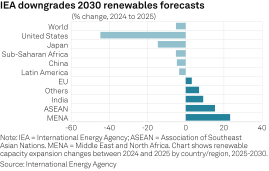
EU and US waste oil imports have surged twentyfold since 2020, intensifying pressure on global biofuel feedstock markets as biofuel demand outpaces vegetable oil supply, according to the International Energy Agency's latest Renewables 2025 report released on Oct. 7.
The agency projects biofuel feedstock demand will reach 825 million metric tons annually by 2030, marking a 25% increase from 2024 levels. By the decade's end, biofuels are expected to account for 27% of global vegetable oil production and 80% of estimated waste and residue oil supplies.
Waste oil trade jumps
According to the IEA, nearly 60% of the waste oil imports into Europe and the US originate from China and Indonesia, highlighting the global nature of the supply chain dynamics.
"The scale and pace of expansion of these imports have raised concerns about supply fraud," the agency cautioned, noting that the US has transformed from a net exporter of waste oils in 2021 to a net importer as renewable diesel and sustainable aviation fuel production ramps up.
The feedstock crunch is being driven by multiple factors: tightening SAF mandates in Europe (6% blending by 2030), maritime biofuel requirements and performance-based policies that reward low-carbon intensity fuels for which waste oils are particularly attractive due to their superior lifecycle emissions profiles, the IEA said.
Diverging regional supply strategies
While feedstock import dependence remains low globally at around 10%, according to the IEA, clear regional patterns are emerging. Indonesia and Brazil maintain strong domestic feedstock availability, with production closely linked to local palm oil and sugarcane supplies.
In contrast, European and US markets are increasingly reliant on imports to meet ambitious renewable fuel targets.
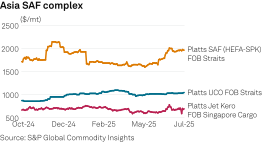
Europe remains the largest demand center for waste and residue oils, though consumption is also rising in Southeast Asia to supply Singapore's growing refining capacity.
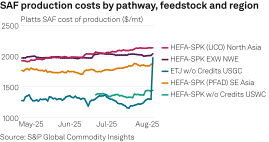
The supply pressure is reflected in pricing as EU waste and residue oil prices reached two-year highs in July 2025, according to data from Platts, part of S&P Global Energy, while US soybean oil futures rose 20% following higher blending obligations and policies prioritizing domestic feedstocks.

Policy response intensifies
Both the EU and the US have responded to supply chain concerns with enhanced oversight measures.
The European Commission launched a Union Database for Biofuels to improve traceability and prevent double-counting, while ISCC, the main international certification scheme, suspended certificates for over 130 companies and tightened audit procedures, the IEA report stated.
In the US, the recent One Big Beautiful Bill Act eliminates tax credits for imported biofuels and those made from imported feedstocks, except for Canadian and Mexican sources.
Proposed Renewable Fuel Standard updates also halve credit values for fuels produced from imported feedstocks.
"These policy shifts are not expected to alter biofuel use significantly from last year's forecast, however, as biodiesel, renewable diesel and SAF were already over-complying with the RFS," the IEA noted.
Pathways for advanced feedstock
While waste and residue oils face supply constraints, advanced feedstock pathways remain limited.
The use of cellulosic ethanol and Fischer-Tropsch fuels is projected to nearly quadruple in the IEA's accelerated scenario but would still reach only 45 million mt/y by 2030.
"Alcohols and lignocellulosic biomass are expected to remain niche feedstocks in the main case, used primarily in the UK and the EU," the report stated, highlighting the continued challenge of scaling next-generation biofuel technologies.
SAF production
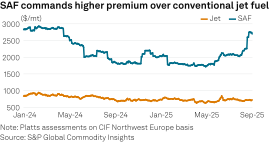
SAF production, while representing just 2% of total feedstock demand by 2030, is placing growing pressure on already-constrained waste and residue oil supplies.
The IEA projects waste oils will provide 55% of SAF feedstocks due to their low life cycle emissions and eligibility under CORSIA and ReFuelEU Aviation regulations.
This competition between road transport biofuels and aviation SAF for the same premium feedstocks is expected to intensify pricing pressures throughout the decade.
Accelerated scenario demands strategic intervention
In the IEA's accelerated case, where biofuel demand could be 30% higher than the main forecast, total feedstock demand would grow an additional 125 million mt/y to reach 950 million mt by 2030.
"Achieving the accelerated trajectory would necessitate an additional 125 million mt of feedstock supplies, but vegetable, waste and residue fats, oils and greases are already under particularly high demand," the agency said.
The IEA noted that meeting these targets would require coordinated strategies emphasizing land-efficient practices such as yield optimization, intercropping, sequential cropping, and cultivation of marginal or degraded land, alongside scaling up emerging technologies that rely on more diverse feedstock sources.
Market outlook
Despite the supply constraints, the IEA maintained a positive outlook for biofuel demand growth, projecting 43 billion liters of additional consumption by 2030.
However, the agency noted that "several producers—especially of biodiesel, renewable diesel and sustainable aviation fuel—continued to experience tight to negative margins in 2025."
Performance-based standards are expected to underpin one-third of total biofuel demand by 2030, up from just under 20% in 2024, as governments increasingly shift from volumetric mandates to frameworks that reward greenhouse gas reductions, according to the IEA.

Editor: