Agriculture, Biofuel
October 07, 2025
Vietnam proposes tax refunds to boost biofuel output ahead of E10 mandate

HIGHLIGHTS
Biofuel producers can claim tax refunds on mineral gasoline
Aims to support domestic ethanol output for E10 mandate
Streamlines refund process ahead of 2026 rollout
Vietnam's Ministry of Finance has proposed new regulations that would allow biofuel producers to claim special consumption tax (SCT) refunds on undeducted mineral gasoline inputs.
The move is widely seen as an attempt to support domestic ethanol output ahead of the nationwide E10 gasoline mandate, which will take effect on Jan. 1, 2026.
The draft circular released on Oct. 3, which is currently open for public comment, details the procedures for licensed biofuel producers to claim refunds or carry forward tax credits on mineral gasoline used in the blending of ethanol fuels.
The regulation is intended to provide clarity and continuity with existing laws, while easing financial pressure on a sector struggling to ramp up production in time for the mandate.
Policy nudge for biofuel producers
Under the proposed rules, companies licensed to produce and blend biofuels would submit refund applications to their local tax authorities if they are unable to fully offset SCT on inputs against other taxable revenues.
The state treasury would process refunds based on decisions issued by the tax authority, in accordance with existing administrative procedures.
The Ministry of Finance said the new rules expand on provisions in Decree 14/2019/ND-CP and Circular 80/2021/TT-BTC, both of which allowed for refunds on SCT related to biofuel production.
However, the new draft updates and streamlines the refund process, including clearer documentation requirements and an explicit timeline for implementation, starting Jan. 1, 2026.
Critical timing ahead of E10 rollout
Vietnam's tax refund policy aligns with its plan to implement the E10 mandate in early 2026, requiring 10% ethanol in all gasoline, including A92 and A95 grades, but domestic production remains far below projected demand.
According to the Ministry of Industry and Trade estimates, the E10 rollout will require 1.2 million to 1.5 million cu m of ethanol per year, while current domestic capacity is around 450,000 cu m/year or less than 40% of the required volume.
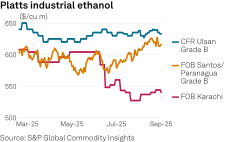
The gap is expected to be filled through imports, which can cause volatility due to fluctuating global ethanol prices and supply chain risks.
Vietnam's flagship Dung Quat ethanol plant is scheduled to restart in November 2025 after a prolonged shutdown, while only two of six national ethanol plants are currently operational.
The government hopes that the financial breathing room provided by tax refunds could encourage more facilities to restart or expand.
Simplified procedures, conditional refunds
According to Article 5 of the draft regulation, eligible companies must submit a request for refund or offset (Form 01a/DNHT) along with proof of licensing to produce biofuel for first-time filers.
Local tax departments are responsible for reviewing these submissions, and the state treasury will disburse refunds based on official refund orders. The provision also allows refunds to be offset against other tax obligations, providing flexibility for companies with diversified operations.
Policy signal in energy transition
Analysts say the proposed tax refund rules send a clear message that the government considers biofuels, particularly ethanol, essential to meeting its transport sector decarbonization goals.
"E10 can only succeed if it is commercially viable for local ethanol producers," said a Singapore-based energy consultant. "This refund mechanism adds a layer of certainty for investors who may be hesitant to pour capital into a sector that has seen multiple false starts over the past decade."
Vietnam has already launched pilot E10 sales in major cities like Hanoi, Ho Chi Minh City and Hai Phong as of Aug. 1, with fuel retailers such as Petrolimex and PV Oil leading the trials.
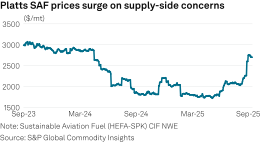
The E10 push supports broader energy sector goals, including achieving net-zero emissions by 2050, a 10% SAF blending mandate by 2035, and participation in international aviation decarbonization schemes such as CORSIA.
The Ministry of Finance has invited public feedback on the draft by the end of this month. If approved, the regulation would take effect alongside the E10 mandate on Jan. 1, 2026 — effectively aligning tax support with the new fuel blending requirement.
The regulation could prove decisive for Vietnam's ethanol producers, particularly those like BSR-BF working to bring idle plants back online.
If tax refunds lower operational costs and improve margins, more plants may resume production — a development that could improve supply security and reduce reliance on imports just as the country begins one of its most ambitious energy transitions to date.
Platts, part of S&P Global Energy, assessed Asian fuel ethanol down 67 cents/cu m day over day at $633.33/cu m CIF Philippines on Oct. 7.
Platts assessed grade B ethanol price up $3/cu m day over day on Oct. 7 at $645/cu m CFR Ulsan.

Editor: