Agriculture, Energy Transition, Refined Products, Biofuel, Renewables, Jet Fuel
October 02, 2025
Australia narrows biofuel focus, excludes UCO and hydrogen from key feedstock plan

HIGHLIGHTS
Unveils bioenergy strategy focusing on agriculture, forestry
Excludes used UCO, municipal waste, green hydrogen
Prioritizes established biofuel pathways over emerging tech
The Australian government unveiled a focused approach to its bioenergy transition on Oct. 2, with the release of a discussion paper for its National Bioenergy Feedstock Strategy that pointedly excludes used cooking oil, municipal waste and non-biogenic sources like green hydrogen.
The strategy, driven by the Australian Labor government's aim to boost domestic biofuel production and achieve net-zero emissions by 2050, will concentrate solely on feedstocks derived directly from primary industries, namely the nation's agriculture and forestry sectors.
Prioritizing farm and forest
The new strategy is designed to support the development of feedstock supply chains and will work in conjunction with the government's A$1.1 billion ($728 million) Cleaner Fuels Program, according to Julie Collins, Minister for Agriculture, Fisheries and Forestry.
The focus will be on established and scalable domestic resources such as canola, tallow, biomass, sugar cane and sorghum.
The move signals a preference for well-established, agricultural-based bioenergy pathways, particularly the hydroprocessed esters and fatty acids method, over emerging technologies.
Hydrogen, waste streams left out
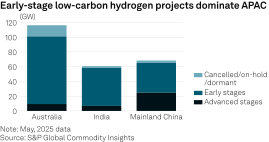
The exclusion of certain feedstocks marks a distinct separation of policy tracks. While the nascent hydrogen sector -- including power-to-liquid projects -- is shut out of the bioenergy feedstock plan, it remains eligible for substantial subsidies under Canberra's separate Hydrogen Headstart program, which has earmarked A$2 billion for its first funding round.
Similarly, other biogenic materials like UCO and municipal waste, while still relevant to the broader circular economy, will not be a focus of this specific agriculture-led strategy.
The government is also sidelining emerging biofuel production methods like Fischer-Tropsch and alcohol-to-jet.
Industry reaction and next steps
Industry groups, including the Australian Forest Products Association, swiftly welcomed the announcement.
AFPA Chief Executive Officer, Diana Hallam, said the discussion paper for recognizing the significant economic and environmental opportunities for the forest sector, particularly in utilizing timber and wood-fiber residues for bioenergy.
The strategy is a key component in Australia's broader policy agenda to cut emissions by 62%-70% below 2005 levels by 2035.
Stakeholders, including companies and industry groups, have until Nov. 7 to provide submissions and feedback on the discussion paper.
The government has yet to release a corresponding discussion paper detailing the design and implementation of the Cleaner Fuels Program.
Australia will invest A$1.1 billion ($710 million) over the next decade to accelerate the production of low-carbon liquid fuels, including renewable diesel and sustainable aviation fuel, in a bid to decarbonize hard-to-abate sectors and strengthen domestic fuel security.
The government unveiled its new Cleaner Fuels Program on Sept. 17, positioning the initiative as both a climate measure and an economic opportunity. The 10-year program will offer competitive grants to domestic producers, with the first "drop-in" fuels, compatible with existing engines and infrastructure, expected to be produced by 2029.
Australia already exports nearly A$4 billion of feedstocks such as canola, sorghum, sugar and tallow, which could instead be converted to cleaner fuels domestically. Agriculture Minister Collins said the investment would benefit farmers and foresters, placing them "at the center of growing Australia's low-carbon liquid fuel industry."
The program builds on earlier government measures, including A$250 million through the Future Made in Australia Innovation Fund, the Sustainable Aviation Fuel Funding Initiative and the expansion of the Guarantee of Origin Scheme to track emissions from Australia-produced fuels.
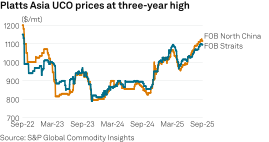
Platts, part of S&P Global Energy, assessed UCO FOB Straits at $1,095/mt on Oct. 2, down $5/mt from Oct. 1. Platts assessed UCO FOB North China at $1,143/mt on Oct. 2, up $8/mt from Oct. 1.
Platts assessed UCOME FOB Straits at $1,270/mt on Oct. 2, up $5/mt from Oct. 1. Platts assessed UCOME FOB North China at $1,175/mt on Oct. 2, down $5/mt from Oct. 1.
