Agriculture, Rice
September 26, 2025
INTERVIEW: India's rice exports likely to close at 30 mil mt in MY 2025-26, IREF says
By Namarita Kathait and Tanya Rana
HIGHLIGHTS
Non-basmati surplus stock to increase to 40 mil mt from 28 mil mt
India aims to expand rice exports beyond traditional markets
New crop and swelling inventories to put deflationary pressure on prices
India's rice exports for marketing year 2025-26 (October-September) are set to rise to 22-23 million metric tons, up 10%-15% year over year with the ambitious expectations to close exports at 30 million mt, up 50% year over year, against the backdrop of a bumper crop with estimated production at 145 mil mt, up 7% up year over year, Prem Garg, National president of Indian Rice Exporters Federation and chairman of the Shri Lal Mahal Group, told Platts.
Meanwhile, as per IREF estimates, surplus stock for non-basmati rice will rise from the current Food Corporation of India stock of 28 million mt to 40 million mt; however, India's export market faces challenges from policy uncertainties and, at times, limited penetration into key destinations, Garg said.
"There's huge scope for Indian rice exports to expand beyond traditional markets," Garg said. "The Philippines imports about 2.3 million mt of rice annually, yet India's share is only around 2%. The bulk of Philippine rice imports still comes from Thailand and Vietnam. A decade ago, some Indian shipments to the Philippines faced quality issues, damaging India's reputation in the market. As a result, India's annual exports to the Philippines have remained capped at around 250,000-300,000 mt."
"We spoke with the Philippines' Agriculture Minister when he was in India a month ago. He gave permission for basmati imports. But non-basmati, they import more than 4 million mt a year, but right now, to support their farmers, they have stopped imports. However, they reevaluated their crop and realized a shortfall by 2-2.5 million mt, which is why they will import more and will consider India rice," Garg added.
On new markets apart from traditional markets like Benin and Ghana, Garg said that shipments to Malaysia have been regular, and the country has bought good volumes during the export ban under government-to-government trade, also in the present year.
For basmati rice, "IREF also presented to the government and spoke with Mr. Piyush Goyal on discussing import duty concessions on basmati milled white rice with the EU in addition to brown rice in order to dissuade the monopoly of a few major players in the EU market."
India's competitiveness against other origins
On Indian rice quality concerns, Garg explained, "Pakistan benefits from not using Tricyclazole, a pesticide still common in India. This gives Pakistan an edge in markets like Europe, where pesticide standards are stricter. However, industry stakeholders stress that Indian non-basmati rice has a superior taste compared with Pakistan's. That said, Pakistan's rice quality has drawbacks. Last year, they exported an old crop with a high moisture content (17%-18%), which undermined its competitiveness. Myanmar's rice quality is also considered inferior to India's, which adds to India's advantage in global markets."
The forthcoming Bharat International Rice Conference plays a pivotal role in improving the current stock position, according to Dev Garg, vice president of the Indian Rice Exporters Federation.
"The upcoming BIRC event is the first large-scale rice event in India, whereas historically, major rice conferences have taken place outside the country. The event will highlight India's role as a reliable supplier, with participation expected from both policy-makers and industry stakeholders."
"Misalignment of various state governments will be solved through the event, amid their participation," Dev Garg said. "The event will provide buyers' exclusivity to Indian suppliers. All policymakers will be present, and they will reaffirm India's position on policy matters, giving confidence to various stakeholders that India is going to be a reliable partner going forward. All-important quality food certifications, FSSAI, EIA will also be present, so any concerns the international community might have, for example, about pesticides etc., [these] concerns will be addressed."
Outlook on India's export policy
India banned white rice in July 2023 and imposed an export duty on parboiled rice. In September, under supply pressure, they opened white rice exports with a minimum export price and then, in October, removed the MEP on white rice and slashed the export duty on Parboiled.
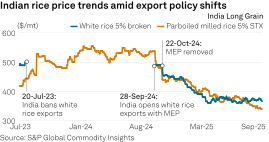
Platts, part of S&P Global Energy, assessed India PB 5% at $340/mt FOB Sept. 26, $12 down month over month, while WR 5% was at $366/mt FOB, down $10 month over month.
"The government has committed to not imposing restrictions on exports of rice. Of course, if it comes to the matter of domestic food security, the government might impose restrictions, but from the current rice surplus situation, the industry is confident that the government will not restrict exports in the foreseeable future," Prem Garg said.
Ahead of new crop harvest, Garg believes there will be deflationary pressure on prices, with parboiled 5% export price to reach $325/mt FOB, if supported by a weakened rupee against the US dollar.
Meanwhile, the government is anticipating lowering the reserve price for the Open Market Sale Scheme amid supply pressure, he said.
According to Energy projections, India is expected to export 24.5 million mt of rice in the MY 2025-26 (October-September), 6.5% higher year over year.

Editor: