Agriculture, Energy Transition, Refined Products, Biofuel, Renewables, Jet Fuel
September 11, 2025
APPEC: Asia’s SAF industry faces policy, feedstock, infrastructure hurdles despite tech momentum
By Samyak Pandey and Thomas Washington
HIGHLIGHTS
Asia struggles to scale SAF production
Policy support is crucial for attracting investments
HEFA technology leads current SAF production
Biofuels, renewables influence SAF's future
Asia's aviation industry is ramping up efforts to scale sustainable aviation fuel production, but panelists at the APPEC 2025 in Singapore on Sept. 10 warned that fragmented policy support, infrastructure gaps, and rising feedstock costs could limit growth in the critical decade to 2030.
Speaking at the "Innovations in SAF in Asia" panel, Gabriel Ho, founder and chief sustainability officer of the Asia Sustainable Fuel Association, told delegates at the event, which is hosted by S&P Global Energy, that countries need customized roadmaps that also align regionally to allow Asia to emerge as a major SAF hub.
"Asia has so much potential, but policy needs to move from being reactive to proactive," Ho said. "If we create a critical mass of biofuel activity, the skills, capital and technology will naturally scale up, making Asia a viable exporter to global markets."
Policy, mandates
Singapore was cited as a model for the region, with its passenger levy scheme offering a predictable demand signal to producers. India, Malaysia, Indonesia and South Korea are expected to introduce SAF mandates starting in 2027, which Ho said would be a positive step toward creating demand visibility and attracting capital for new projects.
Natasha Young, SAF supply assurance manager at Cathay Pacific, cautioned that most Asian markets have not mapped out blending targets beyond 2030. "Europe has a clear glidepath for SAF blending through 2040. Asia needs similar long-term clarity to attract investment and derisk technology development," she said.
The region's agricultural waste streams and underutilized plantations could unlock significant SAF volumes, panelists said, but supply chain traceability and smallholder engagement are still key hurdles. "Certification and education are critical to make sure feedstock can be verified and monetized under international frameworks like CORSIA," Young said.
Alongside this, regional logistics remain a bottleneck, panelists added. "Asia lacks the pipeline, barge and rail infrastructure seen in the US and Europe," Young said. "Unless investments are made to bring production closer to feedstock and demand centers, rising logistics costs could limit competitiveness as volumes scale."
Technology pathways
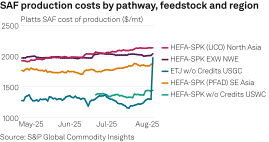
HEFA remains the dominant pathway in Asia, as elsewhere, but alcohol-to-jet and e-fuels are gaining momentum. New SAF facilities are expected to start up in China, Malaysia and Thailand over the next few years, with Thailand potentially leveraging its ethanol surplus for ATJ production. Japan is advancing several pilot projects slated for 2027-2029.
"HEFA is a mature technology, but the next wave will be shaped by the convergence of biofuels and renewable power," Ho said. "Synthetic gas from biomass or captured CO2, combined with green hydrogen, could define Asia's long-term SAF trajectory."
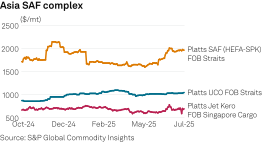
Dependence on HEFA technology focuses demand on a limited supply of feedstock and a number of jurisdictions are trying to develop alternative pathways. A key barrier is price, HEFA-based SAF already commands a significant premium to fossil-based jet. Platts, part of Energy, assessed the Asia SAF-jet fuel spread at $1,300.90/mt on Sept. 10, down $18.26 day over day. By some estimates eSAF could cost over $8,000/mt.
Airline perspective
Cathay Pacific is targeting 10% SAF usage by 2030, with corporate SAF programs helping bridge the price premium. "Our Scope 3 program allows customers to fund SAF purchases that close the price gap with conventional jet fuel," Young said.
Panelists agreed that Asia's policy, infrastructure and financing ecosystem will need to evolve rapidly to meet demand. "This decade is critical," Ho said. "Without a clear runway of incentives and mandates, Asia risks missing its opportunity to lead the global SAF market."
