August 28, 2025
INTERVIEW: Indian shrimp industry can diversify markets, products to tackle US tariffs, says SEAI

By Elvis John
HIGHLIGHTS
Indian shrimp priced out in the US, while competitors gain ‘tariff advantage’
Early completion of India-EU trade negotiations would help Indian shrimp exports
Entering new markets, strengthening position in existing non-US markets essential
Indian domestic market offers opportunities to expand
As Indian shrimp exporters brace for a potentially drastic shift in trade flows after the US's 25% "penalty" tariff took effect Aug. 27, Dr. K. N. Raghavan IRS, the secretary general of Seafood Exporters Association of India (SEAI), told S&P Global Energy that India can navigate the associated challenges by diversifying and entering new markets, while strengthening its position in existing ones.
The US's imposition of a 25% reciprocal tariff and an additional 25% penalty has brought the total tariffs to 50%, excluding countervailing duties and antidumping duties on Indian shrimp imports. These factors would mean that Indian outflows to the US will fall in the short run, said Raghavan, who was also the former chairman of Marine Products Export Development Authority.
"The cumulative levies on [Indian shrimp] will come to 58.26%. It is difficult for any market to absorb such high duties," Raghavan said.
However, he expressed optimism over the possibility of a reversal of the additional 25% tariffs on Indian imports. "Not too long ago, Indian seafood was getting imported without any tariff or CVD. We also hope that negotiations for signing a bilateral trade agreement will end successfully, and tariff rates will moderate," Raghavan said.
Competitive disadvantage
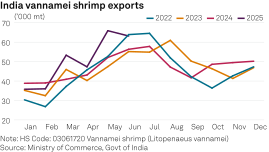
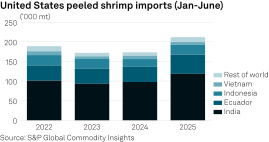
Indian exporters have expressed concerns that India may lose its market share in the US to other origins, as the current tariffs have led to a competitive disadvantage.
Many point out that supply chain disruptions during the COVID-19 pandemic helped Ecuador gain market share in the US and how new trade channels evolved into long-term partnerships.
"It is true that seafood from countries like Ecuador, Indonesia, and Vietnam will enjoy a 'tariff advantage' over produce from India," Raghavan said.
He also noted that since tariffs are applied across the board, "imports of both frozen raw products (Chapter 3 of HSN) and cooked/value-added products (Chapter 16 of HSN) face this threat of tariff disadvantage."
Market diversification
Uncertainties surrounding tariffs and the threat of losing market share in the US have forced Indian shrimp exporters to explore newer markets and products.
Raghavan believes India can navigate the current challenges through diversification. "The Indian seafood sector will have to look at entering new markets, besides strengthening its position in existing markets," he said.
He also noted that "currently, less than 10% of the export basket comprises value-added products. More focus on this segment will open up new markets, besides being more remunerative."
Besides the export market, Raghavan also stressed the importance and potential of the domestic market in supporting the shrimp industry.
European markets
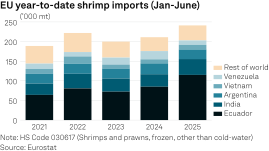
Many Indian exporters are eyeing more market share in premium European markets. Increased buyer interest in peeled and value-added shrimp, and stable macroeconomic conditions make EU markets an attractive destination for Indian suppliers.
EU's increased imports from India in the first half of 2025 and the India-UK bilateral trade agreement have given exporters fresh impetus to push further into the market.
Outflows to Belgium, India's major market in the EU, have consistently risen throughout the year.
"The signing of the India-UK FTA offers exciting possibilities for improving our share in this market," Raghavan said.
He added that an early completion of India-EU trade negotiations would help India increase its exports.
The EU is a mature market with very high standards for sustainability and quality compliance, which pose many challenges for Indian exporters.
Many Indian suppliers have raised concerns over India being omitted from the EU's approved list of suppliers of animal proteins starting September 2026.
Raghavan said the omission was "on account of not providing adequate guarantee that products of animal origin comply with the prohibition regarding the use of antimicrobials."
The Indian government is in the process of issuing a notification banning the use of certain antimicrobials, and a draft notification has been published seeking public opinion.
"We are confident that the EU will include India in the list of countries from which imports of animal-origin products are allowed, once this notification is issued," Raghavan added.
Asian markets
With the demand for animal proteins increasing, many Asian destinations also offer good opportunities for Indian shrimp.
China is the second-largest destination for Indian seafood, and India is well-positioned to increase its share in the near future.
"Vietnam and Thailand import a considerable quantum of seafood from India, which mostly goes into value addition and re-export. We have a good presence in the Middle East," Raghavan noted.
South Korea is another important Asian market, but India faces tariff constraints. "In South Korea, we face a challenge due to high tariffs compared to our competitors," he said.
India has a Comprehensive Economic Partnership Agreement with South Korea, but there are no preferential duty rates for seafood. "This places us at a disadvantage when compared with Vietnam and Thailand," he added.
"A deeper engagement with all these markets is called for in the present situation, where exports to our main market [the US] are facing headwinds," Raghavan noted.
He also stressed that the Indian seafood industry is a sturdy and resilient sector that provides employment and sustenance for close to 28 million people.
"The challenges that this sector faces at present will be successfully overcome, and we will bounce back with renewed vigor and strength," Raghavan added.
