Agriculture, Grains
August 27, 2025
Improving yields lift Russia’s 2025–26 wheat harvest outlook; export recovery lags

By Lalita AVD
HIGHLIGHTS
Rising yields in Siberia, Urals may offset southern drought losses
Grain delivery delays to ports could slow export pace
Import demand from Egypt, Turkey expected to recover
Russia's wheat harvest for the marketing year 2025–26 (July–June) is expected to exceed 85 million mt, driven by improved yield prospects in Siberia and the Urals, according to analysts.
Recently, Institute of Agricultural Market Studies (IKAR) – a Russian agriculture consultancy – revised up wheat harvest forecast for the 2025-26 season to 86 million mt on higher-than-expected wheat yields in the central and Volga regions and the expectation of a high harvest in Siberia and the Urals.
Another Black Sea grain consultancy, SovEcon, raised its Russian wheat production forecast to 85.4 million mt for the 2025-26 season. The wheat forecast was revised upward as yields in Siberia and the Urals are expected to approach record levels, thanks to favorable weather, said Andrey Sizov, SovEcon's managing editor.
Analysts believe that better-than-expected yields in these areas may offset drought-related losses in southern Russia.
During April-June 2025, south Russia, the country's largest wheat-producing region, faced severe drought, causing significant damage to spring wheat crops and leading to sharply lower yields. Key areas such as Rostov and Krasnodar were hit hardest, with some districts reporting high yield losses. The extended dry spell and elevated temperatures have stressed crops at crucial growth stages, leading regional authorities to declare emergencies and seek federal assistance for impacted farmers.
Exports continue at slow pace
Russia's grain exports have continued at a sluggish pace through 2025, weighed down by reduced supply and restrictive export quotas.
Last year, Russian grain producers suffered significant crop losses due to adverse weather conditions, which led to notably lower yields across major growing regions. In response, the government reduced its wheat export quota by 63% for the February–June 2025 period—a move that has kept outbound shipments well below normal seasonal levels.
Additionally, subdued demand from key buyers such as Egypt and Turkey has further weighed on shipment volumes.
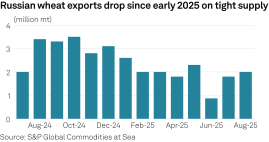
According to Russian Grain Union data, Russia shipped 2.51 million mt of wheat between Aug. 1-20, down 45% compared to 4.53 million mt in the corresponding period last year. Egypt, Turkey and Kenya were the top buyers of Russian wheat during this period.
Despite an optimistic crop outlook, Russian wheat exports are expected to keep up the slow pace, at least in the short-term, due to harvest delay and decrease of crop size in the southern regions of Russia, market analysts said.
"Exporters need to source grains from remote areas to counter lower southern volumes. We expect the export pace to increase to the average seasonal level in September onwards, if any inland logistical issues haven't arisen," said Khrystyna Kornetska, senior EU/Black Sea grains and oilseeds analyst at S&P Global Energy.
"Yields in non-southern regions continue to confirm our optimistic expectations. However, while good crops may offset losses in the South, it will take time to deliver that wheat to Azov and Black Sea ports, complicating Russia's export program over the next few months — often the key period of the season," said SovEcon's Sizov.
Demand likely to improve
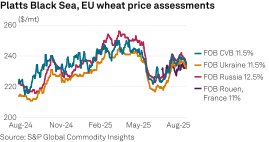
Wheat demand from Egypt remains subdued, with buyers holding off on purchases in anticipation of potential price declines amid forecasts of a large wheat crop in France. Buyers noted that the availability of competitively priced Romanian wheat, coupled with weak demand, may continue to pressure Black Sea wheat prices.
Platts, part of S&P Global Energy, assessed Russian wheat 12.5% FOB Black Sea at $234.5/mt Aug. 26, down $1.5/mt day over day.
Market sources expect import activity to rebound soon as prices ease further.
A stronger Egyptian pound against the US dollar is expected to support an uptick in wheat imports, potentially bringing purchases back to normal levels, a trade source said.
According to recent media reports, Egypt's state grain buyer, Mostakbal Misr, has agreed to purchase at least 200,000 mt of French wheat in private deals with exporters, along with several cargoes of 30,000 mt each from Ukraine and Romania. Traders indicated that Mostakbal Misr may have booked up to seven Panamax ships of French wheat—totaling over 400,000 mt—over the past two weeks.
Turkey's wheat imports are also expected to rise in MY 2025-26 (June-May) as dry weather weighs on the country's wheat production.
The USDA Foreign Agricultural Service in Turkey July 3 lowered its projection for MY 2025-26 wheat production to 16.25 million mt, down from the previous estimate of 19 million mt due to persistent drought conditions. "Wheat production may decline further depending on the extent of the damage caused by drought," the attache report said.
To boost trade with Turkey, Russia suspended wheat export tariffs for the Aug. 13-19 week. The decision follows Turkey's adoption of a duty-free wheat import policy under its inward processing regime on March 19.