Agriculture, Grains
February 19, 2025
Australia, Russia wheat export price spread narrows to three-year low
HIGHLIGHTS
Price gap narrowest since Russia-Ukraine war began
Tight spread driven by tight Russian supply, slow Chinese demand
Saudi Arabia buys Australian wheat in tender
The export prices of Australian and Russian wheat have tightened to their narrowest spread in three years, driven by slow demand from China for Australian wheat and a tightening supply from Russia.
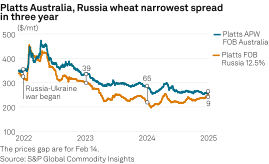
Since the beginning of the year, the price gap between these two wheat origins, specifically the FOB Australian Premium White (APW) and Russian 12.5% protein, has been decreasing, culminating on Feb. 14 when it reached just $9/mt - the lowest spread seen in over three years.
A larger-than-expected Australian wheat harvest in the 2024-25 marketing year (October to September) has largely limited the upside potential to Australian wheat prices in 2025, even as the grower selling pace remains slower than desired, according to market participants. Australia harvested 31.9 million mt wheat in MY 2024-25, up from 26 million mt last year, according to Platts Analysts, while some trade estimates are even higher around 33 million mt.
Conversely, Russian wheat prices have surged to their highest levels since June, driven by a constrained supply due to a production decline of 8.9 million mt year-on-year. The Russian government has set an export quota for the remainder of the marketing year at 10.6 million mt, but traders predict that actual export potential could drop to as low as 8.1 million mt. In February, Russian wheat exports are forecast to be just 2.2 million mt, a significant decrease from 4.4 million mt last year.
As of Feb. 18, Platts assessed the FOB price for Australian Premium White (APW) wheat for cargoes loading from the second half of April to May at $259/mt, while FOB Russian wheat with 12.5% protein was priced at $249/mt for loadings in the second half of March to early April. The last time the price gap was this close was during the early days of the Russia-Ukraine conflict in February 2022, when both prices spiked due to concerns over the Black Sea supply. In the following years, the spread widened significantly, reaching $39/mt in February 2023 and $65/mt in February 2024, before narrowing to its current level.
Traders in Russia are predicting further price increases for Russian wheat in the coming months, suggesting an even tighter spread between the two origins. "I think Russia will stay high unless export taxes and the ruble changes," said one trader, emphasizing the dependence of Russian export prices on the weekly set export tax and the volatility of the ruble against the dollar.
Farmers in Russia have been hesitant to sell at lower price levels, anticipating higher bids from exporters amid rising production costs. "Replacement costs are higher in Russia," said another trader.
Demand trend
On the demand side, buyers are considering both wheat origins, factoring in freight costs and local product demand. A trader based in the UAE said, "We have been buying both origins. Russia is definitely trying to outprice itself for exports." Current spot freight rates indicate that shipping from Russia to the UAE costs $26/mt, while shipments from Australia are priced at $30/mt.
In Southeast Asia and North Asia, few destinations are able to purchase Russian wheat, citing financing and insurance hurdles, but even with those hurdles removed, Australian wheat remains the more competitive origin.
Additionally, China's noticeable absence from the global wheat trade has removed a significant bullish stimulus from Australian wheat prices, one of its biggest supplier, which is encouraging milling wheat buyers in Southeast Asia to stick to a hand-to-mouth buying strategy and keeping Australian milling wheat prices, particularly for mid-protein grades such as Australian Premium White, fairly rangebound.
"I would say demand in the region [for Australian milling wheat] is pretty healthy, but buyers are simply not buying too far ahead," said a grains trader in Singapore.
Dwindling availability from South America and rising prices from active exporters such as Russia have effectively meant little to no competition for Australian mid-protein wheat exports into Asia.
"It's basically an Australia vs Australia game for Q2 shipment demand in Southeast Asia, so exporters don't want to be chasing business too aggressively and pushing prices down, not with where [the] grower selling [pace] is right now," said a trade source based in Victoria.
Elsewhere, Australian wheat is making its way to Saudi Arabia, via a tender from the state board General Food Security Authority (GFSA). The state board bought 920,000 mt of wheat with prices ranging from $272.50 to $284.90/mt for May to July shipments on Feb. 17. One 60,000 mt from Australian trading house CBH was sold at $284.90/mt for H1 May shipment to Dammam port, with traders expecting at least one more 60,000 mt from Australia. The remaining ships were from the Black Sea region - Russia, Romania and Bulgaria.
In the broader Black Sea region, supply constraints persist. Ukraine has approximately 4.7 million mt of wheat remaining under an export quota of 16.2 million mt, while Romania and Bulgaria have about 3.5 million mt available. Traders in Romania have reported that farmers sold much of their stock before the new year, resulting in limited supply to meet new demand.