


Electric Power, Natural Gas, Energy Transition, Renewables
October 21, 2025
COMMODITY TRACKER: 5 charts to watch this week

By Staff
EU gas injection rates have declined as winter approaches, while Vietnam's fragrant rice prices hit a three-year low amid weak export demand. Meanwhile, China's lithium carbonate market remains stable, and European epoxy resin prices have plateaued.
1. EU gas injections decline as winter looms
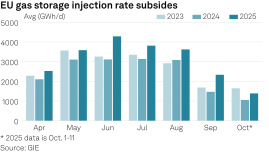
What's happening? EU natural gas injection rates have fallen as the continent approaches winter. While the decline is unsurprising given typical seasonal trends, daily average injection rates have dipped below those seen in recent years for the first time since restocking began in April.
What's next? The EU finished last winter with much lower gas stocks than the past two years. Elevated injection rates have helped it to narrow that gap, but the recent fall signals the EU may struggle to fill stocks much more before colder weather kicks in. Analysts at S&P Global Energy have projected EU storage to reach 84% full by Nov. 1. Current levels are just below 83% full, according to recent data published by Gas Infrastructure Europe.
2. Vietnam fragrant rice prices hit 3-year low
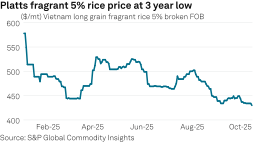
What's happening? Vietnam's fragrant rice prices have fallen to their lowest level in nearly three years, pressured by weak export demand and limited trading activity. The sustained weakness underscores a slowdown in Vietnam's rice trade, with exporters struggling to secure fresh deals amid muted export demand. The decline mirrors broader weakness across Asian markets. Platts, part of S&P Global Energy, assessed Vietnam's fragrant 5% rice at $429/metric ton FOB Oct. 17, the lowest since Sept. 21, 2022.
What's next? With the Philippines out of the market and demand from African destinations tepid, overall export activity is expected to remain subdued, with few new bookings from key destinations. The market is anticipating the autumn/winter crop, of which 28% has already been harvested in Vietnam. According to Energy data, Vietnam is projected to export 7.4 million metric tons of rice in the marketing year 2025-26, down 8.64% year over year.
3. China's lithium carbonate market to remain rangebound in short term
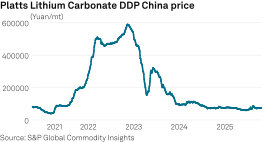
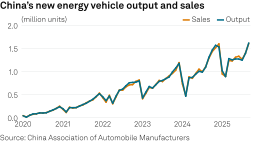
What's happening? Chinese domestic lithium carbonate spot prices have experienced a volatile downtrend, even as downstream demand remains robust, as reflected in rising output and sales of new energy vehicles. This development coincided with a simultaneous increase in domestic supply. Platts assessed battery-grade lithium carbonate at Yuan 74,500/mt ($10,466/mt) Oct. 17 on a DDP China basis, up Yuan 500/mt day over day and Yuan 2,000/mt from a month ago.
What's next? China's lithium market is expected to remain rangebound in the short term, given that both supply and demand for domestic lithium carbonate remain robust, creating uncertainty about future price trends. Lithium salt production in October is expected to maintain its potential for further growth. Meanwhile, demand from the new energy vehicle and energy storage industries is likely to keep the market in a phase of inventory drawdown in the near term. The key market concerns are centered around "preemptive exports" prompted by China's export controls on lithium battery items, the anticipated production restart at the Jianxiawo mine, and pressure from the bulk cancellation of warehouse receipts in November.
4. European liquid epoxy resin prices plateau after steady decline
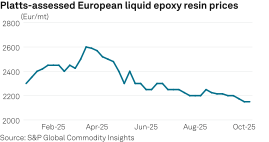
What's happening? Epoxy resin prices in Northwest Europe had been on steady decline since the summer holiday period and have plateaued at Eur2,150/mt in the week to Oct. 14. The European Commission's antidumping duties currently imposed on China, Taiwan and Thailand, exempting South Korea, have failed to rally prices due to prolonged weak downstream demand and continuous influx of competitively priced material from South Korea, India and Saudi Arabia.
What's next? Sources indicated that the year-end destocking process generally prompts producers to lower prices in an effort to reduce excess inventory. Additionally, negotiations for goods scheduled for delivery in January 2026 were heard to have commenced in October.
5. Germany leads as European battery spreads widen amid solar surge
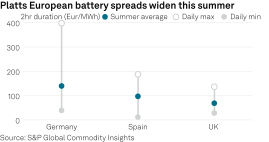
What's happening? European battery spreads widened sharply this summer, led by Germany, according to new Platts assessments. Platts Battery Spreads, which measure the difference between minimum and maximum hourly prices in the day-ahead auction, cover Germany, Great Britain and Spain and provide daily spreads for one-, two- and four-hour periods. The boom in solar installations, with Germany doubling and Spain even tripling solar capacity in just five years, has deflated midday hours during solar peaks during summer months, while morning and evening peak prices rose year over year.
What's next? During winter, solar only plays a minor role across northern Europe, while Spain still has hardly any battery capacity installed. The UK remains Europe's leader for utility-scale batteries, with already over 6 GW of BESS installed, but the economic case for such assets is growing in Germany. While batteries don't play a market role in Spain yet, the peninsula has significant pump-storage hydro capacity that helps keep hourly profiles flat. Analysts at Energy forecast some 16 GW of utility-scale battery capacity to be added this year and next across Europe.
Reporting and analysis by Matt Hoisch, Chirag Aggarwal, Lucy Tang, Litian Wang, Nate Zhang, Andreas Franke and Maxim Grama.

Editor: