


02 Sep 2025 | — Insight Blog
Commodity Tracker: 5 charts to watch this week

By Staff
China's steel industry is seeing strong profits, driven by resilient manufacturing exports and steel demand. In LNG, trading in the spot market is expected to remain robust, while sustainable aviation fuel prices in Europe surge.
1. China's resilient manufacturing exports support steel sector
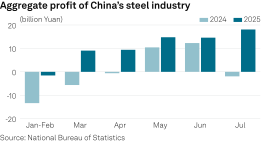
What's happening? China's steel industry saw an aggregate profit of Yuan 64.36 billion ($8.99 billion) over January-July, up from Yuan 1.22 billion a year ago, as strong exports of steel and manufactured goods supported steel demand and high steel production, data from the National Bureau of Statistics showed.
What's next? Most steel mills are likely to see third-quarter profits surpassing Q2, sources said, as the export competitiveness of Chinese steel-intensive manufactured goods, together with Belt and Road Initiative efforts, would help sustain China's manufacturing activity and related steel demand despite tariff headwinds. Some steel mill sources added that steel demand from the production of cars, home appliances, ships and wind turbines is expected to remain strong and continue supporting the flat steel market in the coming months. Steel production is currently also rising due to healthy profit margins.
2. Rising liquidity drives record-high LNG MOC activity, longer cargo chain
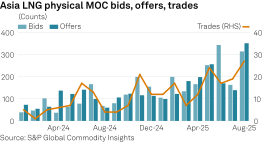
What's happening? The Asian LNG spot market saw unprecedented trading activity in August. This surge, attributed to increased liquidity and the standardization of LNG cargoes, enabled traders to bring cargoes into the current pricing period and optimize positions. The market is also witnessing longer cargo trading chains, where multiple counterparties trade a single cargo multiple times before final consumption. Diverging expectations regarding winter demand and companies' trading volume targets are fueling trading activity.
What's next? Trading activity is expected to remain robust as market participants await clearer winter demand projections. The standardization of LNG cargoes and the ability to hedge through JKM pricing will likely continue to drive liquidity. As traders adjust their strategies in response to market conditions, the trend of longer cargo chains may persist.
3. US EPA acts on 175 small refinery exemptions
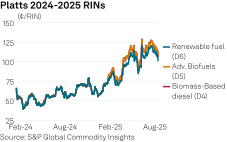
What's happening? The US Environmental Protection Agency on Aug. 22 fully granted 63 petitions and partially granted 77 petitions from small refiners seeking exemptions from requirements to blend biofuels into their products under the Renewable Fuel Standard. US Renewable Identification Number credits are highly sensitive to policy talks, particularly regarding decisions on small refinery exemptions, as they can directly influence supply and demand for the compliance credits. The EPA plans to return 5.34 billion RINs to the exempted refineries. However, only 2023 and 2024 RINs can be used toward compliance, leaving the remaining with little or no value. RINs traded up 17% immediately following the news, but has since declined.
What's next? With an unaccounted 1.39 billion RINs entering the market, a broker said all eyes will be on the credits. Additionally, further volatility is expected, as decisions including the finalization of 2026/27 RVO, 2025 compliance year SREs, and changes to the IRA credit are still pending.
4. European SAF prices soar on spike in supplier demand; planned refinery outages set to tighten supply complex
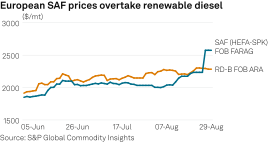
What's happening? Suppliers are rushing to purchase SPK molecules to comply with the ReFuel EU Aviation mandate after a quiet first half of the year. However, the availability of SAF in Europe is tight as several domestic producers are reportedly overcommitted on HVO sales, preventing them from switching their biorefinery output to SAF until existing orders are fulfilled. Additionally, only Jiaao Enprotech has obtained a SAF export license in China while other producers are still awaiting approval, leading to a sharp reduction in expected imports into Europe.
What's next? Market participants anticipate a bullish outlook, with suppliers competing for any available molecules. Planned biorefinery outages by Neste at its Singapore and Rotterdam facilities as well as by EcoCeres, are expected to further tighten the supply landscape. Meanwhile, the market is closely monitoring developments regarding the issuance of export licenses to Chinese producers.
5. Low meal prices pose risks to soybean crush margins in South America
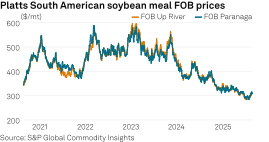
What's happening? Low soybean meal prices have led to reduced crushing margins in Argentina and Brazil, two of the world's top soybean suppliers. As of Aug. 22, the Platts Brazil Soybean Crush Spread, for example, was assessed at around $22/mt, a decline of over 50% from the previous year. Analysts attributed the decline to weaker soybean meal prices, which have been hovering around multi-year lows, coupled with a higher-than-normal soybean basis driven by increased demand from China. Despite robust demand for soybean oil, the crushing pace has not met expectations, leading to uncertainties in production levels.
What's next? The eroded crush margins pose a significant downside risk to the total crush volumes in South America. Analysts from S&P Global Energy have already revised down Argentina's soybean crushing forecast for the 2024-25 and 2025-26 marketing years by 1 million mt each. While Brazil is projected to crush a record 58 million mt in the current cycle, the high prices of soybean oil could lead processors to prioritize domestic needs over exports to meet the mandatory biodiesel blend of 15% with diesel.
Reporting and analysis by Jing Zhang, Shuocheng Ni, Guadalupe Nunez, Melvin Lee, Daniel Workman, Jose Roberto Gomes and Gabriel Diniz Faleiros
