


Carbon Markets
Updated December 03, 2025; First published June 10, 2021
Voluntary carbon markets: how they work, how they’re priced and who’s involved
The voluntary carbon market, or VCM, is one of the tools utilized by various players across a wide range of industries – from oil and gas majors to hedge funds and banks – to achieve carbon reduction goals in line with the Paris Agreement. At the same time, it aims to bring financing to areas of the globe most impacted by changes in the climate.
The VCM allows carbon emitters to offset their unavoidable emissions by purchasing carbon credits to reduce or remove greenhouse gas emissions, or GHG, from the atmosphere.
Each credit, which corresponds to 1 metric ton of reduced, avoided or removed CO2 or equivalent GHG, can be used by a company or an individual to compensate for the emission of 1 metric ton of CO2 or equivalent gases. When a credit is used for this purpose, it becomes an offset. It is moved to a register for retired credits, or retirements, and it is no longer tradable.
Companies can participate in the voluntary carbon market either individually or as part of an industry-wide scheme, such as the Carbon Offsetting and Reduction Scheme for International Aviation, or CORSIA, which was set up by the aviation sector to offset its GHG emissions. International airline operators taking part in CORSIA have pledged to offset all the CO2 emissions they produce above a baseline 2019 level.
What is the value of the voluntary carbon market?
$4 billion
VCM annual market value by 2030: S&P Global Sustainable1 estimates
While compliance markets are currently limited to specific regions, voluntary carbon credits are significantly more fluid, unrestrained by boundaries set by nation-states or political unions. They also have the potential to be accessed by every sector of the economy instead of a limited number of industries.
According to analysts at S&P Global Sustainable1, the VCM could reach an annual market value of up to $4 billion by 2030, with significant market growth likely to happen during the 2030s. Before that, Sustainable1 analysts expect the late 2020s to be a period of gradual market consolidation, characterized by largely stagnating demand but rising credit quality and prices.
Who are the key players in the voluntary carbon markets?
Click to expand and learn more about the key players in voluntary carbon markets
Pricing a diverse supply of carbon credits
When a company turns to the voluntary carbon market as a potential way to compensate for its carbon emissions, one of the key pieces of information it looks for is the price of carbon credits. This information helps a company decide if the VCM can help it meet its emissions reduction target.
At the same time, a clear price signal for carbon allows players already involved in the market to make sure they are trading their credit at a price that reflects the real market value.
But putting a price on carbon credits is not straightforward – there is a wide variety of credits in the market and a number of factors influence prices.
Projects issuing carbon credits can be of many different types and sub-types. The nature of the underlying project is one of the main factors affecting the price of the credit.
Carbon credits can be grouped into two main categories: avoidance projects and removal projects.
Avoidance credits
The avoidance category is aimed at avoiding GHG emissions and includes renewable energy projects as well as forestry and farming emissions avoidance projects. The latter, which are also known as REDD+, prevent deforestation or wetland destruction, or use soil management practices in farming that limit GHG emissions, such as projects aiming to avoid emissions from dairy cows and beef cattle through different diets.
Cookstove projects, fuel efficiency and the development of energy-efficient buildings also fall into the avoidance basket, as do projects capturing and destroying industrial pollutants.
Removal credits
The removal category includes projects that capture carbon from the atmosphere and store it. These projects can be nature-based, using trees or soil, for example, to remove and capture carbon. Examples include reforestation and afforestation projects and wetland management (forestry and farming). They can also be tech-based and include technologies like biochar, direct air capture, or carbon capture and storage.
Removal credits tend to trade at a premium to avoidance credits, not just because of the higher level of investment required by the underlying project, but because of the tighter supply for these types of credits. They are also believed to be a more impactful tool in the fight against climate change.
Beyond the type of the underlying project, the price of carbon credits is also influenced by the volume of credits traded at a time, the geography of the project, its vintage, and the delivery time. Higher volumes and lower vintages typically translate to lower prices.
When a carbon project supports some of the UN’s SDGs, its credits may fetch a higher price and trade at a premium compared to other projects.
For example, community-based projects are usually very localized, typically designed and managed by local groups or non-government organizations, and tend to produce smaller volumes of carbon credits. It is also often more expensive to certify. However, localized projects usually generate additional co-benefits and meet the UN’s SDGs, contributing, for instance, to improved welfare for the local population, better water quality or the reduction of economic inequality.
For this reason, credits emitted by community-based projects may trade at a premium to projects that do not meet SDGs, such as industrial projects, which are typically larger and can often produce higher volumes of credits with more easily verified GHG offset potential.
In current carbon markets, the price of one carbon credit varies from a few cents to hundreds of dollars per metric ton of CO2 equivalent.

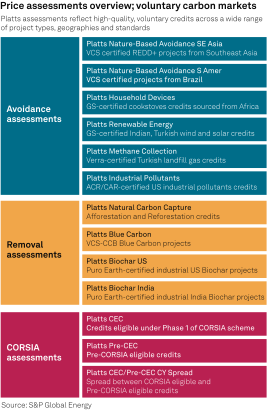
Platts, part of S&P Global Energy, assesses a full suite of carbon credit price assessments, including spot and forward (Year 1) prices for household devices, biochar and blue carbon.
Each price assessment reflects the most competitive credit for each category, based on bids, offers and trades reported in the brokered market or on trading and exchange instruments.
Platts collects bid, offers and trades for carbon credits that have been certified by the most relevant standards for a particular category of credits. Price indications are collected directly from market participants on every trading day.
Against a growing preference for regional standards and project types, regional-specific pools of liquidity have emerged. Platts has evolved its assessments, launching regional carbon price assessment for particular segments of the VCM in June 2025, namely Biochar, US and Biochar, India price assessments as well as the Nature-based Avoidance Southeast Asia and South America price assessments.
CORSIA, an industry-wide offsetting scheme
CORSIA was designed to reduce emissions emissions from the aviation sector, and is managed by the International Civil Aviation Organization. It sets clear decarbonization targets and offers two main routes toward achieving them: using approved low-carbon fuels or offsetting emissions produced above an agreed baseline through the retirement of approved carbon credits.
ICAO mandates that carbon credits qualifying under the scheme must obtain a corresponding adjustment to ensure that the host country does not count the credit toward its own climate objectives, referred to as Nationally Determined Contributions. This prevents the double counting of credits.
What's next for the voluntary carbon markets?
Although the rise of voluntary carbon markets dates back to the early 2000s, following the ratification of the Kyoto protocol, growth was stunted by the 2008 global economic crisis. A new wave of public and private commitments to curb carbon emissions over recent years triggered a resurgence of interest in voluntary carbon credits as one way to manage carbon footprints.
While there are no barriers to entry, the lack of transparency in transactions and insufficient understanding of how carbon finance works have kept many potentially interested players at bay.
In addition, the voluntary carbon market has also been the target of scrutiny over the past few years. After a rush of investments in 2021, several players have reconsidered their positions as academics and the media highlighted flaws in the methodologies underpinning the projects used by many companies to offset their emissions.
Despite this, interest in the VCM remains, and the market is still perceived as a useful tool to achieve the goals of the Paris Agreement while also bringing much needed financing to the areas of the globe most impacted by the climate crisis.
Further standardization in the market could help address market concerns – a certain level of competition on project types, certifications, methodologies and trading products remains necessary to allow for scale and efficiency.
Meanwhile, new quality labels such as the ICVCM’s Core Carbon Principles and the much-awaited new Article 6.4 methodologies should offer buyers the confidence needed to engage in the market.
Related content: The voluntary carbon market's path to unified quality standards
A version of this article appeared in the October 2021 edition of Insights magazine.
