


Energy Transition, Renewables, Hydrogen, Battery Metals
November 26, 2025
ET Highlights: Canadian budget brings carbon price rally; India’s cement sector pushes decarbonization; Shell signs PPAs for green hydrogen project
Energy Transition Highlights: Our editors and analysts bring together the biggest stories in the industry this week, from renewables to storage to carbon prices.
Top story
Alberta TIER carbon prices rally on federal budget support boosting carbon markets
Alberta's Technology Innovation and Emissions Reduction carbon prices have rebounded following the passage of Canada's federal budget on Nov. 17, which seeks to improve the effectiveness of Canada's carbon markets.
Sources stated Nov. 20 that the federal budget's provisions for carbon markets serve as a key driver of renewed interest, providing greater policy certainty for emissions trading and strengthening Canada's carbon pricing framework.
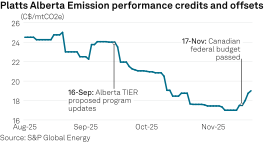
Traded levels rose throughout the week, with a trade for EPCs and Offsets at C$19/mtCO2e on Nov. 20, the highest reported trade since the launch of the assessment on Aug. 1.
"Sounds like the market expects new policy to support TIER and Canadian project development," one broker said.
Benchmark of the Week
C$19/mtCO2e
Alberta TIER Emission Performance Credits and Emission Offsets costs rose C$2/metric ton of carbon dioxide equivalent after the Canadian federal budget was released. TIER prices previously saw an extended period of weakness due to persistent oversupply.
Editor's Picks: Premium and free content
SPGlobal.com
India’s cement sector embraces decarbonization amid robust outlook, policy push
India's cement industry has made significant progress in adopting renewable energy over the past two decades, with leading companies installing a total capacity of 1,800 MW by 2024 and aiming to add another 5 GW by 2030, the Global Cement and Concrete Association India told Platts. The sector has transitioned to dry processes, adopted renewable energy, implemented waste heat recovery systems and increased the production of blended cement, according to GCCA India.
CAAT, Thai airlines agree 2026 SAF rollout; regulator weighs carbon fee mechanism
Thailand's Civil Aviation Authority has signed a memorandum of understanding with eight domestic airlines to begin coordinated use of sustainable aviation fuel from 2026. The MOU includes Thai Airways, Bangkok Airways, K-Mile Air, Nok Air, Thai AirAsia, Thai AirAsia X, Thai Lion Air and Vietjet Thailand. CAAT Director-General Air Chief Marshal Manat Chavanaprayoon said the agreement establishes a joint framework for SAF adoption, lifecycle emissions calculation and alignment with ICAO's Carbon Offsetting and Reduction Scheme for International Aviation.
S&P Global Energy Core
Shell signs renewable PPAs for 100-MW German green hydrogen project
Shell Energy Europe has signed two power purchase agreements in Germany for its 100-MW Refhyne 2 green hydrogen plant under construction in Germany, the company said in a statement on Nov. 18. The Shell subsidiary signed separate agreements with Nordsee One and Solarkraftwerk Halenbeck-Rohlsdorf, it said.
South Korea’s Hyundai Motor to invest in hydrogen ecosystem, 1 GW electrolyzer unit
Hyundai Motor Group announced its largest-ever domestic investment commitment of Won 125.2 trillion ($86 billion) in South Korea through 2030, with a significant focus on building a hydrogen ecosystem, including an electrolyzer unit, the company said. The five-year investment plan allocates Won 50.5 trillion specifically to future technologies, including hydrogen energy systems, marking a corporate bet on hydrogen's role in decarbonizing transportation and industrial sectors, according to Hyundai Motor.
Japan Bank for International Cooperation extends $600 mil green credit to Brazil's Petrobras
The Japan Bank for International Cooperation has signed an agreement to provide a $600 million credit line to Brazil's Petrobras to fund decarbonization and energy transition, in the backdrop of the COP30 UN Climate Change Conference in Belem, Brazil, the development bank said. The credit line facility falls under the bank's GREEN operations framework and aims to create business opportunities for Japanese companies while supporting net zero emissions target for both Brazil and Petrobras by 2050.