


Electric Power, Energy Transition, Renewables
November 21, 2025
India's renewable tenders: storage in focus as tender pace slows
India's renewable energy installed capacity, as reported by the Ministry of New and Renewable Energy, reached 197 GW at the end of September, with about 12.6 GW of new additions in the third quarter of 2025, and 34.7 GW in the first nine months of the year. Capacity additions January to September were about 86% higher year over year.
Given the market demand to firm up renewable supply, there is an increase in focus on renewables with storage and standalone energy storage tenders. Favorable project economics also support demand for these sources.
The increasing demand for renewables with storage and standalone energy storage tenders over other basic renewable tenders marks a clear shift in market maturity and priorities. It emphasizes the strategic transition toward reducing reliance on fossil fuels during periods of low renewable generation.
Storage additions remain crucial for renewables growth
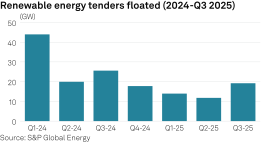
In Q3, Indian tendering agencies requested a total of 19 GW of renewable capacity, including energy storage, which was over 60% more than Q2 but 25% less than in Q3 2024.
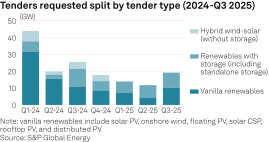
About 40% of the capacity requested in Q3 was for standalone energy storage (battery and pumped storage). Of this capacity, 70% was added for two-hour storage, 17% for four-hour and 13% for six-hour storage. Demand for standalone energy storage capacity has more than doubled quarter over quarter and quintupled year over year.
Tender awards slow amid development challenges
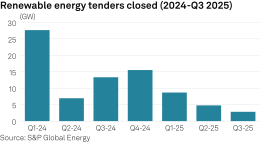
Only about 2.8 GW of new renewable projects were awarded in India in Q3. This marked a 40% decline from the previous quarter and an almost 80% decline year over year.
In Q3, approximately 25% of the awarded capacity went to energy storage, while the remainder was awarded for renewables with storage, including for peak power supply and round-the-clock clean energy procurement.
There was no utility-scale basic solar photovoltaic capacity awarded in Q3. To date in 2025, only about 2.2 GW of utility-scale solar capacity has been awarded after peaking at 8.2 GW in Q3 2024. This trend of slowing down in solar PV only tenders is also a result of the emphasis on the need to firm up renewable generation.
Tariff trends
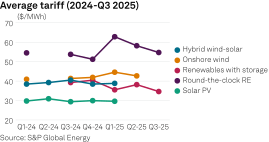
Tariffs for solar PV and onshore wind have remained stable in comparison to tariffs for energy storage and renewables with storage. Tariffs for renewables with storage showed a declining trend -- tariffs awarded in Q3 2025 for such tenders are down 9% quarter over quarter and 12% year over year.
These tariff reductions were primarily a result of declining battery storage costs. Development costs for battery storage have reduced by 17%-25% in 2025 compared to 2024, and costs have more than halved over the last five years.
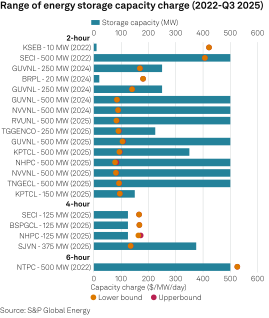
The average capacity charge for a four-hour standalone battery storage tender awarded in Q1 was $5,063/MW a month, whereas the capacity charge in Q3 was $4,127/MW a month, marking a 17% decline.
It must be noted that tariffs for tenders for renewables with storage vary based on the storage requirement and peak power supply conditions. Similarly, capacity charges for standalone battery storage differ based on the required discharge duration.
Energy storage market democratized
A wide range of entities are being awarded tenders for energy storage, including many that did not participate in previous tenders for vanilla solar or wind. This increased diversity has also increased competition in the tender markets.
Challenges in developing renewable energy
Low interest among developers
In August, Solar Energy Corporation of India canceled two tenders for offshore wind. The first was a 500-MW tender for offshore wind capacity off the coast of Gujarat, with a tariff of about $51/MWh. The second involved a seabed lease for 4-GW of offshore wind capacity off the coast of Tamil Nadu. Introduced in September 2024 and February 2024, respectively, these tenders received low investor interest due to stringent conditions related to tariffs and development timelines, despite the provision for viability gap funding, as per S&P Global Energy CERA.
Utilities' renewable readiness gap
During a recent meeting, India's power secretary and officials from key Indian renewable energy implementing agencies, including SECI, NTPC, NHPC, SJVN, discussed the status of renewable energy capacity tendered since the financial year 2023-24. Of the 93 GW tendered, 42 GW remains without final power supply agreements with power offtakers. This is a function of utilities' demand volumes, their demand patterns, and their assessment of the power purchase agreement tariffs, which will dictate the PSA tariff. The Ministry of Power has asked the REIAs to consider canceling tenders that may be lying unawarded for a prolonged period, and those that have not secured final offtakers. Additionally, while capacity additions have increased in recent quarters, the timely expansion of transmission connectivity remains a hurdle.
Renewable curtailment
From May to September, the national grid experienced a notable increase in instances of curtailment of solar energy generation. This makes it challenging to add more solar capacity in key resource-rich states.
Regulatory changes
There exists uncertainty regarding component costs, considering the upcoming implementation of the domestic content requirement for solar cells starting in June 2026.
Prospects for the renewables market
Renewable energy tender activity is expected to remain slow in Q4 2025 as well, citing the challenges. Developers are focusing on executing their existing pipeline over submitting new capacity bids, resulting in a significant backlog of unsigned PPAs and PSAs.
To achieve the 500 GW capacity target by 2030, the Ministry of New and Renewable Energy had set a target of tendering 50 GW of capacity each financial year. In the first six months of FY 2025-26, federal entities have tendered only about 7.7 GW of capacity. This follows after these entities tendered 55 GW and 41 GW, in FY 2023-24 and FY 2024-25, respectively.
Although the MNRE reports strong capacity additions, 2025 presents a speedbump in India's journey of rapid renewable expansion, given the power market's underlying challenges, which in turn affect the market for new renewable capacity.
(Note: Tenders requested mean tenders for which request for selection of bids has been issued, basis the date it was floated. Tenders awarded mean tenders where auction has been completed and winners have been declared, basis date of declaration of winners.)
Further reading: India Power and Renewables Market Briefing
Additional resource: Assets and Projects - Asia Pacific
