


Energy Transition, Agriculture, Refined Products, Carbon, Emissions, Hydrogen, Biofuel, Renewables, Jet Fuel
November 19, 2025
INSIGHT CONVERSATION: Simon Watts, New Zealand Minister of Climate Change

New Zealand's Minister of Climate Change, Simon Watts is leading the country's delegation to the UN Climate Change Conference, or COP30, in Belém, Brazil, which is taking place until Nov. 21.
Prior to attending COP30, Watts spoke with Platts Associate Price Reporter Himanshu Chauhan about New Zealand's climate change goals, recent policy developments on decarbonization, particularly surrounding the nation's Emissions Trading Scheme. Platts is part of S&P Global Energy.

What are New Zealand's top three strategic objectives at COP30, and how will the government use the outcomes of COP in its long-term policy regarding international markets and climate targets?
New Zealand is at COP because climate action is critical for our economy and our region. The Paris Agreement is our best shot at achieving and limiting the impacts of climate change. One of our objectives at COP is to make the Paris Agreement work well. Our region, the Blue Pacific, is at the forefront of climate change. Another objective at COP is to work with our Pacific Island neighbors to address climate change and also amplify the region's voice on the global stage, and this includes supporting Australia's bid to host COP31 in partnership with the Pacific.
Transitioning to a low-emissions, climate-resilient economy is fundamental to New Zealand and New Zealand's prosperity in meeting our climate change goals. Our third objective for COP is international engagement so that we have access to innovation, technology and investments that will enable our prosperity.
What is the government's official position on Article 6 of the Paris Agreement, and can we expect New Zealand to enter Article 6.2 agreements in the near future?
New Zealand is exploring options for collaboration with several countries, including Vietnam, Thailand, the Philippines and Singapore.
In 2024, the Prime Minister of New Zealand made joint statements with Singapore, Thailand and the Philippines, reflecting our interest in collaborating on climate action, potentially including NDC (Nationally Determined Contributions) implementation. In February of this year, I signed New Zealand's first Memorandum of Arrangement on climate change cooperation with Vietnam, and negotiations on other arrangements are ongoing.
More broadly, New Zealand continues to prioritize domestic action to help achieve our first NDC. We are exploring all options while balancing some challenges. This includes international cooperation in the context of Article 6 of the Paris Agreement.
In a Nov. 4 press release, your government said, "removing the provision within the act that states that NZ-ETS unit volumes and price control must accord with our NDC under the Paris agreement." What is the rationale behind this removal?
Currently, the New Zealand government must make annual ETS setting decisions, which accord with both our domestic and international emissions reduction targets. This means that they must be set at a level that supports New Zealand to reach its current legislated targets, including NDCs.
The requirement for ETS settings to accord with our international targets is at odds with the design of the NZ-ETS, which is solely a domestic policy tool. This change clarifies the purpose of the NZ-ETS as our primary tool to drive domestic emissions reductions. These changes will take effect from the 2026 ETS settings process.
The decision to remove the NDC accordance requirement was not related to the change to the 2050 target. They are being progressed in the same bill to ensure that the removal of the NDC accordance requirement happens before the 2026 ETS settings process.
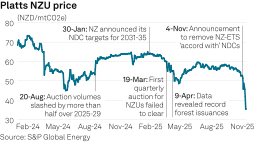
NZU auctions continue to be unsuccessful and the price remains disconnected from the floor. What specific steps is the government considering to ensure the ETS provides a meaningful price signal?
First and foremost, the non-clearing of auctions does not mean or infer that the market is failing.
Non-clearing of the New Zealand ETS auctions prevents oversupply when the market is already sufficiently supplied. A key driver of the current NZU prices and auctions not clearing is a stockpile of NZUs in the market. We are deliberately restricting auction volumes to draw down that stockpile, and this will help the ETS move more effectively to incentivize emission reductions and removals.
We've recently announced changes to the functions of the ETS to provide greater certainty to the market and reduce disincentives for investment in decarbonization projects.
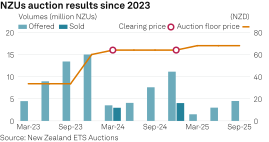
Beyond cutting auction volumes, what alternative policy interventions or design modifications is the government exploring to strengthen market confidence?
We have announced improvements to market governance, including improving trading information availability, providing clear market conduct standards, setting up the Ministry for the Environment's monitoring powers and adding the Financial Markets Authority in New Zealand as the agency that will oversee market conduct.
Can you provide a definitive timeline for when the government will release a detailed framework for the agricultural emissions pricing scheme?
In October, we announced that we are no longer progressing with on-farm emissions pricing from 2030. Pricing is not the only way to reduce agricultural emissions. Our approach in New Zealand to agricultural emissions is clear. Technology and partnership will deliver the reductions that we need.
In New Zealand's second emissions reduction plan, or ERP-2, the government pledged support for the emissions trading system and suggested reliance on carbon capture technology. Is there a policy to monetize and incorporate carbon capture and storage into the ETS?
We've decided on key elements of a CCUS (carbon capture, utilization and storage) framework, which is designed to enable CCS in New Zealand. Under the CCUS framework, businesses that capture and store carbon dioxide will be rewarded through the NZ-ETS. CCUS is gaining momentum internationally.
In New Zealand, this approach has significant untapped potential. Our government's ERP-2 was released in 2024, highlighting CCS as one of the key tools for meeting the second and third emissions budgets.
How will the government support low-carbon hydrogen and its integration into industrial clusters, and what infrastructure and certification frameworks are planned to ensure bankable demand and export options?
Actions to unlock market-led private investment are set out in our November 2024 hydrogen action plan. Two actions in the plan are around supporting access to internationally aligned certification schemes and using country-to-country relationships to attract foreign investment and promote market access.
On Oct. 31, the Green Economy Partnership Agreement negotiations were launched in partnership with Singapore and Chile to enable trade and investment opportunities in key sectors, including hydrogen.
We have also consulted on possible regulatory approaches to enable exploration for natural hydrogen and geological hydrogen in July. The submissions are currently being considered regarding that.
The government recently passed a bill limiting farm-to-forestry land conversions. What are the key objectives of this legislation?
In September, the government passed a bill to stop large-scale farm-to-forestry conversions to protect the future of New Zealand's food production. This provides much-needed certainty for foresters, farmers and also investors. The bill restricts wholesale conversions of farmland to exotic forestry by stopping land use classes. It does allow up to 25% of a farm to go into trees, but it stops the kind of blanket ETS planting that has been gutting rural communities.
What is the government's approach to scaling a domestic sustainable aviation fuel industry from pilot to commercial deployment?
The government acknowledges that SAF is currently the only viable solution to decarbonize long-haul aviation.
Our ERP-2 and the fuel security plan reference highlighted the importance of getting enabling settings correct to support the adoption of alternative fuels. Both New Zealand and Australia are working together on policy regarding SAF.
It is a reality that the majority of the world's longest long-haul flights originate from New Zealand or Australia. Hence, ensuring the harmonization of settings across our jurisdictions is a crucial part of our work.
Work is underway across both countries to align and explore opportunities.
This interview has been edited for clarity and length.

Editor: