


Energy Transition, Renewables, Hydrogen, Battery Metals
November 19, 2025
ET Highlights: India’s pivot to domestic renewable hydrogen as export outlook fades; China's first large-scale export of SAF
Energy Transition Highlights: Our editors and analysts bring together the biggest stories in the industry this week, from renewables to storage to carbon prices.
Top story
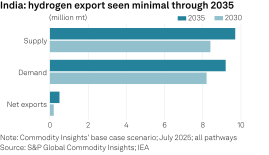
India must pivot renewable hydrogen strategy to domestic demand as export outlook fades
With export prospects waning, India’s renewable hydrogen sector must shift focus to meet burgeoning domestic demand -- a move that industry experts say could strengthen the country’s long-term position in the emerging global clean fuels market.
India’s fast-growing renewables sector may fall short of its 5 million metric ton renewable hydrogen output target by 2030 due to global headwinds and may reach the level by 2032, a senior official in the Ministry of New and Renewable Energy said at the International Conference on Green Hydrogen India, 2025, in Delhi.
Gauri Singh, deputy director general of the International Renewable Energy Agency told Platts, given the complex world, pegging clean fuels growth to external factors is undesirable; therefore, it was advisable to build a domestic eco-system, which will eventually help the nation integrate globally.
Indian renewable hydrogen developer Avaada, which has an export-oriented project in east India, will be looking more closely at domestic renewable ammonia supply opportunities henceforth, and bid in local auctions “aggressively,” Vineet Mittal, chairman of Avaada told Platts.
Benchmark of the Week
$5.18/kg
Platts assessed Japan hydrogen produced via alkaline electrolysis, including capex, at $5.18/kg Nov. 12, up 0.97% from a month ago.
Editor's Picks: Premium and free content
SPGlobal.com
China’s Shandong ships first large-scale SAF cargo to EU as Beijing expands export rollout
China's eastern Shandong province has completed its first large-scale export of sustainable aviation fuel, with a 14,000 metric ton cargo of used cooking oil-based SAF sailing to the EU in recent days. The shipment was supplied by Shandong Haike Chemical Co., operator of what the authorities describe as China's largest single-train SAF unit, located in the Dongying Chemical Industry Park, according to an update from the provincial government. The facility can process over 500,000 metric tons/year of UCO and waste fats and produce around 370,000 metric tons/year of SAF via hydroisomerization.
EU Council greenlights UK carbon market linkage negotiations
EU member states approved a mandate to begin negotiations with the UK on linking their emissions trading systems, the EU Council said in a draft decision. The prospect of linking has supported prices for UK Allowances, as linking with the EU market could lead to tighter supply with the introduction of a mechanism akin to the Market Stability Reserve, a tool used to regulate supply and demand dynamics in the EU ETS.
S&P Global Energy Core
US EPA authorizes Texas to take over carbon emission storage permitting
The Trump administration authorized Texas to assume CO2 storage oversight, giving the state's oil and gas regulator final say over dozens of proposed carbon capture projects. The US Environmental Protection Agency finalized a rule that will allow the Texas Railroad Commission to take over the permitting of CO2 injection wells, known as Class VI wells. The Railroad Commission of Texas is ready, willing and able to add Class VI wells to its underground injection control program, according to Scott Mason, administrator of EPA Region 6.
Air Liquide starts world's first industrial ammonia cracker at Antwerp
Air Liquide has successfully commissioned the world's first industrial-scale ammonia cracking facility at the Port of Antwerp-Bruges, according to the company. The 30 metric tons/day pilot unit converts ammonia back into hydrogen, solving a critical challenge in developing long-distance hydrogen logistics networks. The French industrial gas company's proprietary technology enables the export of ammonia from energy-rich regions to end-users worldwide, where it can be cracked back into hydrogen.