Energy Transition, Emissions
November 13, 2025
The potential proliferation of CBAM: a fragmented carbon tariff landscape
Until recently, carbon emissions regulations were largely a domestic concern, confined within national or regional bubbles. That is now changing. The EU's Carbon Border Adjustment Mechanism will enter its definitive phase on Jan. 1, 2026, marking the first time a regulator will impose a price on the greenhouse gases emitted during the production of imported goods.
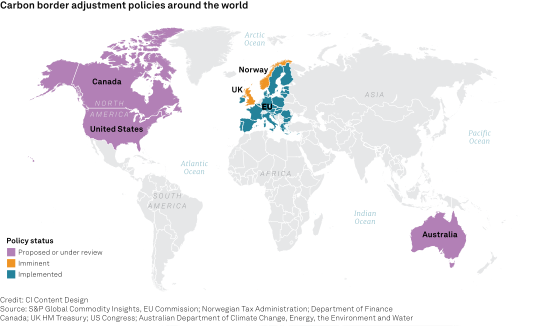
Europe is not alone -- it is just the frontrunner -- with other countries advancing their own versions of a carbon tariff. A proliferation of carbon tariffs could create a fragmented landscape for businesses to navigate. Below is a breakdown of the status of CBAM-style policies worldwide.
The EU as the first mover
The EU CBAM aims to prevent “carbon leakage" -- an issue that can occur when countries impose carbon prices that rise to levels that impact the competitiveness of carbon-intensive trade-exposed sectors. The carbon price presents a cost that foreign companies may not face. If left unaddressed, investment can shift from regions with more stringent environmental policies to countries with less stringent regimes.
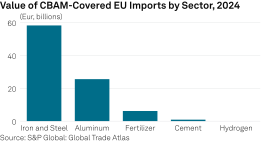
CBAM will apply to EU ETS-covered emissions-intensive sectors with a high risk of carbon leakage. Initially, the following sectors will be covered: iron and steel, cement, aluminum, fertilizers, electricity, and hydrogen. While the scope is limited to raw materials and some semi-finished goods, a proposal to expand the scope to include downstream products is currently under review.
From January 2026, EU importers will be required to purchase certificates to cover the process emissions from imports. The share of emissions subject to compliance costs will increase annually, reaching 100% in 2034. The certificate price will mirror the weekly average price of EU ETS allowances. For reference, the average price of the Platts EU Emissions Allowance Nearest-December assessment (EADLP00) was Eur78.51/mt in October. Carbon costs paid in the country of origin, if any, would be deducted from any CBAM liabilities, subject to EU approval. The details of calculating origin country carbon costs are the subject of an ongoing consultation. A decision by the EU Commission is expected in Q4 2025.
A review due before the end of 2025 will set a timetable for adding other ETS sectors, including refined products and organic chemicals, to the CBAM’s scope by 2030.
Norway mirrors EU model
As a European Economic Area member, Norway is deeply integrated into the EU’s single market and is already a participant in the EU ETS. To maintain regulatory alignment with its largest trading partner, Norway’s CBAM is set to take effect in 2027, directly mirroring the EU policy. Because both are part of the EU ETS, trade between Norway and the EU will not be impacted. For outside trade partners, this means the EU’s carbon-accounted market is effectively expanding to include Norway, requiring the same reporting standards and compliance costs.
UK plan has key differences
The UK is set to introduce its own CBAM in 2027. It will not adopt the EU CBAM wholesale, as Norway did. Trading between the EU and the UK will be managed by two different systems. While the goal is the same -- to protect domestic industry from carbon leakage -- the design has several key differences.
First, the scope: the UK policy includes the iron, steel, aluminum, fertilizer, and cement sectors, but not electricity. The UK CBAM will apply to both direct and indirect (i.e., power) emissions. This contrasts with the EU CBAM, which considers indirect emissions from cement and fertilizers but not from iron, steel, aluminum, hydrogen, or electricity.
Default emissions values used for reporting when actual, facility-level emissions are unavailable will also be determined differently. The UK will assess one global default value per product based on the production-weighted average emissions intensity of the UK’s trading partners, whereas the EU will publish different default values for each country.
In a further departure, the UK system will forgo the certificate-based approach and instead operate as a direct tax at a quarterly rate set by the government to match the effective carbon price paid by domestic producers. In October, the Platts UK Allowance Nearest December (AIEUK00) averaged £55.54/mt, about 20% below the EU carbon price.
Despite these differences, in October 2025, reports emerged suggesting the EU and UK could agree to exempt UK exports from EU CBAM compliance requirements for 2026.
Rest of world: More diversity, less certainty
Other versions of carbon tariffs have also been considered in the US, Canada, and Australia, though no formal policies have yet been enacted.
In the US, two Republican Senators introduced the Foreign Pollution Fee Act first in 2023 and again in the 2025 Congress. Rather than pricing carbon directly, the proposal would function more like a traditional tariff assessed on the value of high-emissions imports.
Canada considered a border carbon adjustment in 2021 due to its high domestic carbon prices, but did not move forward with a CBAM. In the April 2024 Comprehensive Economic and Trade Agreement with the EU, Canada explained that decision because of “trade integration with the United States, which does not have a national carbon price, and the high export intensity of Canada’s emissions intensive industries.”
Australia’s Safeguard Mechanism places emissions limits on its largest industrial facilities, creating a need to address potential carbon leakage. Platts assessed Generic Australian Carbon Credit Units (ACCGA00) at an average of A$38.25/mtCO2e in October, 73% lower than EU allowances. The government launched a formal review in July 2023 to assess the feasibility of an Australian CBAM, especially for the steel and cement sectors. The review will deliver its advice to the government later this year.
Fragmented future, but emissions data crucial
The concept of CBAM is expanding, but not uniformly. In time, businesses may face a mosaic of different carbon tariffs. The EU’s certificate-based model, the UK tax, and the various timelines and sectoral coverages create a compliance challenge.
For those trading in these markets, this new reality brings three takeaways:
Complexity is the new norm: Supply chain and trade compliance teams must prepare to navigate multiple estimation, reporting, verification, and assurance regimes. This will undoubtedly add cost and friction to trade.
Robust monitoring, reporting, and verification of emissions data is increasingly a necessity: What was once a metric for voluntary emissions disclosure will become a hard financial variable. Regulators increasingly demand reliable, verifiable, and granular data on the emissions intensity at the product-level of goods entering their markets.
Emissions impact competitiveness: A product’s emissions intensity will increasingly become part of its competitiveness. Companies that can market lower-carbon products may finally be able to gain an advantage in key markets.
Further reading: CBAM: Redefining commodity trade dynamics
