Electric Power, Energy Transition, Renewables
November 06, 2025
Declining costs, shifting revenues: evolving business case for battery storage
Battery energy storage systems are critical to the global energy transition, enabling the integration of variable renewable power sources and ensuring grid stability. The financial performance of these assets has been a subject of intense focus over the past few years, marked by significant shifts in market dynamics.
S&P Global Energy analysts have examined merchant battery revenues across key markets using a proprietary modeling tool called OSMOSIS, or Optimal Storage Modeling and Simulation Suite. The results in key markets, such as Australia, China, Japan, the UK, Germany, and Electric Reliability Council of Texas and California Independent System Operator in the US, are included in this analysis to highlight key market trends.
A changing revenue landscape
From 2022 to 2024, a primary trend observed across most major markets was a decline in merchant battery revenues. According to Energy analysts, the principal causes were the growing saturation of ancillary service markets and a narrowing of wholesale electricity price spreads, which can be attributed to growing battery capacities and falling gas-peaker costs. These ancillary services, which are critical for maintaining grid stability, have been a key revenue stream for batteries due to their ability to provide near-instantaneous responses for services, such as frequency regulation and contingency reserve services. The rapidly diminishing ancillary service revenues have, therefore, significantly reduced overall battery revenues.
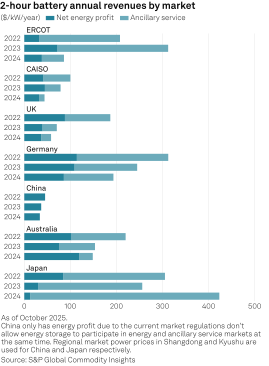
The declining overall revenue trend, however, was not consistent globally. Japan served as a notable exception, where the introduction of new ancillary service products created strong revenue opportunities. These products in Japan are significantly undersupplied due to the low installed capacity of energy storage, which caused high ancillary service prices where batteries have a strong revenue opportunity. The same trend was observed in 2023 when the ERCOT Contingency Reserve Service was introduced. This demonstrates how BESS projects can benefit from changes in market structure during the transient window of opportunity while the market settles.
Moreover, the modeling results highlight that a significant portion of annual battery revenues is typically concentrated within a small number of highly volatile periods. For instance, two-hour batteries in ERCOT and Australia generated nearly half of their total revenues during the top 10% of days. As batteries increasingly target the more volatile real-time markets due to narrowing day-ahead spreads, this trend is likely to intensify.
Consequently, sophisticated operational strategies and high asset availability are crucial for capitalizing on these lucrative short-lived price spikes.
Falling costs maintain profitability
Despite the downward pressure on merchant revenue, the overall profitability of battery storage projects has remained strong. This financial resilience can be attributed largely to the continuous and substantial reduction in battery costs. From 2022 to 2024, advancements in manufacturing processes and product innovations have driven down the BESS capital expenditure by around 30% in major markets.
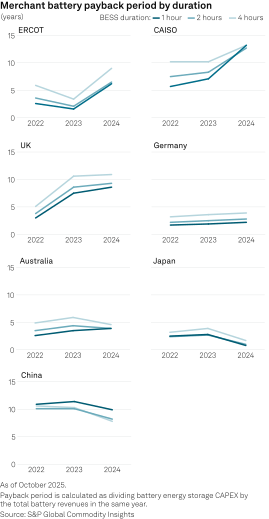
This decline in cost has served as a counterbalance to revenue compression, helping to maintain stable and, in some cases, even shorter project payback periods. For typical battery systems with up to four hours of duration in all seven markets observed, payback periods frequently remain under 10 years. Meanwhile, in markets with relatively higher payback periods through merchant revenues, such as the UK and CAISO, battery participation in capacity mechanisms helped remunerate energy storage assets with long-term contracts. This confirms that while revenue streams are becoming more dynamic, the fundamental investment case for BESS is well-supported by ongoing technological improvements and cost efficiencies.
Outlook: adapting to a dynamic future
The composition of BESS revenue is projected to further evolve. As ancillary service prices become more saturated, the proportion of revenue derived from energy arbitrage is expected to keep increasing. Battery operators will likely target more volatile, short-term real-time markets to capitalize on price spikes. Furthermore, capacity mechanisms and other structured products are anticipated to play a crucial role in adequately compensating flexible assets like BESS. These shifts in revenue streams are likely to incentivize the deployment of longer-duration batteries, which can better leverage energy price spreads, have higher derating factors in capacity markets, and have more flexibility to exploit real-time price spikes.
The long-term investment outlook for BESS remains positive given ongoing cost reductions, increasing adoption of long-term contracts and a supportive regulatory environment. These factors will enhance revenue certainty, thereby de-risking projects and facilitating the financing process.
This analysis leverages Energy proprietary in-house battery simulation tool, Optimal Storage Modeling and Simulation Suite (OSMOSIS), to model battery revenue generation. OSMOSIS optimizes the battery revenue stack across multiple revenue streams, based on input prices, battery's technical constraints, prevailing market regulations and saturation awareness. The model operates on a price-taker basis, assuming perfect foresight of market prices and that its dispatch decisions do not influence market-clearing prices or bid acceptance.
Further reading: Cleantech Business Models: Battery Energy Storage Revenue Streams
Webinar: APAC ET Market Briefings
