Electric Power, Energy Transition, Natural Gas, Emissions
October 27, 2025
From ambition to execution: CCUS in the age of AI
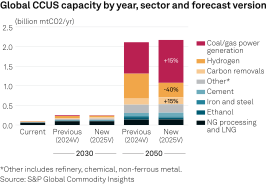
The carbon capture, utilization and storage market is entering a new era of maturity. Global carbon capture capacity is expected to quadruple by 2030, according to S&P Global Energy CCUS Market Capacity Outlook, marking a decisive shift from speculative ambition to tangible achievement.
This projected growth in the near term serves as the basis for a broader, multi-decade deployment. The latest Energy CCUS outlook, which updates expectations for 2030, continues to forecast strong and consistent progress through 2050, with global carbon capture capacity anticipated to exceed 2 billion metric tons/year.
Emerging catalysts reshaping the CCUS landscape
The AI effect: Rapidly rising energy demand from AI and data center expansion, along with the accelerating electrification, is intensifying the challenge of phasing out fossil fuels. In the latest Global Power and Renewables Market Outlook, Energy analysts said global electricity demand is projected to grow at a compound annual growth rate of 3.2%–3.6% from 2024 to 2030, with AI workloads and digital infrastructure acting as major drivers. While renewables continue to gain ground, the need for reliable, round-the-clock power has reinforced the role of fossil fuels in the energy mix. Consequently, CCUS is reasserting its importance as a technology that can balance immediate energy security with long-term climate ambitions. This dynamic has renewed interest in CCUS as a critical technology to bridge immediate energy security needs with long-term climate goals.
Announced CCUS-linked power projects in North America and Europe have totaled up to over 10 GW of planned gas-fired capacity via framework, partner or strategic supply agreements as of the end of the third quarter, according to Energy research based on information from different companies. These projects, ranging from several hundred megawatts to a multi-gigawatt scale, signal growing confidence from major energy companies and data center operators in CCUS as a solution for decarbonizing baseload power.
The latest Energy CCUS outlook shows CCUS capacity reaching over 1 Gt/year by 2050 -- a 36% increase from the previous forecast -- yet this would still account for less than 10% of fossil fuel generation capacity and only about 1% of total global power capacity.
This underscores the reality that while CCUS is a vital tool for specific applications, it remains a niche solution that must still overcome significant technical, financial and regulatory obstacles. It is not a large-scale substitute for broader decarbonization efforts.
Strategic reorientation: Initial enthusiasm for a swift transition to a hydrogen economy is being tempered by cost and infrastructure realities. Rather than sidelining CCUS, this recalibration is channeling investment and policy support back to its core mission: decarbonizing foundational industries like cement, steel and chemicals, rather than focusing primarily on blue hydrogen production.
The carbon removal race: Pragmatism is prevailing among emerging carbon removal solutions. Bioenergy with carbon capture and storage is scaling up more quickly than the more expensive direct air capture technology by leveraging existing infrastructure and cost efficiencies. DAC adoption remains limited due to its high costs.
Global CCUS timeline and key players
The CCUS outlook highlights regional development in different stages, with leadership shifting in the next few decades:
Phase I (Now-2030): North America is expected to lead, supported by its established oil and gas sector, existing infrastructure and incentives, such as the Inflation Reduction Act's 45Q tax credits.
Phase II (2030-2040): Europe is projected to assume leadership, with advanced carbon pricing systems and developed industrial hubs, particularly around the North Sea.
Phase III (Post-2040): China is anticipated to become the frontrunner, facing the task of deploying CCUS technology at scale to address emissions from its coal-fired power plants.
Key areas to watch in the CCUS market
Sector diversification: The expansion of CCUS into industries beyond oil and gas -- such as cement, metals, and pulp and paper -- will be crucial for broader industrial decarbonization. The outcomes of these pioneering projects will pave the way for wider adoption.
The power sector's role: With electricity demand surging due to AI and widespread electrification, CCUS's contribution to enabling low-carbon baseload power is increasingly critical. Tracking developments in gas and coal power projects that utilize CCUS will be a key measure of the technology's potential to support a resilient, decarbonized grid.
Policy and regulatory progress: While incentives have grown stronger, the focus is shifting to streamlined execution and regulatory clarity. The efficiency of permitting processes for both capture facilities and CO2 storage sites will be vital to sustaining and accelerating sector momentum.
From ambition to execution
The CCUS industry stands at a critical inflection point. The debate has decisively shifted from a proof of concept to a race for scaled deployment.
Despite this robust long-term outlook, a persistent climate gap remains. To close this gap, the focus must shift from potential to performance. This requires a concerted effort where policy support, market dynamics and business models evolve from ambition to execution.
The next five years are crucial. The industry must demonstrate commercial success beyond its traditional strongholds and prove its role in ensuring a stable, low-carbon future. The challenge is no longer just to build projects, but to build them at a pace that matters, turning plans into operational pipelines and ambition into tangible, large-scale abatement.
Further reading: Carbon Capture Utilization and Storage Market Outlook
