


Fertilizers, Chemicals, Energy Transition, Agriculture, Refined Products, Renewables, Carbon, Biofuel, Jet Fuel, Olefins, Grains, Vegetable Oils, Solvents & Intermediates
October 14, 2025
COMMODITY TRACKER: 5 charts to watch this week
Natural carbon capture credit prices have fallen significantly due to oversupply, while Ukraine's corn prices are under pressure from a robust harvest. Additionally, ammonia prices in Northwest Europe have increased amid ongoing global supply disruptions.
1. Natural carbon capture credit prices fall
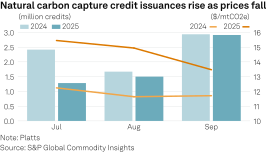
What's happening? The Platts Natural Carbon Capture credit price fell to $13.30/mtCO2e on Oct. 10, 2025, as an increase in credit issuances outpaced corporate demand. Platts is part of S&P Global Energy. September saw a 94% increase in credit issuances, reaching 2.9 million credits, while retirements rose 24% month over month but fell 18% year over year. The oversupply and limited corporate action have driven prices down, with the average price for September at $13.47/mtCO2e, still 15% higher year over year.
What's next? According to a US nature-based removals developer, Q4 and Q1 typically see higher sales activity for emissions offsets, but buyers are increasingly selective, preferring newer vintages. Most retirements in 2025 were from 2021-2024 vintages, indicating a preference for higher-quality credits. Despite an increase in intermediary requests, the oversupply problem persists, compounded by new issuances. Developers are prioritizing selling older credits, with newer versions offered at a premium.
2. Straits-China used cooking oil spread widens in October
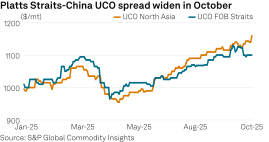
What's happening? The Straits-China UCO spread has widened as Straits sellers await Malaysia's export tax announcement, expected to be between 10% and 20%, leading to limited trading activity. In contrast, the China market anticipates stronger demand and higher prices, driven by rising collection costs and increased export volumes driven by sustainable aviation fuel demand. As of Oct. 13, Platts assessed UCO FOB Straits at $1,103/metric ton and UCO North Asia at $1,155/mt, maintaining a spread of $52/mt.
What's next? Market participants are closely watching Malaysia's upcoming export tax announcement, anticipating significant changes in trading dynamics. According to market sources, implementing the UCO export tax could restrict Malaysian UCO exports, driving demand towards Chinese UCO. If the tax takes effect, more Chinese-origin UCO could enter Europe as buyers shift their inquiries and interest from Straits UCO to China UCO.
3. Ukraine's corn prices fall as new harvest rises
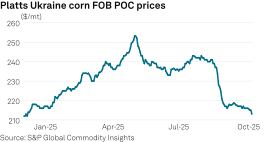
What's happening? Ukraine's corn prices have increased to $213/mt as of Oct. 6, a significant drop from $241/mt in August. This decline is attributed to the advancing new crop harvest and a slowdown in demand from primary markets, particularly Turkey and Egypt. The harvest, which began arriving in October, is priced lower due to anticipated high production this season, leading to increased supply. According to an importer from Turkey, as Turkish domestic prices fall amid their own harvest, demand for Ukrainian corn has weakened.
What's next? Looking ahead, analysts expect Ukrainian corn prices to remain under pressure due to high supply and ongoing demand challenges. The competitive pricing from South America and the US is likely to limit the attractiveness of Ukrainian corn.
4. Platts CFR Northwest Europe ammonia price rises amid global supply crunch
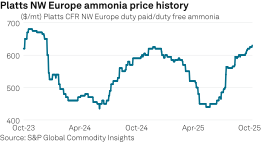
What's happening? Ammonia prices globally have increased in recent months due to supply interruptions in all major production hubs. Northwest Europe has felt the full force of the squeeze, with import prices rising since July. Platts assessed CFR Northwest Europe ammonia duty paid/duty free at $630/mt CFR on Oct. 9, marking a 22-month high and $5/mt higher than the previous peak in November 2024.
What's next? There are some signs that the supply tightness is easing, with production improving in recent weeks in Southeast Asia and North Africa. However, output cuts are expected in Trinidad & Tobago in November, Gulf Coast Ammonia and Woodside's new plants in the US Gulf are not yet exporting. Further ahead, the EU's Carbon Border Adjustment Mechanism is set to enter the definitive phase on Jan. 1, 2026, adding further costs for importers.
5. Refinery-grade propylene market shifts
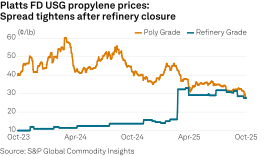
What's happening? Refinery-grade propylene prices increased in early 2025 following the closure of Lyondell Basell's Houston refinery. Platts assessed RGP at 33 cents/lb on March 27, a four-year high. Since then, RGP prices have remained high with limited spot trades, leading to structural pricing changes. The spread between RGP and polymer-grade propylene has narrowed to below 10 cents/lb. The closure of Phillips 66's California refinery in Q4 is expected to further impact market dynamics, with most RGP now contracted, shifting profitability dynamics. Platts assessed spot polymer-grade propylene at 25 cents/lb FD USG and US prompt refinery-grade propylene was assessed at 27.50 cents/lb FD USG as of Oct. 10.
What's next? The acetone and cumene markets are transitioning from RGP to PGP-based pricing formulas due to elevated RGP prices and declining liquidity. Multiple sources in the acetone market said a commonly used RGP reference index is expected to be discontinued by 2026.
Reporting and analysis by Santiago Canel Soria, Chau Kit Boey, Amrutha Dileep Chingoroth, Mollie Gorman, Daniela Morales Pumarino

Editor: