


8 October 2025 | 04:05 UTC — Insight Blog
ET Highlights: India’s sustainable fuels for energy security push; US shutdown’s mixed impact on energy; early 2026 benchmark expectations for CBAM
Energy transition highlights: Our editors and analysts bring together the biggest stories in the industry this week, from renewables to storage to carbon prices.
Top story
India's economic ambitions linked to renewable hydrogen development
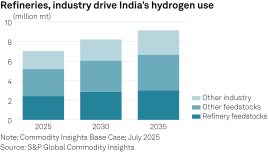
India's top policy experts called for accelerated adoption of sustainable fuels to strengthen the country's energy security and reduce its massive fossil fuel import bill in line with the nation’s targeted journey from a $4 trillion to a $30 trillion economy by 2047.
Speaking at S&P Global Commodity Insight’s World Hydrogen India conference on Sept. 25- 26 in New Delhi, the experts highlighted India's unique climatic advantages and renewable energy capabilities, which can position it to become a global leader in renewable hydrogen production.
Minister of New and Renewable Energy Pralhad Venkatesh Joshi and Minister of Petroleum and Natural Gas Hardeep Singh Puri asserted their support for growing renewable hydrogen for decarbonizing heavy industries, transportation, and power generation, pledging their support to investors with favorable policies and subsidies.
Volatile crude prices and shifting geopolitics make energy security important for India’s growing economy and the solution lies in achieving self-sufficiency in fuels, Nitin Jairam Gadkari, minister of Road Transport & Highways, said, noting India imports around 87% of its oil supplies with a budget close to Rupees 22 trillion ($248 billion).
For further reading on India's hydrogen prices, check out this article featured in the latest Energy magazine: India's Hydrogen Breakthrough.
Editor's Picks: Premium and free content
WORLD HYDROGEN: Kandla port plans renewable methanol bunkering hub for Singapore-Rotterdam route
State-run Deendayal Port Authority is positioning Kandla port as a strategic renewable methanol bunkering hub to fuel vessels operating on the Singapore-Rotterdam corridor, as shipping lines prepare for stricter EU emissions regulations, Sushil Kumar Singh, chairman of the port authority told Platts on the sidelines of the World Hydrogen India summit. The initiative targets around 200 methanol-compliant vessels expected to be deployed on the route, capitalizing on methanol's lower energy density compared to fossil fuels, which creates opportunities for mid-route refueling, according to Singh.
Mixed impacts for energy, mining as US government shuts down
The US federal government shut down on Oct. 1 after Republicans and Democrats failed to pass a budget deal before funding expired, a move detrimental to the energy sector’s progress. During a shutdown, most federal agencies close nonessential operations, and employees are typically furloughed. For the energy sector, that could mean longer wait times and delays in permitting and agency approvals. For example, one impact of the shutdown could be a delay in Trump administration regulatory priorities, such as reversing the government’s endangerment finding and power plant emissions rules.
Brussels to finalize CBAM benchmarks by early 2026 as businesses await clarity
The European Commission expects to release the final benchmarks for its Carbon Border Adjustment Mechanism by early 2026, as pressure builds on Brussels to provide clearer implementation guidance. In a letter addressed to the European Association of Non-Integrated Metal Importers and Distributors, seen by Platts, the Commission said it is working to finalize the methodology for calculating embedded emissions and default values and conditions for deducting third-country carbon prices. The Commission said the CBAM benchmarks will be based on the respective EU Emissions Trading System benchmarks to adequately mirror the bloc's carbon market.
Japan certifies first two hydrogen projects as part of Yen 3 trillion price-gap subsidy
Japan has certified the first two projects as part of the country's Yen 3 trillion ($20.2 billion) hydrogen price-gap subsidy, Minister of Economy, Trade and Industry Yoji Muto said. The first project involves renewable hydrogen produced by Toyota Tsusho to manufacture green steel at Aichi Steel's electric furnace in Tokai City, Aichi Prefecture, he said. The other plan is a pioneering initiative by Resonac to gasify waste plastics in Kawasaki City, Kanagawa Prefecture, to produce hydrogen and ammonia, which will then be used to manufacture and sell as raw materials for clothingy experts called for accelerated adoption of sustainable fuels to strengthen the country's energy security and reduce its massive fossil fuel import bill in line with the nation’s targeted journey from a $4 trillion to a $30 trillion economy by 2047.
Learn more about S&P Global Energy Energy Transition Services

Subscribe to this newsletter on LinkedIn
to get weekly updates on the biggest stories
in energy transition