Crude Oil, Refined Products
October 28, 2025
Absolute Canadian oil sands emissions continue on slower growth track
The greenhouse gas intensity of the Canadian oil sands continued its slow decline in 2024, down 3% compared with 2023 to average 57 kg of CO2 equivalent/b of marketed product (synthetic crude oil [SCO] or barrel of diluted bitumen).1
S&P Global Energy estimates that absolute emissions rose by less than 1 million metric tons of CO2 equivalent to 85 million mtCO2e in 2024. Production rose by about 150,000 b/d.2
.svg)
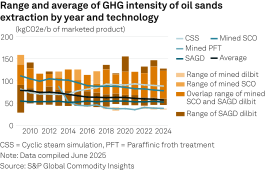
In 2024, Energy analysts estimated the average intensity of the Canadian oil sands was 57 kgCO2e/b, with individual operations ranging from 35 kgCO2e/b to 123 kgCO2e/b. This variability highlights that the average should not be taken to be representative of any one facility.
Also in 2024, all forms of oil sands extraction showed evidence of efficiency improvements, with the GHG intensity of marketable products declining between 2023 and 2024. This is consistent with a long-term trend that has seen intensity decline 28% since 2009 -- the furthest back Energy models.
The greatest intensity reductions came from mining operations, declining 30% and 18% for mined SCO (mining operations integrated with an upgrader) and mined PFT dilbit facilities (mining operations without an upgrader, which markets diluted bitumen), respectively. Steam-assisted gravity drainage, or SAGD, thermal operations have declined more modestly at 4%. More mature cyclic steam stimulation, or CSS, increased by 8%.
Since roughly the pandemic period of 2020, absolute emissions growth has been on a slower growth trajectory. From 2019 to 2024 (measuring and skipping 2020 to avoid the worst of the pandemic disruption), absolute emissions increased nearly 5 million mtCO2e, while production grew by nearly 400,000 b/d. In the preceding five years (2015-2019), production increased nearly 600,000 b/d while absolute emissions rose nearly 12 million mtCO2e.
The industry has not been able to have intensity reductions outpace production growth, which would lead to a decline in absolute emissions. However, for each operation and even each extraction segment, the trajectory of absolute emissions has begun to vary.
In 2024, absolute emissions were nearly flat for CSS and mined PFT dilbit. SAGD emissions had modest declines as intensity reductions appeared to outweigh production gains. Conversely, mined SCO experienced stronger growth and higher emissions as a result. Results presented are at the overall segment level, and each operator experience will be unique.
Looking to the future, evidence continues to point toward additional intensity improvements. When coupled with our present oil sands outlook, Energy analysts see oil sands absolute emissions continue to grow at a slower rate. Should Energy analysts’ production outlook prove too optimistic, all the ingredients are there for absolute emissions growth to stall or even decline modestly.
Conversely, an acceleration of growth could push absolute emissions higher, but in this scenario, the pace of absolute emissions growth would likely be more modest than in the past, as the growth will likely come from less intensive production.
The key game changer for oil sands emissions is the fate of the Pathways Alliance carbon capture and storage project, which would result in large-scale lock-step reductions in absolute oil sands emissions.
S&P Global Energy present outlook varies from prior years' outlooks, not as a result of methodology changes that have driven differences over time, but upward revisions to historical production outlook. This outlook presents, to the best of Energy analysts’ knowledge at the time of publication, estimated oil sands emissions based on publicly available information using Energy proprietary oil sands emissions model. Any individual facility can and will vary from this aggregated estimate.
1The S&P Global Energy oil sands estimate is based on production. This includes both emissions associated with diluent production and share of blended bitumen, but also upstream natural gas extraction emissions. To align with comparisons from other basins, the emissions associated with upstream production of natural gas used in oil sands operations were not included in this estimate. Work released prior to 2024 used to include emissions associated with upstream natural gas production used in oil sands operations. Slower production additions, coupled with ongoing intensity reductions, moderated the rise of absolute emissions in 2024.
2It is important to note that the S&P Global Energy estimate of absolute oil sands GHG emissions differs from Canada’s National Inventory Report (NIR) by methodology and facilities included. To the best of our knowledge, Canada’s NIR includes the emissions of both the Cenovus Energy Bi-Provincial Upgrader (BPU) and the Northwest Redwater Refinery (NWR). BPU is not included in our analysis because it is not dedicated to upgrading oil sands bitumen, and it also processes non-oil-sands-derived heavy oil. The NWR facility is not included because it is designed to market refined products.
