


Crude Oil
October 01, 2024
Commodity Tracker: 5 charts to watch this week

By Staff
HIGHLIGHTS
1. OPEC expects healthy oil demand growth up to at least 2050

What's happening? OPEC sees no sign of global oil demand peaking and expects it to rise to at least 120 mil b/d in 2050, it said in its World Oil Outlook released Sept. 24. OPEC also revised its estimate of global oil demand in 2045 to 118.9 million b/d, a 2.5% upward revision on its 2023 estimate. It forecasts demand growth to be driven by Asia, the Middle East and Africa, where it expects demand to rise by 22 million b/d between 2023 and 2050. OPEC's long-term optimism contrasts with recent downward revisions to 2024 and 2025 demand growth forecasts. It said Sept. 10 that global oil demand will grow by 2 million b/d in 2024 -- 80,000 b/d less than the organization had forecast in August.
What's next? The Joint Ministerial Monitoring Committee, which oversees the OPEC+ crude production agreement, will meet Oct. 2 to discuss oil markets and production policy. Near-term forecasts for global demand will play a crucial role in its strategy up to the end of 2024 and through 2025. For 2025, it expects demand to rise a further 1.7 million b/d -- a 40,000 b/d downward revision on its previous estimate. Non-OPEC+ supply will peak at 59 million b/d in the early 2030s, according to OPEC projections, and then decline to 57.3 million b/d by 2050. OPEC also said that the industry will require a cumulative $17.4 trillion investment in upstream and downstream projects to meet the demand in 2050.
2. Power restoration continues in US Southeast from Hurricane Helene
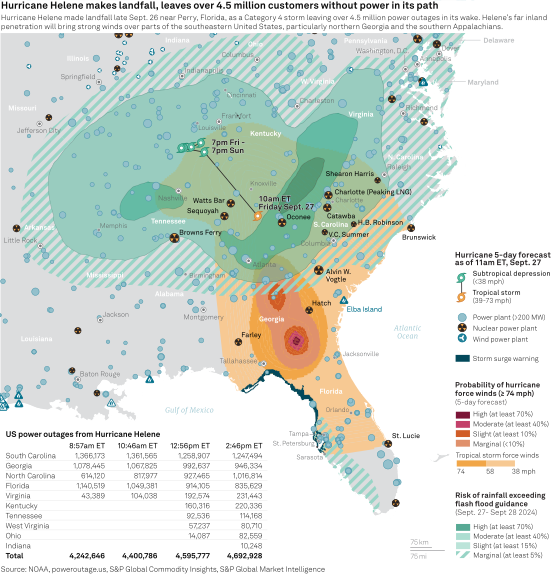
What's happening? Hurricane Helene made landfall late Sept. 26 near the Big Bend area of the Florida Gulf Coast and quickly brought hurricane conditions inland. Power outages peaked near 5 million Sept. 27, with nearly 2 million outages remaining Sept. 30. Heavy rain and severe winds downed trees, poles and power lines across several US Southeast states. Duke experienced severe damage to its transmission infrastructure in Upstate South Carolina, while in North Carolina entire substations were under water and need to be evaluated, repaired and rebuilt.
What's next? Power restoration efforts are expected to continue through the week. There is the potential for further damage and power outages due to the saturated ground and weakened trees, said Georgia Power, which called Helene the most destructive hurricane in the company's history. The Atlantic hurricane season is becoming quite active after a slow start, with three named storms and two disturbances now active.
3. Gas winter looms with strong EU storage amid market caution
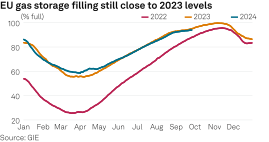
What's happening? Europe is entering the fourth quarter, and the official start of the gas winter, with markets still on edge despite healthy storage levels. EU storage sites are currently 94.2% full having reached the EU-mandated 90% target in mid-August. However, the stock build has slowed through September on the back of heavy Norwegian gas infrastructure maintenance.
What's next? A mild October could see EU gas stocks reach close to tank-top as Norwegian maintenance winds down. But while European gas demand is still well down on pre-2022 levels, it is set to rise by some 6% year on year in Q4, according to S&P Global Energy forecasts.
4. August global crude steel output falls 6.5% on year
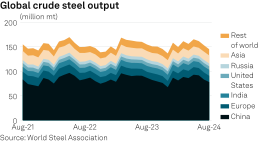
What's happening? Global crude steel production totaled 144.8 million metric tons in August, dropping 6.5% year on year, the second consecutive month of year-on-year falls, according to World Steel Association data. China, the world's largest producer, saw output fall on a year-on-year basis for the second straight month in August at 77.9 MMt, down 10.4% year on year, making up 53.8% of total global crude steel output.
What's next? While global crude steel production for the first half was steady year on year, the lower July and August figures brought the total for the first eight months to 1.25 billion metric tons, down 1.5% on the year. It remains to be seen whether output will recover in the coming months. World Steel said in its April Short Range Outlook it expected steel demand to increase 1.7% in 2024 to 1.79 billion t, with further growth of 1.2% in 2025 to 1.8 billion t. Its next market outlook is due to be published in October.
5. Brazil's soybean active crush capacity reaches nearly 20-year high

What's happening? Brazil's soybean processing capacity is set to reach its highest active level in nearly 20 years by the end of 2024, driven by favorable margins and an increased biodiesel mandate. Energy forecasts an active capacity of 204,793 metric tons/day, representing 93.5% of the total installed capacity, the highest level since 2005, according to data from Brazilian Association of Vegetable Oil Industries.
What's next? The Brazilian government plans to raise the biodiesel blend rate by one percentage point annually, targeting 20% by 2030, pending further technical research on the B20 viability. If approved, the crushing industry will need to expand its capacity to meet this goal, as less than 7% of the country's total current capacity remains inactive.
Reporting and analysis by Rosemary Griffin, Kassia Micek, Stuart Elliot, Jacqueline Holman¸ Gabriel Diniz Faleiros, José Roberto Gomes