


Refined Products, LNG, Crude Oil, Maritime & Shipping, LPG, Naphtha
September 16, 2025
COMMODITY TRACKER: 5 charts to watch this week
COMMODITY TRACKER: 5 charts to watch this week
Declining US Gulf Coast re-exports of Canadian crude and rising US beef imports amid tariffs are in focus. Shipping companies are under pressure to comply with EU emissions deadlines and competitive LNG prices are drawing attention from Indian refineries.
1. US Gulf Coast re-exports of Canadian crude by region
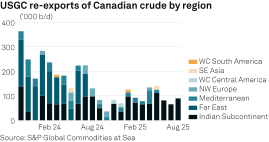
What's happening? Following the Trans Mountain pipeline expansion in May 2024, Canada's Pacific Coast is drawing crude barrels from the US Gulf Coast. In August, Canada exported 13.7 million barrels of crude from the Pacific Coast, up from 9.2 million barrels in August 2024 and 600,000 barrels in August 2023, according to S&P Global Commodities at Sea data. Meanwhile, re-exports of Canadian crude from the USGC decreased to 2.8 million barrels in August, all bound for India, down from 6 million barrels in June 2024.
What's next? The availability of Canadian barrels for re-export may decline due to the tighter supplies of heavy waterborne crudes available to USGC refiners. Exports from Mexico and Venezuela have also decreased in the last year due to production headwinds, tariffs and sanctions. As a result, the US crude slate has lightened significantly, which has shifted price differentials with refiners investing in new capacity capable of processing Permian light sweet crude.
2. High Brazilian beef tariffs may limit US beef imports
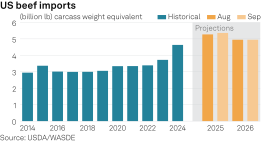
What's happening?The US Department of Agriculture raised the US beef imports forecast despite ongoing tariff concerns to 5.364 billion lb, 1.7% higher than its previous estimate, according to the World Agricultural Supply and Demand Estimates report released Sept. 12. According to the USDA, beef imports are likely to increase 15.7% year over year from 4.64 billion lb due to continued strong demand. The US has imposed tariffs on top beef suppliers, including 10% on Australia, 76.4% on Brazil and 15% on New Zealand.
What's next? Although demand estimates have increased, analysts believe it is difficult for imports to rise sharply year over year due to the high tariffs on Brazilian beef still in place.
3. Shipping companies face EU emissions deadline
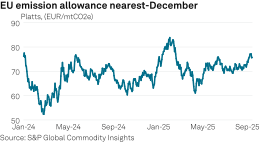
What's happening? Shipping companies are rushing to meet the EU's Sept. 30 deadline for surrendering emissions allowances under the extended Emissions Trading System, which now includes maritime transportation. While larger operators are prepared, smaller companies, especially those outside the EU, are struggling and risk fines. Recent transactions for EU emissions allowances range from 67 to 100,000 EUAs. The nearest-December EUA contract was assessed at Eur75.71/mtCO2e on Sept. 12, up from Eur52.36/mtCO2e in February 2024.
What's next? The shipping sector, contributing 3%-4% of EU emissions, is facing increasing compliance obligations. Ship operators must obtain EUAs for 40% of their emissions in 2024, escalating to 70% in 2025 and 100% by 2026. Late buyers might emerge, but their impact on the market is expected to be minimal. Companies face challenges with EUA surrender processes and account setups, risking fines of Eur100/mtCO2e for non-compliance.
4. LNG prices fall below naphtha, capturing Indian refineries' attention
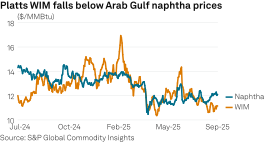
What's happening? Indian companies are comparing LNG prices against Arab Gulf naphtha prices. Platts, part of S&P Global Energy, assessed FOB Arab Gulf naphtha at $568.1/metric ton, while the West India marker for LNG at $10.963/MMBtu, Sept.15, with the freight between the Gulf and India at $19.19/mt. Despite LNG prices being lower than those of Naphtha since August, an increase in demand for LNG cargoes has not been observed. This stagnation is attributed to regassification costs, tax implications and pipeline transportation expenses.
What's next? Companies such as Nayara Energy, HPCL Mittal Energy Ltd. have started sourcing regassified LNG from the Indian domestic market. For larger demand to materialize, companies are waiting to see if the gap between LNG and Naphtha prices widens.
5. China's vehicle sales impact cold-rolled coil steel market
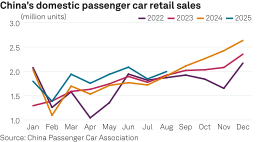
What's happening? China's domestic car retail sales in August increased 4.6% year over year, but the growth rate slowed from 6.3% in July and 18.1% in June, according to the China Passenger Car Association. This slowdown might affect the cold-rolled coil steel market, as CRC is crucial in vehicle production. In the first week of September, the domestic car sales declined rapidly, which may indicate a slowdown in momentum in the domestic car market, some market sources said.
What's next? Market sources expected a year-over-year decline in domestic car sales for the remainder of 2025. This is partly due to the strong car sales during the same period of 2024, driven by government subsidies, pulling future demand forward. The potential slowdown in vehicle sales could exert downward pressure on CRC prices in October, possibly affecting hot-rolled coil market prices as well. Despite robust car export projections, the domestic market's subdued growth outlook and rising steel production levels could further challenge CRC and HRC markets.
Reporting and analysis by Binish Azhar, Ashok Dutta, Sampad Nandy, Sergio Alvarado, Max Lin, Suyash Pande, Jing Zhang
