


Refined Products, Crude Oil, Renewables, Agriculture
September 09, 2025
Commodity Tracker: 5 charts to watch this week

By Staff
APPEC 2025, hosted by S&P Global Energy, is underway and Asia's oil demand amid market challenges is dominating conversations at the conference. This week's Commodity Tracker also looks at LNG trade in Europe and developments in global hydrogen investments.
1. Asia's oil demand remains strong amid challenges
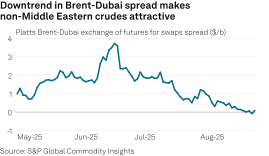
What's happening? Asia's oil demand in 2025 has exceeded expectations, driven by China's strategic crude stockpiling and robust arbitrage trading opportunities. Saad Rahim from Trafigura and Frederic Lasserre from Gunvor Group noted at APPEC 2025 in Singapore on Sept. 8 that US tariffs have not yet significantly affected consumer prices, allowing oil demand to remain stable. China's aggressive stockpiling strategy and favorable arbitrage trades from the Americas have further bolstered the region's oil consumption.
What's next? China's continued crude stockpiling, especially during price declines, is expected to sustain its demand, influencing global oil prices. Rahim predicts China's imports will rise as it seeks to align reserves with strategic goals. The favorable arbitrage trade for US and Brazilian crudes is enhancing Asian refiners' margins, diversifying supply sources, and providing operational flexibility. With the Brent-Dubai spread at minus 8 cents/b as of Aug. 27, Asian refiners are capitalizing on low-sulfur sweet crudes from various regions. Increased demand for refined products in Asia is expected to drive further exploration of new markets and operational expansion.
Related topic: APPEC
Further reading: Asia oil market: Resilient under pressure
2. Europe LNG trades with Platts NWE vs TTF floating price mechanism gain traction
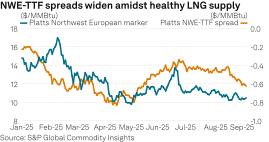
What's happening? European trading patterns in the LNG market are beginning to evolve, with European LNG traders moving toward linking contracts to the floating price difference between LNG cargoes and pipeline gas to better manage market risks associated with fixed price discounts. Companies are employing the Platts Northwest Europe Marker in LNG term sheets and strip contracts -- referencing the floating price published by Platts for a half month against its differential to the Dutch TTF futures, sources said. Effectively, This formula keeps the discount to TTF floating while negotiating an LNG deal for cargoes delivered to Northwest Europe, sources added. Platts is part of Energy.
What's next? As LNG supply grows and Europe and Asia compete for waterborne cargo volumes, trading mechanisms will continue to evolve globally. While currently the JKM-TTF spread is used as an indicator of possible arbitrage between Atlantic and Pacific markets, the two benchmarks are far from identical. The price gap captures multiple dimensions at once: delivery periods, product specifications and volumes, and geography -- with TTF tied to Europe's pipeline gas and JKM reflecting LNG cargoes into Asia. As Europe's LNG market matures, focus is shifting toward the Platts NWE-JKM spread. Unlike JKM-TTF, this comparison looks exclusively at LNG in both Northwest Europe and Asia. By stripping out timing and product mismatches, it isolates the pure locational difference that traders are most interested in managing.
3. Global hydrogen FID capacity rises amid investment growth
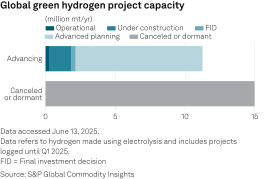
What's happening? The global capacity for low-carbon hydrogen projects that have reached final investment decision (FID) has surpassed 6 million mt/year, with $110 billion committed across over 500 projects, according to the Hydrogen Council's Global Hydrogen Compass report. Currently, 1 million mt/year of capacity is operational. The report highlights a $35 billion increase in committed capital from 2024, indicating the industry's shift from early-stage projects to commercial deployment. Despite a mismatch between supply and demand, about 3.6 million mt/year of binding offtake has been secured, potentially rising to 8 million mt/year by 2030 as policy clarity improves.
What's next? Considering potential delays and project attrition, the existing pipeline could enable 9 million-14 million mt/year of clean hydrogen capacity by 2030. However, realizing this hinges on demand development, which remains a significant challenge. To unlock hydrogen's potential, consistent policy support and effective execution are crucial, said Sanjiv Lamba, Linde CEO and Hydrogen Council co-chair.
4. Black Sea milling wheat faces price pressures as buyers predict further declines
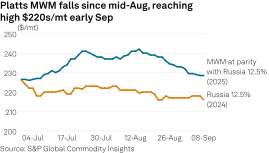
What's happening? The Platts Milling Wheat Marker has experienced a further decline in price amid increasingly weak demand and improved yields in key producing areas. Platts last assessed the marker at $228.50/mt on Sept. 8, at parity with the Russian wheat 12.5% FOB export price and representing a constant decline since Aug. 13, when the market was priced at $242/mt.
What's next? Buyers have said they expect further price drops, with some indicating they will hold off on purchases until Russian wheat prices reach the low $220s/mt. One buyer said that "if Russia does not export big volumes soon, they will be forced to sell cheaply in the new year." For the marketing year 2025-26, Russian wheat exports are projected to increase to 43 million mt, up from 41.4 million mt last season, with production expected to rise to 83.2 million mt, compared with 81.6 million mt last year, according to Energy analysts.
Related infographic: INTERACTIVE: Platts Grains Import Equation: Mapping Global Trade and Subsidy Policies
5. China's mannitol exports hit record high amid strong demand from India
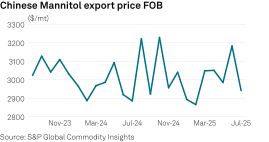
What's happening? China exported a record 17,554 mt of mannitol between January and July, up 11% year-on-year, with export value rising 12% to $52.6 million, according to S&P Global Market Intelligence's Global Trade Atlas. This rise was supported by steady demand across the food, pharmaceutical and industrial sectors. Mannitol is primarily derived from corn starch, but despite falling domestic corn starch prices, export prices remained stable at $2,941/mt FOB in July, according to S&P Global Energy.
What's next? Export momentum is expected to continue, driven by strong demand -- especially from India, which accounted for over a quarter of China's total exports. However, future pricing may be shaped by energy costs, catalyst availability and production efficiency. While corn starch is the main input, it contributes relatively little to overall production costs, which remain high due to low yields and complex processing. These factors may limit further expansion despite recent output improvements.
Reporting and analysis by Gawoon Philip Vahn, Aly Blakeaway, Sakshi Jalan, James Burgess, Vivian Iroanya, Mark Chooi Kim Weng
