


Agriculture, Energy Transition, Refined Products, Biofuel, Renewables, Jet Fuel
November 18, 2025
COMMODITY TRACKER: 5 charts to watch this week

By Staff
UK biofuel supply is on the rise, but the country's sustainable aviation fuel mandate is facing compliance issues. Meanwhile, Germany is set to reduce energy costs for industries and gasoline prices in Brazil are rising.
1. UK SAF mandate lags despite biofuel supply growth
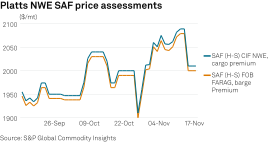
What's happening? Verified renewable fuel supplied to the UK reached 2.4 billion liters in the first 10 months of 2025, accounting for 6.8% of total transport fuel, according to provisional data from the Department for Transport. Under the Renewable Transport Fuel Obligation, bioethanol led supply at 1.1 billion liters, followed by biodiesel (519 million liters) and hydrotreated vegetable oil(408 million liters). However, the UK's first-year sustainable aviation fuel mandate is showing significant compliance friction. With only weeks left in the 2025 compliance period, just 163 million liters of SAF have been supplied, representing 1.63% of total jet fuel, a significant gap from the 2% mandate. More critically, only 2 million hydroprocessed esters and fatty acids-derived SAF certificates have been issued for the 163 million liters reported, indicating substantial delays in verification and compliance. Platts, part of S&P Global Energy, assessed the SAF (HEFA-SPK) FOB Farag outright price at $2,828.75/mt, Nov. 17.
What's next? Suppliers have a rapidly closing window to bridge the gap to the 2% mandate. The market is facing structural constraints, including a verification bottleneck for certification, tight global availability of eligible feedstocks like used cooking oil, and an underdeveloped SAF certificate trading market. All certified SAF so far have been HEFA-derived, with 71.6% originating from China, highlighting feedstock concentration risks. If these early adoption and compliance issues persist, suppliers face rapidly accelerating costs and potential shortages as the mandate ramps up to 5% in 2026 and 10% by 2030.
2. US EIA's unexpected storage increase stirs market
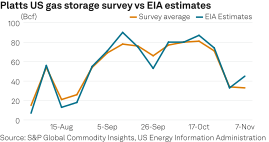
What's happening? The US Energy Information Administration reported a surprise 45 Bcf injection into US gas storage for the week ending Nov. 7, exceeding the anticipated 33 Bcf build from Platts' survey. This unexpected increase briefly affected NYMEX gas futures, causing December futures to dip below $4.40/MMBtu before rebounding. The total US gas in storage reached 3.96 Tcf, 4.5% above the five-year average. Despite the bearish report, futures have risen, driven by forecasts of an early December cold spell.
What's next? Market analysts expect the first withdrawal of the heating season in the next EIA report, with a projected 30 Bcf withdrawal for the week ending Nov. 14. Eli Rubin from EBW Analytics noted potential gains in natural gas prices due to anticipated cold weather moving eastward. The US National Weather Service predicts significantly colder temperatures in key heating regions, potentially increasing demand. The EIA will release its next report on Nov. 20, providing further insights into storage levels and market reactions.
3. India's cement capacity poised for growth amid tightening carbon policies
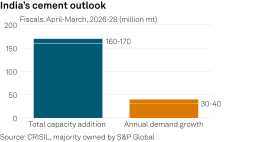
What's happening? India's cement industry is poised to add a grinding capacity of 160-170 million metric tons between fiscals 2026-2028, according to CRISIL, majority owned by S&P Global. The capacity addition will be up 75% from the 95 million mt added in the past three fiscals, fueled by a healthy demand outlook and high capacity utilization. Over the fiscals 2026-2028, Indian cement makers are expected to see incremental demand of 30-40 million mt annually, building on the robust compounded annual growth of 9.5% seen in the past three fiscals.
What's next? India is building scale while costs are still competitive. Carbon is expected to become a strong cost driver, with the World Cement Association warning about a potential 3 to 4 times increase in cement prices due to European decarbonization policies. Indian cement operators will be looking to leverage the key drivers, such as infrastructure and housing, all while adjusting to greener portfolios as carbon policies continue to tighten globally.
4. Germany plans to cut energy costs for industrials
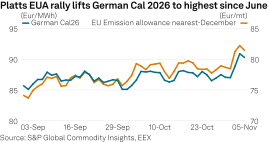
What's happening? German lawmakers have approved measures to reduce gas and power prices for 2026. This includes cancelling the gas storage levy, lowering electricity Friedrich Merz also announced plans for an industrial power price around Eur50/MWh, significantly lower than the current industry average of Eur160/MWh. The focus is on aiding sectors like chemicals, glass, ceramics, and machinery, with state aid also expected for steel makers to counter high energy costs.
What's next? The German government is set to implement an industrial power price from 2026 to 2028, aiming for around 5 cents/kWh. Funding is anticipated to start in 2027 via the Climate and Transition Fund, with up to Eur5 billion of state aid over three years. This initiative follows the EU's Clean Industrial State Aid Framework, allowing temporary price relief for energy-intensive companies. The measures are expected to reverse industrial decline in Germany by reducing electricity costs by about 25%, benefiting major power consumers like the steel and chemical industries.
5. Brazil's gasoline market sees price increases
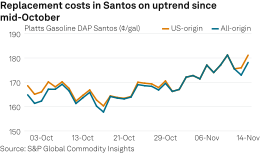
What's happening? In Brazil's South-Southeast region, spot gasoline prices have increased following the stoppage of private refiners Refit and SSOil. These refiners had been offering competitive prices, and their absence led to a rise in spot market prices at Santos and Paranagua ports, from a discount of Real 130/cu m to between flat and a Real 80/cu m discount against Petrobras' prices. Petrobras' price cuts on Oct. 21 helped moderate this increase. Additionally, significant imports were recorded, with 13,202 cu m at Santos and 89,175 cu m at Paranagua in October.
What's next? Looking ahead, market participants expect a potential build-up in regional gasoline stocks in anticipation of a state tax increase effective January 2026. This may prompt more imports in December. Platts has launched new gasoline FCA assessments in Santos and Paranagua to help bring transparency to these increasingly competitive markets.
Reporting and analysis by Samyak Pandey, J Robinson, Shivam Praksh, Andreas Franke, Isabela Rocha

Editor: