


Refined Products, Agriculture, Metals & Mining Theme, Energy Transition, Diesel-Gasoil, Gasoline, Food, Rice, Ferrous, Carbon
August 26, 2025
COMMODITY TRACKER: 4 charts to watch this week

By Staff
This week, S&P Global Energy editors and analysts keep an eye on India's agriculture exports, particularly seafood and rice, as the products face higher tariffs from Aug. 27. Analysts warn of a potential decline in Mexico's fuel imports while China is looking at another record year in semi-finished steel exports.
1. India's seafood and basmati shipments risk diversion from US market
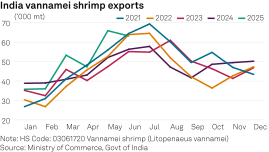
What's happening? India's seafood and rice sectors brace for the impact of Washington's move to double tariffs on imports from Aug. 27. Shrimp, India's top seafood export at $5.17 billion in FY 2024-25, now faces nearly 60% combined duties in the US, eroding its cost advantage against Ecuador (18.8%), Vietnam (20%) and Indonesia (19%), with over 40% bound for the US. Farmgate shrimp prices in hubs like Andhra Pradesh fell Rupees 30-55/kg in August as exporters diverted cargoes to Europe and China. Rice is also feeling the pinch, with $337 million worth of basmati rice exported to the US in FY 2024-25. As Pakistan reallocates volumes to fill US demand, India is redirecting cargoes to Europe, which sources 54% of its basmati from Pakistan and 46% from India. But congestion at Kandla and Mundra ports is slowing flows, threatening India's premium advantage.
What's next? Seafood processors are seeking certification to access markets in China and Japan, while some farmers pivot to fish farming after repeated price drops. Rice exporters are expected to capture additional market share in Europe, but logistical bottlenecks could constrain shipments. Analysts warn both sectors face sustained margin pressure through late 2025 as the US closes off a critical outlet.
2. Mexico's gasoline, diesel imports face uncertainty as economy shows signs of weakness
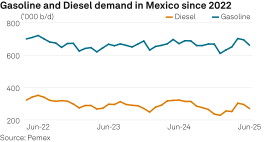
What's happening? Mexico's fuel demand has been weakening in 2025 when compared to 2024. In June, gasoline sales stood at 661,000 b/d, while diesel demand was 270,500 b/d, according to official data. In the same month, Mexico imported roughly 235,000 b/d of gasoline and 87,000 b/d of diesel, down from 420,000 b/d and 200,000 b/d, respectively, in June 2024.
What's next? Analysts said Mexico's fuel demand outlook is turning uncertain as the economy shows signs of weakness under the weight of tariffs, weak job creation and declining investments. With Mexico's economy expected to grow less than 1% this year, economists warn that this weakening could further slow demand for gasoline and diesel by the end of 2025, just as Pemex's Dos Bocas refinery ramps up production. With lower demand and higher output, Mexico could be looking at even lower fuel imports, analysts said.
3. ACCU prices hit over 7-month highs on compliance buying
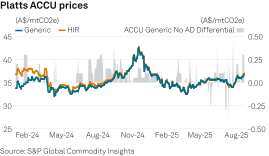
What's happening? Platts Australian carbon credit unit prices touched more-than-seven-month highs across the liquid segment of the market due to increased Safeguard demand ahead of expected tighter compliance policies. The liquid segment of the market comprises Generic ACCU, Generic ACCU without avoided deforestation and ACCU Human-Induced Regeneration. Market participants attributed this bullishness to the early reemergence of demand from compliance entities, or Safeguard facilities.
What's next? Safeguard demand have historically driven up prices between late-September and end-November. Australia's nationally determined targets for 2035 are expected to be announced in September ahead of the UN Climate Change Conference, as several participants were waiting for it to gauge market direction for ACCUs. As most of the upcoming policies have yet to come to the market and materially affect demand, participants expect ACCU prices to continue to climb.
4. China's semi-finished steel exports hit all-time high in July
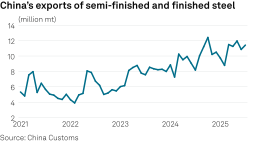
What's happening? China's semi-finished steel exports in July reached 1.58 million mt – an all-time high – as it rose 34.4% from June and 349% higher than a year ago, latest Chinese customs data showed.
What's next? Some trading sources expected China's exports of semi-finished and finished steel to maintain historically high levels in August-September. The expectations stem from China's likely move to strengthen scrutiny on tax-evading trades starting Oct. 1, which are pushing exporters to ship steel products out by the end of September. Amid the export rush, some sources expected steel exports to retreat notably in October. However, most market participants expected total exports of semi-finished and finished steel in 2025 to inch higher than a year ago and record a new all-time high.
Reporting and analysis by Sheky Espejo, Aliana Zulaika Yeong, Jing Zhang, Samyak Pandey
