


Crude Oil, Refined Products, Maritime & Shipping, Containers, Dry Freight, Wet Freight
May 22, 2026
INTERACTIVE: Tankers brave Red Sea for Saudi crude, traffic at 2.5-year high
By Max Lin and Binish Azhar
Editor:
HIGHLIGHTS
Uneven traffic revival in key waterway
Relative calm compared with Hormuz
Tankers earn healthy profits for Yanbu shipments
Tanker companies have been returning to the Red Sea over the past couple of months as Saudi Arabia's Red Sea port of Yanbu emerges as the top Middle East oil export hub. But ship operators in other sectors have less incentive to resume transits via the key waterway connecting the Indian Ocean with the Mediterranean.
Iran has seized control of the Strait of Hormuz, which would normally handle some 20 million barrels/day of crude transits, in response to the war with Israel and the US, which broke out Feb. 28. To mitigate the conflict's impact on its exports from the Persian Gulf, Saudi Arabia has used the 1,200 km, 7 million b/d East-West pipeline to divert its crude to the Red Sea.
S&P Global Commodities at Sea data shows crude and condensate exports from Yanbu jumped from 816,000 b/d in February to a record 3.16 million b/d in March before setting another all-time high of nearly 4 million b/d in April. While the pipeline diversion focuses on crude, Saudi exports of refined products from the Red Sea have remained stable at close to 1 million b/d.
In an earlier CAS research note, S&P Global Energy CERA analysts said Saudi Arabia's Red Sea port of Yanbu "has emerged as a pivotal outlet." The analysts noted that Egypt has served as a transshipment hub for Yanbu barrels before they reach Europe, and that Saudi Arabia's Asian customers also remain large offtakers.
Since the beginning of the war, crude loadings from the Red Sea to East of Suez have averaged 4 million b/d, and product tanker loadings have averaged 700,000 b/d, according to Niels Rasmussen, BIMCO chief shipping analyst. Most shipping companies had avoided the area after Yemen-based Houthis began to target merchant vessels in November 2023, claiming to support Palestinians in the Israel-Hamas war. The Iran-backed militants later ramped down their attacks amid ceasefire agreements, prompting a gradual recovery in ship traffic.
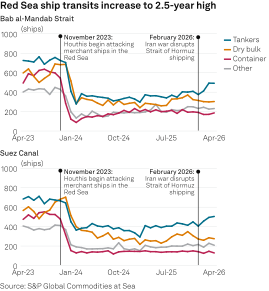
But the Hormuz shipping crisis has altered the Red Sea's operational environment. Tanker transits via the Suez Canal and Bab al-Mandab Strait have reached their highest in nearly two-and-a-half years, roughly 30% below the pre-Houthi levels, to serve Saudi export needs. Meanwhile, container lines have halted or even reversed their return to the Red Sea to avoid disruptions to their shipping schedules, while dry bulk traffic has not shown significant changes given its limited exposure to the Asia-Europe corridor.
Tanker operators are increasingly willing to transit the chokepoints as the number of maritime attacks has fallen significantly. Houthi fighters have targeted more than 100 ships in the Gulf of Aden and Red Sea, according to Platts data collected from the International Maritime Organization, UK Maritime Trade Operations, shipowners, and S&P Global Maritime Intelligence Risk Suite. But only eight of them occurred in 2025, and none this year. Platts is part of S&P Global Energy.
In comparison, more than 30 ships have been attacked in the Persian Gulf and the Gulf of Oman since the Iran war broke out. While more Somali piracy activities have been reported since last month, the western coast of the Arabian Peninsula remains relatively safe compared with the eastern coast.
In the clean freight market, LR1 rates for the Red Sea-Northwest Europe trade jumped on initial Houthi attacks before retreating, but the US-Iran war ignited another rate rally. The Red Sea-China Suezmax rate did not experience the "Houthi bump," but skyrocketed to a record high amid the Hormuz conflict. Freight rates for VLCCs, which have emerged as the workhorse for Yanbu exports, hovered around a firm level of $30/metric ton earlier in May.
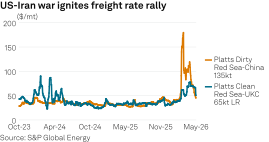
"Freight could jump higher quickly when geopolitical risk reduces effective supply ... while pullbacks can occur once the market has 'digested' new plateaus," according to a research note from S&P Global Energy CERA. "If risk premiums persist and owners continue to ration exposure, rates should stay elevated and prone to spikes."
Freight rates have normalized from early price shocks, though they remain elevated as closures at the strait have sprouted new crude flows. But after riding the initial wave of higher rates, shipowners are now opting to hold out for the Strait of Hormuz to reopen.
With Hormuz still closed to regular traffic, there is enormous pressure on the Red Sea as an alternative. But amid fragile ceasefire talks, the threat of military escalation in the Middle East remains a concern, including the potential for further disruptions to shipping routes in the region, such as those seen earlier at the Red Sea's Bab al-Mandab Strait.
But transiting the alternative route poses its own challenges, as nearly 85% of crude tanker loadings in the region have been on VLCCs that cannot transit the Suez Canal fully laden, according to BIMCO.
If transit through Bab al-Mandab were shut in, all cargo would face much longer sailing distances, Rasmussen said -- more than double to China and five to six times longer to India. And any additional closures at chokepoints would trigger further shipping inefficiencies, significantly increase ton-mile demand, and raise freight rates.
