Crude Oil, Refined Products, Maritime & Shipping, Wet Freight
May 08, 2026
EU opens legal recycling route for shadow fleet tankers, sanctions maze constrains impact

By Max Lin
Editor:
HIGHLIGHTS
EU exempts sanctioned ships for scrapping deals
Policy aimed at facilitating more recycling
Impact limited by US and UK sanctions overlap
New EU rules will provide a legal channel for recycling shadow fleet tankers, according to industry participants and analysts, even though their actual impact could be limited by the complex international sanctions network.
In its 20th sanctions package against Russia, adopted April 23, Brussels announced an exemption for companies to deal with EU-sanctioned ships if they were to be sent to scrapyards.
"The scrapping clause is a constructive addition," Dimitris Roumeliotis, a research analyst at Xclusiv Shipbrokers, told Platts, part of S&P Global Energy. "Ιt creates a legitimate pathway for vessels to exit the shadow fleet through recycling."
In recent years, Russia, Iran and Venezuela have partnered with shadow fleet operators to acquire tens of hundreds of aged tankers to maintain their energy sales in circumvention of Western sanctions.
Many shipping professionals have warned that such ships pose significant environmental risks with their lack of proper vetting, and some suggested Western governments should create legal avenues for the ships to be scrapped at the end of their trading life.
In a note published in January, the Royal United Services Institute for Defence and Security Studies said sanctioned ships could need to travel to junkyards uninsured and unregulated with recycle industry participants seeking to avoid legal risks.
Data from S&P Global Commodities at Sea and Maritime Intelligence Risk Suite shows that 31 of the 64 oil and chemical tankers demolished between January 2025 and April 2026 were sanctioned, indicating a large number of ships were in recycle sales outside of intentional legal regimes.
"The EU policy change will definitely help, but its impact will be evaluated case by case," said Kiran Thorat, a trader at GMS, a Dubai-based company that purchases aged ships and sells them to shipbreakers.
"The exemption will be enforced by member states, each of them could have different national requirements. Also, this only covers the EU's Russia program ... there are also many ships sanctioned by the US and UK not being exempted currently."
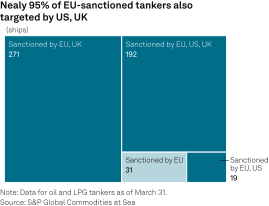
CAS data shows 563 oil and LPG tankers were on the EU's blacklist as of the end of March, of which only 31 were not sanctioned by the UK or the US, or both.
Policy aims
The exemption was announced alongside Brussels' new requirement for EU-based tanker sellers to ensure their ships would not be used to transport Russian oil by the initial buyers and future buyers in resales.
While the sales ban is aimed at limiting the shadow fleet's growth, the exemption for scrapping is designed to encourage recycling by sanctioned tanker operators, according to Fotios Katsoulas, tanker research director at S&P Global Energy CERA.
"The goal is to force a choice: recycle the ship or face a total prohibition on maritime services," Katsoulas said.
